

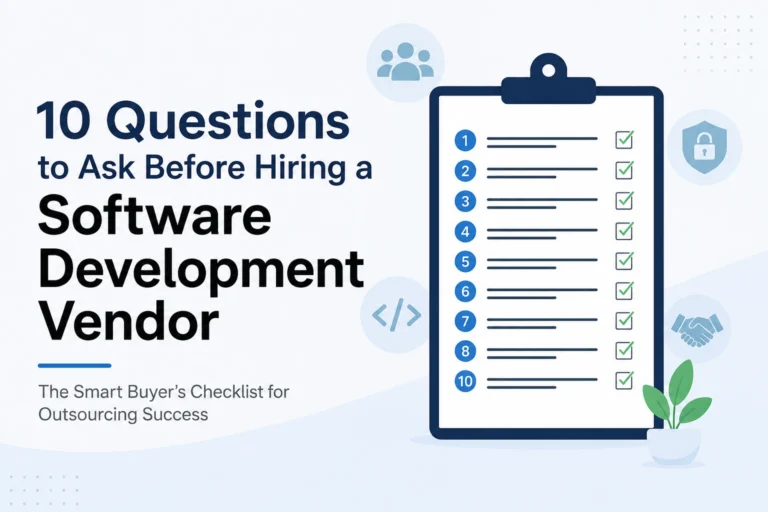
Picking the wrong software development outsourcing vendor costs far more than the contract price. Missed deadlines, unmaintainable code, IP disputes, and mid-project turnover can turn a growth initiative into a fire drill. This post gives ten questions for every vendor call, covering quality, delivery methodology, IP and security, domain experience, turnover, long-term references, support, communication across time zones, total cost of engagement, and exit strategy, with strong versus weak answer signals. Use it for RFPs, vendor scorecards, and reference checks before you commit.
- 1 The lowest hourly rate often loses on total cost once turnover, IP risk, and hidden fees are counted.
- 2 Strong vendors answer clearly on quality process, SOC 2, long-term references, and exit planning.
- 3 Ask for two active clients in your vertical and call them, including about the hard periods, not just wins.
- 4 Under four hours of daily time-zone overlap creates lag on every question; written decisions beat batched status calls.
- 5 Score every vendor against the same rubric and run reference calls before you sign.
10 Questions to Ask Before Hiring a Software Development Vendor
Picking the wrong software development outsourcing companies costs more than the contract value. Missed deadlines, code you cannot maintain, IP disputes, mid-project team turnover. Any one of these turns a growth initiative into a fire drill. The right questions asked early prevent much of the damage. This post gives you 10 questions to put on every vendor call, plus what a strong answer looks like and what a weak answer signals. Use it for RFPs, vendor evaluations and reference calls.
The Rising Demand for Outsourcing Software Development Services
Outsourcing software development services grew again in 2026 as talent scarcity in the US pushed more product teams toward global delivery. The market matured too. Vendors who could not deliver at quality lost accounts to those who could. Buyers who hire a software development team through a structured evaluation found strong partners; buyers who chose on hourly rate alone usually returned to market within 12 months. The decision framework matters more than the shortlist. Get the questions right and the shortlist takes care of itself. If you plan to hire software development team capacity through a global vendor, the evaluation framework in this post applies directly.
How to Structure the Vendor Evaluation Process
Before running through the 10 questions, it helps to have a consistent process for evaluating every vendor on your shortlist, rather than asking good questions inconsistently across different calls. A structured process catches more red flags than a strong question list applied unevenly.
Start by sending the same written questionnaire to every vendor before any call happens. This does two things: it gives you a baseline written record to compare against verbal answers later, and it filters out vendors who take too long to respond or hand you a generic, clearly templated document. How a vendor handles a simple pre-sales questionnaire is often a preview of how they’ll handle project documentation later.
Schedule the actual evaluation calls with the people who would work on your account, not just the sales or business development team. A polished sales pitch says little about the technical leadership actually running delivery. If a vendor is reluctant to put a tech lead or senior engineer on an early call, that’s worth noting as a data point on its own.
Finally, score every vendor against the same rubric immediately after each call, while details are still fresh. Waiting until all calls are finished to score retroactively tends to blur details between vendors and biases scoring toward whichever call happened most recently.
1. How Do You Ensure Quality When We Hire a Software Development Team?
Ask about code review discipline, senior oversight ratio and quality gates. Strong answer: every commit gets senior review, tech lead owns delivery, quality metrics reported weekly. Weak answer: process varies by team
2. What Is Your Process for Outsourcing Software Development Projects?
Look for a defined onboarding sprint, sprint cadence tied to your team, and clear handoff points. Vendors without a repeatable process rebuild it per client, and quality varies with the team assigned
3. How Do Outsource Development Companies Protect Intellectual Property?
Ask about NDAs, IP assignment clauses, background checks and data residency. Verify the vendor holds SOC 2 Type II. Ask what happens to code access when an engineer rotates off your account.
4. What Is Your Experience in Our Specific Industry?
An IT outsourcing firm without domain experience takes six months to reach the productivity a specialist team hits in six weeks. Ask for two active clients in your vertical, at your size, and call them.
5. How Do You Handle Developer Turnover and Team Scalability?
Turnover rates above 20 percent annually signal a vendor that will lose your context regularly. Ask about knowledge transfer processes, bench capacity for ramps and retention data by role.
6. Can You Provide References From Long-Term Partners?
Strong software development outsourcing companies have clients running with them for three or more years. Ask to speak to two. Ask about the hard periods, not just the wins. Real vendors welcome those calls.
7. What Does Your Post-Launch Support and Maintenance Look Like?
Software often runs for years after launch. Ask about on-call rotation, incident response SLAs and maintenance pricing. Vendors focused only on new builds leave support gaps that hurt customer trust.
8. How Do You Manage Communication Across Time Zones?
Ask for daily overlap hours, async communication patterns and issue tracker integration. Under four hours daily overlap creates lag on every question. Written decisions beat batched status calls.
9. What Is the Total Cost of Engagement (Not Just Hourly Rates)?
Ask about tool licenses, environment costs, PM overhead, change request pricing and onboarding fees. The cheapest hourly rate frequently loses on total cost. Get the all-in number, not the headline number.
10. What Is the Transition/Exit Strategy if the Engagement Ends?
Ask about code handoff, documentation standards and knowledge transfer duration. Vendors that make exit painful are showing you their retention strategy. Contract explicitly for a clean exit path from day one.
Red Flags That Should End a Vendor Conversation Early
Some warning signs are serious enough that they justify ending an evaluation early, rather than continuing through the full question list out of politeness or sunk cost.
A vendor unwilling to name specific team members who would work on your account, offering only vague assurances about “senior developers” without introducing anyone, is a common early flag. Teams get assembled after signing, and the people you meet during evaluation often aren’t the people who show up on day one.
Reluctance to provide reference contacts, or references that turn out to be unreachable or clearly rehearsed, is another. A vendor confident in their delivery history generally has no issue connecting you directly with a current or recent client, hard periods included.
Pricing that seems substantially lower than every other vendor on your shortlist, without a clear explanation for the gap, deserves scrutiny rather than excitement. Unusually low rates are sometimes explained by legitimate factors like lower regional costs, but they can also signal understaffing, junior-heavy teams, or a bait-and-switch pricing structure that changes once a contract is signed.
Finally, a vendor unable to clearly explain how intellectual property ownership and code access work once the engagement ends is a serious flag on its own, regardless of how strong the rest of their pitch is. This is exactly the kind of detail that’s easy to overlook during an enthusiastic sales conversation and expensive to discover after the fact.
Vetting Checklist: IT Outsourcing Firm Selection Criteria
This condensed IT outsourcing firm checklist maps the 10 questions to a scoring rubric you can bring into every vendor call.
| Criterion | Strong signal | Warning sign |
| Quality process | Weekly metrics, senior review | Process varies by team |
| Delivery methodology | Defined onboarding, sprint fit | Rebuilt per client |
| IP and security | SOC 2 Type II, clear NDAs | Vague policies |
| Domain experience | 2+ active clients in vertical | Generic case studies |
| Turnover rate | Under 15 percent annual | Above 25 percent |
| Long-term clients | 3+ year relationships | Only recent logos |
| Support and maintenance | Named SLAs, on-call rotation | Build-only focus |
| Communication cadence | 4+ hours overlap, async docs | Batched status calls only |
| Total cost transparency | All-in pricing offered | Hourly rate only |
| Exit path | Documented handoff plan | Vague or missing |
Why Innostax Fits as an Outsourcing Software Development Partner
Innostax runs outsourcing software development engagements where every question above has a strong answer. Senior tech leads own delivery on every account. SOC 2 aligned processes and clear IP terms. Long-term clients include Travelstart, Nuwardrobe and Ashore. Sub-15 percent turnover. Documented exit paths. If you are evaluating vendors right now, run this checklist on us and compare the answers to any shortlist you have already gathered.
Conclusion: Choosing Software Development Outsourcing Companies for Long-Term Success
Software development outsourcing companies deliver dramatically different outcomes based on the quality of your evaluation. Ask the 10 questions above of every vendor on your shortlist. Score against a rubric. Talk to references. Choose the partner who will still fit two years from now, not the one who wins on the first quote. The decision compounds either way, so make it deliberately.