DevOps outsourcing with a dedicated Tech Lead who owns your pipeline
Innostax provides DevOps engineering as a managed service — CI/CD pipelines, infrastructure as code, containerisation, and observability — with a dedicated Tech Lead accountable for what gets built and how it runs. The DevOps capability your team needs without the full-time hire.
The DevOps problem most engineering teams are sitting on
Why Developer-Led DevOps Is Not the Same as a Real DevOps Practice
In most engineering teams, DevOps work gets absorbed by the developers who are most comfortable with it. The senior backend engineer who set up the CI pipeline. The tech lead who provisioned the AWS environment. The developer who wrote the deployment scripts that everyone uses but nobody fully understands.
It works — until it doesn’t. The pipeline breaks and only one person knows how to fix it. A new developer joins and spends two weeks getting their environment to match production. A deployment fails in a way that nobody anticipated because the process was never properly documented.
Infrastructure costs grow quarter over quarter because nobody owns the cloud spend.
The problem isn’t that your developers are doing DevOps. It’s that DevOps done as a side responsibility — without dedicated ownership, without a proper toolchain, without someone accountable for the pipeline’s reliability — accumulates debt the same way application code does. Quietly, until it’s expensive.
DevOps outsourcing gives you a dedicated engineer and a Tech Lead who own the pipeline, the infrastructure, and the toolchain — so your developers can focus on the product.
What DevOps Outsourcing Covers and What You Can Expect
CI/CD pipeline build and management
Designing, building, and maintaining the continuous integration and delivery pipelines your team ships on. Fast, reliable builds. Automated testing gates. One-click deployments to any environment. Pipelines built for your stack and your deployment cadence — not a generic template that needs adapting every time something changes.
Infrastructure as code
Moving your cloud infrastructure from manual provisioning to version-controlled, reproducible code — Terraform, Pulumi, AWS CDK. Every environment reproducible. Every change reviewed. Every resource tracked. The infrastructure your team can trust because it’s the same infrastructure in staging as in production.
Containerisation and orchestration
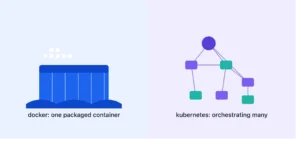
Docker and Kubernetes implemented for your actual deployment patterns — consistent environments, predictable deployments, and the scaling characteristics that manual deployment can’t provide. We don’t containerise for the sake of it. We containerise when it solves a real problem your team has.
Observability and monitoring
Structured logging, distributed tracing, metrics dashboards, and alerting — configured before your first production incident, not after. The observability layer that tells you what’s wrong before your users do, and gives your engineers the context to fix it quickly when something does go wrong.
Cloud cost management
Cloud bills grow quietly. We audit your cloud spend, identify idle resources, right-size over-provisioned instances, and establish cost governance that prevents the next unexpected bill. Cost optimisation isn’t a one-time exercise — it’s an ongoing responsibility we take on as part of the engagement.
Security and compliance hardening
IAM policies, secrets management, network security groups, dependency scanning, and the security baseline that enterprise customers and regulated industries require. Security built into the infrastructure from the start, not retrofitted when a customer’s security review finds the gaps.
Incident response and on-call support
For teams that need DevOps coverage beyond business hours — on-call support for production incidents, runbooks for common failure modes, and the post-incident analysis that prevents the same incident from happening twice.
How the DevOps outsourcing engagement works
Embedded in your team. Accountable for your pipeline.
Assessment first
Before we build anything, we understand what you have — your current CI/CD setup, cloud infrastructure, deployment process, observability coverage, and the pain points your team is experiencing. No surprises in week four because we didn’t look properly in week one.
Prioritised remediation plan
The assessment produces a prioritised list of improvements — what’s causing the most pain, what’s carrying the most risk, and what will deliver the most value fastest. We work through it in order, not randomly.
Embedded in your workflow
Your Innostax DevOps engineer works in your tools — your Slack, your Jira, your GitHub. The Tech Lead attends your planning sessions, flags infrastructure implications of product decisions before they become problems, and is available when something breaks.
Daily visibility
The Tech Lead’s daily Loom update includes DevOps status — what was built, what’s running, what was fixed, and what’s coming next. You always know the state of your pipeline without having to ask.
Infrastructure as code from day one
Everything we build is version-controlled. Every change is reviewed. If something breaks, we can roll back. If something needs to be rebuilt, we can rebuild it in minutes.
DevOps outsourcing vs a full-time DevOps hire
We’re direct about this because the comparison matters.
A full-time DevOps hire is one person
One set of skills, one point of failure, one salary whether your DevOps needs are high or low. A senior DevOps engineer in the US costs $130,000–$160,000 per year before benefits and overhead. And finding one, hiring one, and onboarding one takes three to six months.
Innostax DevOps outsourcing gives you a Tech Lead and a team
With depth across CI/CD, cloud architecture, security, containerisation, and observability — at a cost structure that scales with your actual needs. Available within days, not months. Scalable up or down with 1-day notice.
The right answer depends on your situation
If you’re at the scale where a full-time DevOps hire is justified and you have the time to find the right person, hire one. If you need the capability now, at a cost that makes sense for where you are, outsourcing is the faster and more flexible path.
Your pipeline should work reliably. You'll know within two weeks whether ours does.
2-week free trial on real infrastructure
Your CI/CD pipeline, your cloud environment, your Tech Lead doing real work. You’ll see within two weeks whether the pipeline improves or whether we’re still figuring out your setup. If it’s the latter, walk away. No invoice.
1-day termination notice
If the engagement isn’t delivering, you’re out tomorrow. A DevOps partner that needs lock-in to stay accountable isn’t a partner — it’s a vendor.
Engineers who own what they build
Great Place to Work certified — the DevOps engineer who builds your pipeline in month one is still running it in month six. Pipeline continuity matters. An engineer who has to rediscover your infrastructure every quarter isn’t owning it, they’re inheriting it repeatedly.
CLIENT OUTCOMES
Proof: DevOps engineering on the record
Technique
100% successful . Zero data loss
Technique needed to migrate to Azure and build a Power Automate-based project management automation platform. Innostax’s DevOps engineers designed and executed the migration — 100% successful, zero data loss — and built the automation workflows that reduced manual work by 85–90%. Infrastructure work that moved a business metric.

Online Education Platform
$300K+ Saved
The platform’s integration infrastructure was facing a $300,000 Mulesoft renewal. Innostax’s engineers rebuilt the integration layer in-house on modern infrastructure — eliminating the fee entirely and delivering a more maintainable, better-performing integration layer in the process.

Ashore
Shipping new features on a near-daily cadence requires a delivery pipeline that doesn’t get in the way. Innostax maintained the infrastructure and deployment pipeline that let Ashore ship at that velocity — consistently, without the stability cost that typically comes with moving fast.

Teams That Need Reliable DevOps Without a Full-Time Hire
Engineering teams where DevOps is currently owned by developers as a side responsibility — the pipeline works until it doesn’t, and when it doesn’t, it takes your best engineers away from product work to fix it.
CTOs at growth-stage companies who need proper DevOps infrastructure but can’t justify a full-time DevOps hire yet — or who need the capability immediately and can’t wait three to six months to hire.
Startups post-seed whose infrastructure was set up quickly and pragmatically, and whose technical debt is now showing up as deployment friction, environment inconsistency, and growing cloud bills.
Engineering teams scaling their organisation who need the infrastructure to support more developers, more deployments, and more environments — without the coordination overhead that manual infrastructure creates.
Tech Stack
Tech stacks we use for DevOps service
The Tech Lead selects the right combination from this stack based on your product requirements, scale targets, and integration needs.
- GitHub Actions
- GitLab CI/CD
- CircleCI
- Jenkins
- Azure DevOps
- Terraform
- Pulumi
- AWS CDK
- Bicep
- Docker
- Kubernetes (EKS, AKS, GKE)
- AWS
- Azure
- GCP
- Datadog
- Grafana
- Prometheus
- Sentry
- ELK Stack
- Vault
- AWS IAM
- Azure AD
- Snyk
- SAST/DAST tooling
- Ansible
- Python scripting
- Microsoft Power Automate
FAQ about DevOps Outsourcing
A DevOps hire is one person — one set of skills, one point of failure, and a six-month hiring timeline. Innostax DevOps outsourcing gives you a Tech Lead and a team with depth across CI/CD, cloud, security, and observability. Available within days. Scalable with 1-day notice. The right choice depends on your scale and timeline — we'll tell you honestly if a full-time hire is the better answer for your situation.
We start with an assessment that identifies the highest-pain points and the quickest wins. Most teams see meaningful pipeline improvements within the first sprint. The assessment tells us what to prioritise — we don't start with a three-month roadmap when a two-week fix addresses the thing that's causing the most friction.
Both. We work in your existing tools — your source control, your project management system, your cloud provider. We also bring tooling recommendations where your current setup has gaps. We don't impose a toolchain. We improve the one you have and fill in what's missing.
For teams that need coverage beyond business hours, we provide on-call support as part of the engagement — with defined response time SLAs and runbooks for common failure modes. Post-incident, we conduct root cause analysis and implement the changes that prevent the same incident from recurring.
The Tech Lead owns the pipeline, the infrastructure decisions, the toolchain, and the reliability of what we've built. You own product direction and deployment decisions — what gets deployed and when. The Tech Lead flags infrastructure implications of product decisions before they become problems, but they're not waiting for your input on every infrastructure call. That's the point of the model.