

- 1 Low quotes hide real costs
- 2 The six root causes behind the outage
- 3 What budget agencies skip and why
- 4 Cost of fixing vs building right
- 5 Questions that expose weak agencies early
- 6 What stable deployments actually require
The Promise Looked Great on Paper
The roadmap was growing. The team was underwater. Someone pulled up a cheaper agency’s proposal and the numbers made sense on paper — faster delivery, lower cost, same outcome. At least that was the pitch.
One of our clients took it. They were a SaaS startup moving quickly, and handing off to a lower-cost agency felt like a smart call at the time. The agency was fast. They shipped a feature to the dev environment without much fuss. Then they pushed to production.
It broke within hours. And stayed broken for a week.
“Speed without structure isn’t velocity. It’s a clock ticking down to implosion.”
— Innostax Engineering, Post-mortem Review
What Actually Happened, Week by Week
Week 1–2
The agency onboards, gets through the handover docs, and ships a feature to dev ahead of schedule. Things look good.
⚠ The Breaking Point
First production push. The system goes down within hours. Production stays down for 7 days.
⚠ Agencies 2 & 3
The client brings in two more agencies to salvage things. Both make it worse. New bugs surface. The outage drags on.
✓ Innostax Steps In
The client calls us. We don’t touch anything for the first day or two — just read code, trace logs, understand what actually happened. No heroics, just homework.
✓ Production Comes Back
We rebuild the deployment pipeline, put proper protocols in place, and get production stable. This time the system is set up so a bad deploy doesn’t become a catastrophe.

What the Codebase Looked Like

The original agency wasn’t doing anything unusual. No exotic patterns, no deliberate cutting of corners. Just six common shortcuts that, without any safety nets underneath, compounded until the whole thing collapsed.
⚠ The Six Root Causes
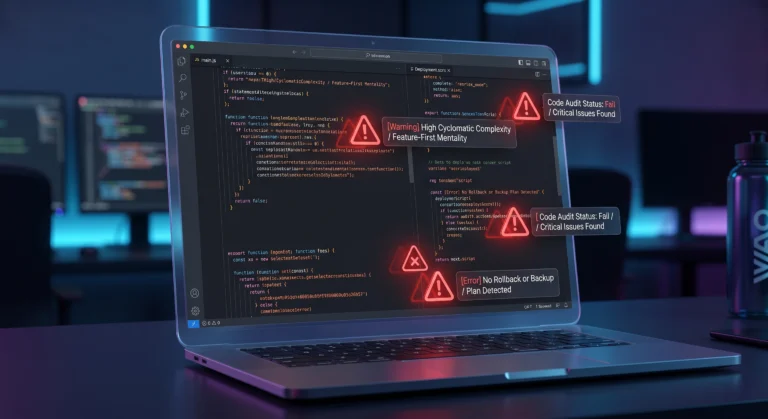
✕ Version mismatches between dev and production — what ran locally didn’t match what ran in prod.
✕ No rollback or backup plans — when something broke, there was no documented path back.
✕ No backward compatibility — new code broke existing functionality with no checks to catch it.
✕ No automated quality gates — bugs walked straight into production.
✕ Features over stability — velocity was measured in what got delivered, not in what kept running.
Each of these is manageable on its own. Together, with no fail safes in place, one bad deploy had nowhere to stop.
The Math Nobody Runs Before Signing
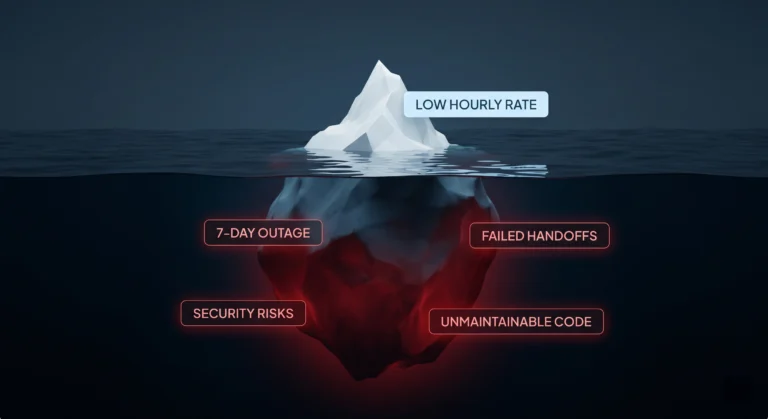
Lower hourly rates are easy to compare. The harder costs are the ones that don’t appear on the proposal.
Suppose one agency quotes $60 an hour and another quotes $100. If both appear capable of delivering the same feature, the cheaper proposal looks obvious. But the hourly rate says little about the total cost of getting that feature safely into production.
The real comparison should include engineering time, rework, internal oversight, and post-launch problems.
A cheaper team may need more time to understand the codebase, while your internal engineers spend additional hours reviewing work, explaining architecture, or correcting decisions.
If a production issue takes a week to resolve, engineers stop roadmap work, product managers coordinate the incident, and customer-facing teams handle complaints.
A more useful equation is:
Total cost = Development cost + Oversight + Rework + Incident cost + Opportunity cost
The point is to compare the actual cost of delivery, not just the lowest hourly rate.
What Should You Compare Besides the Hourly Rate?
Look beyond the number on the proposal. Ask how each team handles:
- Technical discovery
- Architecture and planning
- Code reviews
- Quality assurance
- Automated testing
- Deployment and rollback
- Documentation
- Post-launch support
- Production incidents
- Communication and project management
These activities may not create visible features, but they affect delivery cost and reliability.
A cheaper proposal may simply exclude work another agency has included. Before comparing prices, make sure you are comparing the same definition of “done.”
Why Do Lower Rates Usually Mean Lower Ceilings, Not Just Lower Costs?
A lower rate does not automatically mean lower quality. Good developers exist at every price point, and a higher rate does not guarantee better engineering.
The risk appears when price becomes the primary differentiator.
An agency competing mainly on cost may have less room for senior reviews, testing, infrastructure work, and technical leadership.
This creates a lower ceiling.
The code may work for a small feature or user base, but problems often appear as the product grows. Features take longer to change, fixes create new issues, testing expands, and releases become more stressful.
The software may continue to function, but the effort required to improve it keeps increasing.
How Does Technical Debt Show Up in a Growing Product?
Technical debt often appears as:
- Longer development cycles
- More regressions
- Difficult releases
- Repeated fixes
- More time explaining the codebase
- Fewer engineers willing to modify critical areas
- Dependence on one or two people
These symptoms may seem manageable early on. They become expensive when the business depends on frequent releases and reliable customer experiences.
The Safety Nets That Never Made It Into the Estimate
Rollback procedures, automated checks, code reviews, and compatibility testing are easy to overlook because customers don’t see them. They simply expect the product to work.
That makes these activities vulnerable when an agency is working within a tight budget or deadline.
Removing them doesn’t remove the work. It moves the work later.
Instead of preparing a reliable deployment process, the team may spend that time recovering from a failed release. Instead of catching a compatibility problem during testing, developers discover it after existing functionality breaks.
This is technical risk being deferred rather than eliminated.
When reviewing an estimate, ask what sits behind the quoted development hours:
- Is senior code review included?
- Is QA included?
- Are automated tests expected?
- Who validates backward compatibility?
- Who owns deployment?
- Is rollback preparation included?
- Is documentation included?
- What happens after launch?
The answers reveal how the agency defines delivery.
Two proposals with identical feature lists may represent very different levels of engineering work. The price difference may reflect not markup, but different definitions of production-ready software.
Why the Damage Rarely Stays Contained to One Feature
A production failure often becomes a product problem, not just a technical one.
When production goes down, developers stop planned work. Product teams delay releases. Customer support handles complaints. Sales conversations may be affected. Existing customers may question whether they can depend on the service.
There is also a less visible consequence: loss of confidence.
After a serious incident, teams often add manual checks, avoid risky parts of the codebase, and postpone ambitious changes. That caution is understandable, but it slows the business.
Customers may not know whether an outage came from a bad deployment, infrastructure problem, or architectural weakness. They only know that the product stopped working. Trust is difficult to rebuild once reliability becomes uncertain.
The original feature may have been inexpensive. The disruption can affect engineering capacity, customer relationships, product strategy, and revenue.
That is why the cost of a development mistake should be measured by its blast radius, not just by the amount of code involved.
What “Cheap” Actually Buys You in the Long Run
There is nothing inherently wrong with choosing an affordable development partner.
The problem is assuming that a lower price buys exactly the same service as a more expensive one. It usually doesn’t.
If the commercial model leaves little margin, the team has fewer options when additional work appears. Something may give: review, testing, documentation, senior involvement, or delivery time.
Sometimes that trade-off works. A simple product with a clear scope may not need an elaborate engineering process. The risk increases when the software becomes business-critical.
Once customers depend on the system, reliability becomes part of the product. Engineering discipline becomes part of protecting the investment.
The more useful question isn’t:
“Which agency costs less?”
It’s:
“What level of engineering discipline am I getting for the price?”
A more expensive team should be able to explain where the additional cost goes. A cheaper team should be able to explain what is excluded and what risks that creates.
The best decision is not necessarily the cheapest or most expensive. It is the one where cost, engineering maturity, and business risk are understood before work begins.
The Question That Actually Predicts the Outcome
The most revealing conversations with an agency often concern problems that have not happened yet.
Most agencies can explain how they build a feature. Fewer can explain what they do when it behaves unexpectedly in production.
Ask about rollbacks, incident ownership, failed tests, and changes that break existing workflows. The level of detail matters.
An experienced team can usually describe these processes without relying on vague promises. It understands that deployments fail, requirements change, and production differs from development.
For example, ask:
“What happens if a production deployment fails?”
A weak answer is:
“We’ll investigate it and fix the issue.”
A stronger answer explains who detects the problem, who owns the response, whether the previous version can be restored, and how the team identifies the cause.
The same applies to code reviews. Don’t stop at:
“Do you conduct code reviews?”
Ask:
“Who reviews the code, what do they check, and what prevents unresolved issues from being merged?”
The goal isn’t to find an agency that never makes mistakes. No team can promise that.
The goal is to find one with systems for detecting mistakes early, limiting their impact, and recovering quickly when they reach production.
What We Actually Did to Fix It — The Innostax Approach
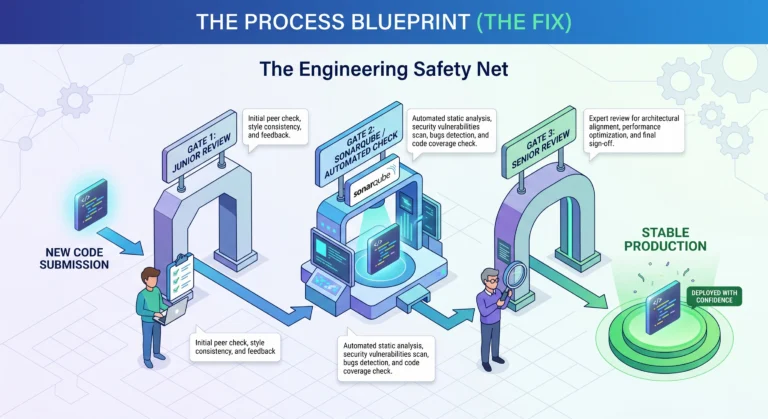
We didn’t start by writing code. We sat with the client, mapped out what had broken and why, and got specific about what “working” needed to look like for their use case. Then we rewrote what needed rewriting.
| ✕ Before | ✓ After (Innostax) |
| Small team, no review structure | Tiered reviews: junior → senior → lead |
| No code reviews | SonarQube + ESLint on every PR |
| Deploy and cross fingers | Rollback plan drafted before each deployment |
| No automated checks | Quality gates at multiple stages of the pipeline |
| Nobody clearly responsible | Named owner on every task |
| Deployments unpredictable | Consistent release process, no surprises |
Deploys got boring. That’s a good thing. The team went back to shipping at pace, but now problems got caught in the pipeline instead of in production.
Five Questions Worth Asking Any Dev Agency
Whether you’re evaluating someone new or second-guessing who you’re already with, these questions cut through the proposal language fast.
1. Who reviews code, and at what point?
Not “we do code reviews” — that’s a given. Ask who’s reviewing, what they’re checking for, and what actually blocks a merge. If the answer is vague, the process is probably informal.
2. Walk me through your last production rollback.
How they answer this says a lot. If it’s never happened, dig into why — that’s either earned confidence or inexperience. If it has happened, how fast did they catch it and what was their process?
3. Who do I call at 2am when something’s down?
“The team” isn’t an answer. Get a name. Understand who’s actually on call and what their response time looks like. This is the question budget agencies most often fumble.
4. What does your QA pipeline look like?
SonarQube, ESLint, Code Climate — these aren’t differentiators, they’re baseline. If an agency treats these as optional, their definition of “done” and yours probably don’t match.
5. Do you handle documentation at handoff?
Sloppy documentation is usually a sign the agency isn’t planning for you to leave — or doesn’t think it’s their problem when you do. Always plan for transitions.

Dealing with instability from a previous agency?
We’ve cleaned similar messes. Let’s chat about yours.