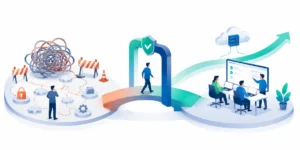
Legacy software modernization without the rewrite risk
Innostax modernizes legacy systems incrementally — module by module, with old and new running in parallel until the migration is complete. No big-bang rewrite. No business disruption. A dedicated Tech Lead accountable for every stage.
The problem with legacy systems
Your legacy system isn't the problem. How you modernize it might be
Legacy systems accumulate cost in ways that are easy to underestimate until they’re impossible to ignore. Maintenance overhead that grows every year. Integration friction with modern tools and APIs. Developer hours spent understanding code nobody wrote recently. Security vulnerabilities in frameworks that no longer receive patches. And the slow tax on every new feature — the extra weeks it takes to build anything new on top of a system that wasn’t designed for what you’re asking it to do now.
The instinct is to rewrite. Start fresh, do it properly this time, migrate everything at once. It’s a reasonable instinct and it’s almost always wrong.
Big-bang rewrites fail at a rate that should make any engineering leader pause. The business rules baked into a legacy system over years are rarely fully documented. The edge cases that the old system handles — often invisibly — don’t make it into the new one. The timeline expands. The scope grows. The business runs on the old system while the new one is being built, and by the time the new one is ready, the old one has changed again.
Innostax modernizes legacy systems differently. Incrementally. With the old and new running in parallel. Module by module, with each migration validated before the next begins.
How we approach legacy modernization
Assessment before architecture. Architecture before code.
Technical assessment Before we recommend anything, we understand what you have. The Tech Lead leads a structured assessment of your legacy system — architecture, functionality, data model, integration dependencies, and the business rules baked into the code. This is where we identify what’s actually causing the pain, not just what looks old.
We evaluate every module against three parameters: the impact of modernization on your business processes, the ease of modernization, and the dependencies between modules. This determines the sequence — which modules to tackle first, which to leave until later, and which might not need modernization at all.
Modernization strategy Based on the assessment, the Tech Lead defines a modernization strategy — the target architecture, the technology choices, and the migration approach. We’re clear about the trade-offs between approaches and direct about which one fits your situation.
The approaches we use, depending on what the assessment reveals:
Parallel migration For incremental replacement, we build a bridge between the old and new systems that facilitates systematic, secure data transfer. Both systems run in parallel — data is replicated in both databases, so your business operations continue without disruption while the migration proceeds. Modules are migrated one at a time, validated, and only then decommissioned from the old system.
This approach is slower than a big-bang rewrite. It’s also dramatically more likely to succeed.
Validation and decommission Each migrated module is validated against the old system’s behaviour before the old version is decommissioned. Edge cases that the legacy system handled are tested explicitly. Business rules that weren’t documented are surfaced and handled, not discovered in production.
End-to-End Legacy Application Modernization Services
Monolith to services architecture
Decomposing a monolithic application into independently deployable services, without the disruption of a full rewrite. Phased, tested, reversible.
On-premise to cloud
Migrating from on-premise infrastructure to AWS, Azure, or GCP. Infrastructure modernization that reduces operational overhead and enables the scaling your business requires.
Legacy integration layer replacement
Replacing expensive or brittle integration middleware with modern, maintainable alternatives. Often the fastest path to significant cost reduction — see the proof point below.
Technology stack upgrade
Moving from end-of-life frameworks and languages (.NET Framework, PHP 5, legacy Java) to modern equivalents, with the codebase restructured to take advantage of what the new stack makes possible.
Database modernization
Migrating from legacy database systems to modern alternatives, with data integrity validated at every stage.
Modernization projects fail when the scope is wrong and the exit is impossible. We fix both.
Start with a paid assessment, not a proposal
Before we recommend a modernization approach, we understand your system. The assessment surfaces the actual risks, the realistic timeline, and the right sequencing — so you’re not committing to a scope defined before anyone looked at what’s actually there.
1-day termination notice
If the engagement isn’t delivering at any stage, you’re out tomorrow. Legacy modernization projects go wrong when clients are locked into a vendor who’s already spent the budget. We remove that leverage entirely.
Engineers who stay for the full migration
Great Place to Work certified — the engineer who learns your legacy system’s architecture in month one is still accountable for it when the final module migrates. In legacy work, an engineer who knows the system’s history is worth more than a fresh one who has to rediscover it.
CLIENT OUTCOMES
Proof: Modernization with measurable outcomes
Online Education Platform
$300K+ Saved
The platform was facing a $300,000 Mulesoft renewal for their integration layer. Innostax assessed the architecture, identified that the integration layer could be rebuilt in-house, and built the replacement — eliminating the fee entirely. The right modernization decision, made by a team accountable for outcomes rather than hours, saved $300,000 in year one and millions over three years as the platform continued to evolve. That’s what integration modernization looks like when the assessment is done properly.

Technique
Full migration • Zero data loss
Technique needed to migrate to a modern Azure-based platform with Power Automate workflows. Innostax planned and executed the migration — 100% successful, zero data loss, with the automated workflows reducing manual work by 85–90%. A high-stakes migration delivered without business disruption.

Legacy System Modernization for CTOs, Engineering Teams & Business Leaders
CTOs and engineering leads at companies with systems over five years old whose maintenance costs are growing, whose developer velocity is slowing, and who know the system needs to change but are wary of the rewrite risk. You’ve seen modernization projects go wrong before. You need a partner who’s seen the failure modes and knows how to avoid them.
Engineering teams inheriting legacy codebases who need to understand what they’ve inherited before they can improve it. The assessment is often the most valuable thing we deliver — a clear picture of what’s actually there, what’s causing the most pain, and what to tackle first.
Finance and operations leaders whose legacy systems are creating compliance risk, security exposure, or integration friction with modern tools. The business case for modernization is often clearest when it’s framed in terms of cost reduction and risk elimination rather than technical improvement.
Tech stack
Legacy modernization pathways
Typical source stacks we retire and the modern targets we move teams toward - always chosen for your constraints, risk, profile and delivery pace
- .NET Framework
- PHP 5/7
- legacy Java
- on-premise infrastructure
- Mulesoft
- monolithic architectures
PostgreSQL, MySQL, MongoDB, SQL Server — migration from legacy database systems
Microsoft Power Automate, REST APIs, GraphQL — replacing legacy middleware
FAQ about Legacy Software Modernization
Because full rewrites fail at a rate that should concern any engineering leader. The business rules baked into a legacy system over years are rarely fully documented — they live in the code, in the edge cases, in the behaviour that nobody thought to write down. An incremental approach surfaces those rules as each module is migrated and validates them before the old version is decommissioned. It's slower. It's dramatically more likely to succeed.
For incremental migrations, we build a bridge between old and new systems that replicates data in both directions. Both systems run in parallel — your business operations continue on the old system while the new one is being validated. Modules are only decommissioned from the old system after the new version has been validated against the old system's behaviour.
It depends entirely on the scope — which is why we start with an assessment rather than a proposal. A legacy integration layer replacement might take 8–12 weeks. A full monolith-to-services migration might take 12–24 months. We'll give you a realistic timeline after the assessment, not before.
They always do. That's one of the reasons big-bang rewrites fail — the undocumented rules don't make it into the new system. Our incremental approach surfaces them module by module, during migration, when they can be handled deliberately rather than discovered in production.
Yes — and often the infrastructure is the right place to start. Moving from on-premise to cloud can deliver significant cost and operational benefits without touching the application layer at all. We assess both and recommend the sequence that delivers the most value for the least risk.
Every data migration is treated as a high-stakes operation — because it is. We validate data integrity at every stage, run old and new systems in parallel until the migration is confirmed complete, and test edge cases explicitly before decommissioning the old system. The Technique migration — 100% successful, zero data loss — is the standard we hold ourselves to.