Agentic AI Development: Systems That Act, Not Just Answer
Innostax builds agentic AI systems — multi-step agents that reason across tools, APIs, and data sources to complete complex tasks autonomously. Not chatbots. Not single-turn LLM calls. AI that acts, verifies, and delivers outcomes with a dedicated Tech Lead accountable for what ships.
Agentic AI Explained
Unsupervised AI Agents That Can't Be Trusted Are Liabilities
Agentic AI is the category of AI systems that go beyond responding to a single prompt — systems that break down a complex goal into steps, choose the tools and data sources needed at each step, execute actions, evaluate the results, and continue until the goal is achieved. The difference between an LLM integration and an agentic system is the difference between AI that answers and AI that acts.
The capability is real. The implementation risk is equally real.
Agents fail in specific ways that single-turn LLM calls don’t. They hallucinate intermediate steps that compound into downstream errors — a wrong decision in step two propagates through steps three, four, and five before anyone notices. They get stuck in reasoning loops when a tool returns an unexpected result.
They take irreversible actions — sending an email, updating a database record, making an API call — based on a reasoning chain that was subtly wrong. They perform well on the tasks they were tested on and fail on the edge cases that only surface in production.
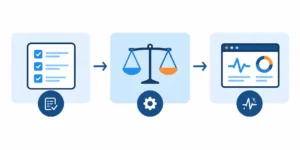
Building agentic AI that can be trusted to act unsupervised requires engineering discipline at every layer: tool design that makes actions reversible where possible, confidence thresholds that determine when the agent escalates to a human, step-level validation that catches errors before they propagate, and observability that makes the agent’s reasoning chain auditable after the fact.
Innostax builds agentic systems designed to be trusted — not just demonstrated.
Agentic AI Systems We Build for Autonomous Business Workflows
Task-completion agents
Agents that take a high-level goal and execute the multi-step workflow to achieve it — researching, reasoning, calling tools, evaluating results, and iterating until the task is complete. Built with the planning architecture, tool selection logic, and error recovery that makes autonomous task completion reliable rather than brittle.
Multi-agent systems
Architectures where specialised agents collaborate — an orchestrator agent that breaks down complex tasks and routes sub-tasks to specialist agents, each optimised for a specific domain or tool set. For workflows too complex for a single agent to handle reliably, multi-agent systems distribute the reasoning load and allow each agent to operate within a well-defined scope.
Agentic voice and conversation systems
AI agents that conduct natural, multi-turn voice and text conversations — handling objections, answering questions from a knowledge base, following conversation scripts, and escalating to humans when the interaction requires judgment the agent isn’t equipped for. For teams building AI-powered outreach, customer communication, or support at scale.
Document processing agents
Agents that ingest documents, extract structured information, validate it against rules, fill forms or checklists, and produce auditable outputs with evidence for every decision. For compliance-heavy workflows — banking, insurance, healthcare — where the agent’s reasoning needs to be explainable and every output needs to be traceable to a source.
Tool-using agents
Agents integrated with your existing systems — CRM, databases, APIs, calendars, communication platforms — that can read from and write to those systems as part of completing a task. Built with the access controls, action logging, and reversibility design that makes tool-using agents safe to deploy in production environments where mistakes have real consequences.
Human-in-the-loop agents
Agentic systems designed for workflows where full autonomy isn’t appropriate — agents that complete the parts of a workflow they can handle confidently and surface the decisions that require human judgment, with the context the human needs to make that decision quickly. The right architecture for regulated industries and high-stakes workflows where full automation isn’t the goal.
The engineering decisions that determine whether an agent can be trusted.
Tool design before agent design.
The tools an agent uses — the APIs it calls, the databases it reads, the actions it takes — determine the failure modes more than the agent’s reasoning logic. Before designing the agent, we design the tool layer: what each tool does, what it returns, how it handles errors, and whether its actions are reversible. Agents built on well-designed tools fail gracefully. Agents built on poorly designed tools fail unpredictably.
Confidence thresholds and escalation logic.
Every agentic system we build has defined confidence thresholds — the conditions under which the agent escalates to a human rather than acting autonomously. These thresholds are established during design, not discovered when the agent takes a wrong action in production. In regulated industries, escalation logic isn’t optional — it’s the compliance requirement.
Step-level validation.
For multi-step agents, each step’s output is validated before it’s passed to the next step. Errors caught at step two are cheap. Errors that propagate to step five — and trigger irreversible actions — are expensive. Step-level validation is the engineering discipline that keeps compounding errors from becoming production incidents.
Reasoning chain observability.
Every agent action is logged — the input, the reasoning, the tool called, the result, and the confidence score. Not just the final output. The full reasoning chain, auditable after the fact. For regulated industries, this is a compliance requirement. For all industries, it’s what makes an agentic system debuggable when something goes wrong.
Adversarial testing.
Agents are tested against the inputs they weren’t designed for — edge cases, unexpected tool responses, conflicting instructions, inputs designed to trigger reasoning failures. Adversarial testing is what separates an agent that works in a demo from one that can be trusted in production.
Gradual autonomy expansion.
Agentic systems go to production with limited autonomy first — human review of all actions, then human review of low-confidence actions, then full autonomy for well-validated task types. Autonomy is expanded as the agent’s reliability in production is demonstrated, not assumed from the start.
Production-Ready Agentic AI, Not Just Testing
2-week free trial on real work.
Your use case, your tools, your actual workflow. You’ll see within two weeks whether the agent handles edge cases reliably or whether the failure modes are already visible. If the latter, walk away. No invoice.
1-day termination notice.
If the agentic system isn’t performing to the standard we committed to, you’re out tomorrow. No lock-in, no notice periods.
Engineers who stay for the full build.
Great Place to Work certified — agentic systems require iterative refinement that depends on understanding the system’s history. The engineer who designs your agent’s tool layer and escalation logic in month one is still tuning it in month six. Continuity isn’t optional for agentic AI — it’s how the system gets better.
Agentic AI in Live Production Systems
Agentic voice AI for healthcare patient communication
An agentic AI system that conducts automated patient outreach — medication reminders, test scheduling, care follow-ups — through natural, multi-turn voice conversations indistinguishable from human care executives. The agent handles conversation flow, responds to patient questions from a knowledge base, manages scheduling requests made during the call, and generates structured call summaries for care owners. Alerts escalate to care owners when additional human assistance is needed.
Built on a HIPAA-compliant microservices architecture on AWS — end-to-end encryption
Encrypted storage, data residency controls, and AI agents that pass all security requirements. Agentic AI operating autonomously in a regulated environment where the compliance requirements are non-negotiable and the failure modes have patient safety implications.
Multi-model document processing agent for banking compliance
An agentic pipeline that processes property appraisal documents, reasons across compliance rules, fills checklists, and provides evidence for every answer — replacing a manual process that was time-consuming and inconsistent. The agent uses multiple models via AWS Bedrock at different pipeline stages, with multi-step validation that cross-checks outputs across models before they reach reviewers. Low-confidence outputs are flagged rather than passed through. Every decision is traceable to a source document. End-to-end encryption and event-driven architecture ensure compliance and auditability throughout.
Where Agentic AI delivers the most value
CTOs and product leaders at companies with high-volume
multi-step workflows that are currently manual — document processing, compliance review, customer outreach, data extraction and routing. The workflows where a human is currently doing the same sequence of steps repeatedly, and where the cost of that repetition is a constraint on the business.
HealthTech and FinTech teams building AI automation in regulated environments.
You need agentic systems with the escalation logic, audit logging, and compliance architecture that regulated industries require — not autonomous agents that act without oversight in environments where oversight is mandatory.
Product teams building
AI-native features where the value proposition is AI that completes tasks, not just AI that responds to queries. The difference between a product that uses AI and a product that is AI.
Tech stack
Agentic AI Development Tech Stack and Tools We Use
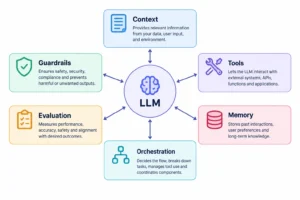
We build agentic AI systems using LLMs, tools, orchestration, cloud, and secure scalable infrastructure.
- Retell AI
- AssemblyAI
- WhisperX
- REST APIs
- GraphQL
- Database connectors
- CRM integrations
FAQ about Agentic AI Development Services
An LLM integration takes a single input, calls a model, and returns an output. An AI agent takes a goal, breaks it into steps, chooses tools and data sources at each step, executes actions, evaluates results, and continues until the goal is achieved — or escalates to a human when it can't. The difference is autonomy and multi-step reasoning. Agents are appropriate when the task is too complex for a single LLM call and when the value comes from AI completing a workflow, not just informing a human decision.
Through tool design (making actions reversible where possible), confidence thresholds (escalating to humans when the agent's confidence is below the defined threshold), step-level validation (catching errors before they propagate), and gradual autonomy expansion (starting with human review of all actions and expanding autonomy as reliability is demonstrated). No agentic system goes fully autonomous in production from day one.
Every agent action is logged — input, reasoning chain, tool called, result, confidence score. The full trace, not just the final output. For regulated industries, this audit log is a compliance requirement. For all industries, it's what makes the system debuggable when something goes wrong and trustworthy when everything goes right.
Yes — but it requires specific architectural decisions that most agentic frameworks don't enforce by default. HIPAA compliance requires data residency controls, end-to-end encryption, and AI agents that pass security requirements. Financial regulation requires audit trails and human oversight of high-stakes decisions. We design these requirements into the architecture from the start. We've built HIPAA-compliant agentic systems in production — it's achievable with the right engineering, not just the right framework.
Workflows that are currently manual, multi-step, high-volume, and rule-governed — where a human follows the same sequence of steps repeatedly, the steps involve reasoning across documents or data, and the output is a structured decision or action. Document processing, compliance review, customer outreach, data extraction and routing, research and summarisation. Workflows that are highly variable, require deep contextual judgment, or have unacceptable failure modes for autonomous action are better suited to human-in-the-loop designs.
A focused single-agent system for a well-defined workflow typically takes six to ten weeks to production-ready. A multi-agent system with complex tool integrations, compliance requirements, and gradual autonomy expansion typically takes three to five months. We'll give you a realistic estimate after the discovery phase — the timeline depends heavily on the complexity of the tool layer and the state of your underlying data.