Reliable CI/CD Pipelines and Infrastructure as Code
Innostax builds CI/CD pipelines that give your team fast, reliable feedback on every commit — and infrastructure as code that makes every environment reproducible, every change reviewable, and every deployment predictable. A dedicated Tech Lead owns what gets built.
The pipeline problem most teams inherit
Your CI/CD Pipeline Was Set Up Once by Someone No Longer There
Most engineering teams have a CI/CD pipeline. Most of them also have a complicated relationship with it.
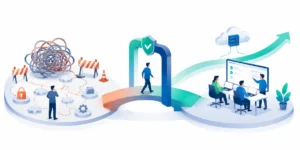
It was set up during a sprint when there was time. It mostly works. Nobody fully understands all of it. When it breaks — and it breaks — the same two engineers fix it, because they’re the only ones who know where to look. New developers spend their first week getting their local environment to match what the pipeline expects. Deployments to staging work differently than deployments to production, for reasons that are documented somewhere nobody can find.
Infrastructure has the same problem at a different layer. Cloud resources were provisioned manually, one at a time, as the product grew. Nobody’s entirely sure what all of it does.
Staging doesn’t match production — which means bugs that don’t reproduce in staging make it to production regularly. The cloud bill is growing but nobody owns it.
This isn’t a failure of your engineering team. It’s what happens when CI/CD and infrastructure are treated as one-time setup tasks rather than engineering disciplines that need ownership.
Innostax builds CI/CD pipelines and infrastructure as code that are designed to be maintained, not just written — with a Tech Lead who owns them and is accountable for their reliability.
DevOps Infrastructure Built for Speed, Reliability, and Scale
CI/CD pipeline design and build
End-to-end continuous integration and delivery pipelines — from commit to deployment — designed for your stack, your team size, and your deployment cadence. Fast builds. Reliable test gates. Automated deployments to every environment. Built on the tools that fit your workflow: GitHub Actions, GitLab CI/CD, CircleCI, Jenkins, or Azure DevOps.
Infrastructure as code
Your cloud infrastructure in version-controlled code — Terraform, Pulumi, or AWS CDK — so every environment is reproducible, every change is reviewed, and every resource is tracked. No more manually provisioned resources that nobody remembers creating. No more staging environments that don’t match production.
Environment management
Consistent, reproducible environments for development, staging, and production — built from the same infrastructure code, so what works in staging works in production. The single most effective way to eliminate the class of bugs that only appear in production.
Deployment automation
Automated deployment pipelines with the safeguards that make fast deployment safe — automated rollback on failed health checks, blue/green and canary deployment strategies for zero-downtime releases, and deployment gates that prevent broken builds from reaching production.
Pipeline maintenance and optimisation
For teams with existing pipelines that are slow, flaky, or poorly understood — we audit what you have, fix what’s broken, document what isn’t, and optimise build times and reliability. A pipeline that takes 45 minutes to run doesn’t get run. We make it fast enough to be useful.
Secrets and configuration management
Vault, AWS Secrets Manager, Azure Key Vault — secrets managed properly, not hardcoded in environment files or passed around in Slack. Configuration management that works consistently across environments without creating the drift that causes production-only bugs.
How we build CI/CD pipelines and infrastructure as code
Fast feedback. Reliable deployments. Infrastructure you can trust.
Pipeline architecture before pipeline code
Before writing a single pipeline configuration, the Tech Lead designs the pipeline architecture — the stages, the gates, the parallelisation strategy, and the deployment model. A pipeline designed for your workflow is faster and more reliable than one adapted from a template.
Incremental build optimisation
Build time is developer time. We design pipelines with caching, parallelisation, and test splitting that keep feedback loops tight — unit tests in under two minutes, full integration test suites in under ten. A fast pipeline gets run. A slow one gets bypassed.
Infrastructure as code from day one
Every resource we provision goes into code. Every change goes through review. Every environment is built from the same code. If something breaks, we roll back. If something needs to be rebuilt, we rebuild it in minutes from the code that defines it.
Drift detection and prevention
Infrastructure drift — where the actual state of your infrastructure diverges from what the code says it should be — is how manual changes accumulate into a system nobody fully understands. We configure drift detection that alerts when the actual state diverges from the defined state, and enforce that all changes go through the IaC workflow.
Documentation as a deliverable
Every pipeline and infrastructure component we build is documented — what it does, why it’s structured the way it is, and how to change it. The documentation that makes the next engineer able to work with what we’ve built without having to reverse-engineer it.
A pipeline that breaks when you need it most isn't a pipeline. You'll know within two weeks whether ours holds up.
2-week free trial on real work
Your stack, your repository, real pipeline work. You’ll see within two weeks whether the pipeline we build is reliable and fast or whether it needs constant attention. If it’s the latter, walk away. No invoice.
1-day termination notice
If the pipeline isn’t delivering the reliability and speed your team needs, you’re out tomorrow. No lock-in, no notice periods.
Engineers who own what they build
Great Place to Work certified — the engineer who designs your pipeline architecture in month one is still maintaining it in month six. Pipeline ownership requires context that doesn’t transfer in a handover document.
Teams That Need Reliable, Scalable CI/CD
Engineering teams whose CI/CD pipeline is owned by one or two people — when those people are unavailable, deployments slow down or stop. That’s a single point of failure, not a pipeline.
Teams where staging doesn’t match production — the class of bugs that only appears in production is almost always an environment consistency problem. Infrastructure as code solves it structurally, not case by case.
CTOs at growth-stage companies whose infrastructure was provisioned manually as the product grew and is now a system nobody fully understands. Infrastructure as code is the path from “we think this is what we have” to “we know exactly what we have.”
Engineering teams scaling their organisation who need a pipeline that supports more developers, more concurrent branches, and more frequent deployments — without the coordination overhead that a slow or unreliable pipeline creates.
CLIENT OUTCOMES
Proof: CI/CD and infrastructure on the record
Ashore
Shipping new features on a near-daily cadence requires a delivery pipeline that’s fast enough to run on every commit and reliable enough to trust. Innostax maintained the CI/CD pipeline and infrastructure that let Ashore ship at that velocity — consistently, without the stability cost that typically comes with moving fast.

Technique
Technique’s migration to Azure required building the target infrastructure from scratch in a way that was reproducible, auditable, and reliable enough to run business-critical workflows. Innostax built the Azure infrastructure as code, executed the migration with zero data loss, and delivered the automation workflows that now run on top of it.

Online Education Platform
$300K+ Saved
The right infrastructure decision — replacing an expensive integration middleware with a custom-built alternative — saved $300,000 in year one. Infrastructure as code made the replacement reproducible and maintainable. The right tooling, owned by the right team.

Tech Stack
Tools & Technologies we use for CI/CD
The Tech Lead selects the right combination from this stack based on your product requirements, scale targets, and integration needs.
- GitHub Actions
- GitLab CI/CD
- CircleCI
- Jenkins
- Azure DevOps
- Terraform
- Pulumi
- AWS CDK
- Bicep (Azure)
- Docker
- Kubernetes (EKS, AKS, GKE)
- HashiCorp Vault
- AWS Secrets Manager
- Azure Key Vault
- AWS
- Azure
- GCP
- Datadog
- Grafana
- Prometheus
- CloudWatch
- Azure Monitor
FAQ about CI/CD and DevOps
A basic pipeline — automated builds, test gates, and deployment to staging — can be running within a week for most stacks. A full pipeline with environment management, deployment strategies, secrets management, and observability integration typically takes two to four weeks. We'll give you a realistic estimate after understanding your stack and current setup.
Yes — and it's often the right approach. We audit what you have, identify the specific problems causing the most friction (slow builds, flaky tests, unreliable deployments), and fix them incrementally. A full rebuild is only warranted when the existing pipeline is so far from what you need that incremental improvement would take longer than starting fresh.
The cloud console lets you provision resources manually. Infrastructure as code means your infrastructure is defined in version-controlled files — every resource, every configuration, every dependency. The practical difference: with IaC, every environment is reproducible (staging matches production), every change is reviewed (no untracked manual changes), and every state is recoverable (if something breaks, you roll back the code). Manual provisioning accumulates drift. IaC prevents it.
It depends on your source control, your team's familiarity, and your deployment targets. GitHub Actions is our default recommendation for teams on GitHub — tightly integrated, well-documented, and sufficient for most use cases. GitLab CI/CD is the right choice for teams on GitLab. Azure DevOps for teams with significant Azure infrastructure. We'll make a clear recommendation based on your setup, not based on what's easiest for us to implement.
Secrets never live in pipeline configuration files or environment variables passed in plaintext. We configure a secrets management solution — Vault, AWS Secrets Manager, or Azure Key Vault depending on your infrastructure — and integrate it into the pipeline so secrets are injected at runtime from a managed, audited source. Every secret access is logged. Every secret rotation is handled without pipeline changes.
Pipelines need maintenance as the product evolves — new services, new deployment targets, dependency updates, build time optimisation as the test suite grows. Your Innostax Tech Lead handles this as part of the ongoing engagement, treating the pipeline as a first-class engineering asset rather than a set-and-forget configuration.