


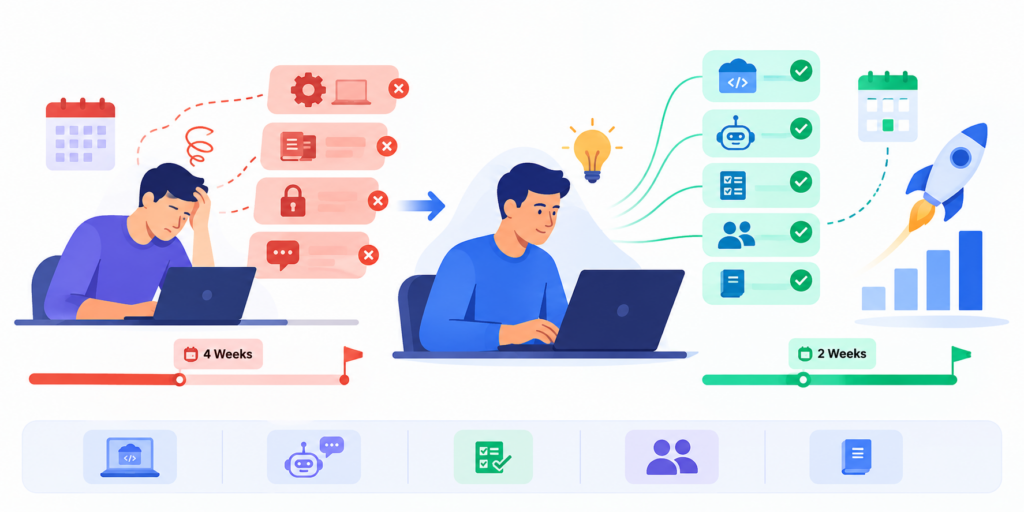
- 1 Slow onboarding reduces productivity and delays delivery.
- 2 Developer experience (DevEx) has a direct impact on ramp-up time.
- 3 AI tools, dev containers, and a structured buddy system accelerate onboarding.
- 4 Track metrics like time to first PR and first shipped feature.
- 5 A well-designed 14-day onboarding plan gets developers productive faster.
A new engineer joins on Monday. Their first meaningful pull request lands four weeks later. That gap is the industry default, and it is a tax every engineering team pays. Software developer productivity in the first month depends less on the engineer and more on the system they land in. This post breaks down the four bottlenecks that stretch onboarding into a month, five strategies that compress it into two weeks and the onboarding tools worth adopting in 2026.
The Hidden Costs of Slow Onboarding New Developers
Onboarding new developers slowly costs more than salary during ramp. Senior engineers lose time answering setup questions and reviewing tentative PRs. Delivery timelines slip because the new hire cannot yet take a real ticket. New engineers themselves lose confidence and start doubting the fit. The longer the ramp, the higher the risk of first-year attrition. Teams that treat onboarding as a quarter-long process pay the invoice twice: once in wasted senior time, again in retention risk.
4 Main Bottlenecks Killing Software Development Productivity
Software development productivity for a new hire dies in four specific places. Local environment setup that fights the engineer for two days. Undocumented tribal knowledge that only surfaces in Slack threads. Complex approval chains for basic access. A code review backlog where the new hire’s first PR sits for a week. Any one of these delays ramps up. Combined, they turn a two-week ramp into a two-month one. Fixing each is cheap. Ignoring them is expensive. Many engineering leaders underestimate how much of the ramp comes from these process gaps rather than the engineer’s ability.
Strategy 1: Using Modern Developer Productivity Tools
Modern developer productivity tools cut the setup and context tax. A dev container ships the environment ready to run. A repo Q&A assistant answers questions that would have become Slack pings. A test generator drafts coverage for legacy modules so the new hire can change them safely. These tools do not replace mentorship. They handle the routine part so mentorship covers what actually needs a human.
Strategy 2: Increase Developer Productivity With AI-Assisted Onboarding
AI-assisted onboarding is the fastest way to increase developer productivity in the first week. Give the new engineer a code assistant with access to the repo. Ask them to explain a module in their own words after reading the assistant’s summary. Have them extend a small function with the assistant pairing. First commits land in days, and the engineer learns the codebase by working in it, not by reading through it.
Strategy 3: Implementing a “Buddy System” and Shadowing Program
Onboarding new developers works better with a named buddy, not an open invitation to ask questions. Assign a mid-level engineer as the go-to for the first 30 days. Schedule three shadowing sessions in the first week: a design review, a production incident and a code review. The buddy answers the small questions. The shadowing sessions build the mental model for how the team actually works.
Developer Onboarding Tools Worth Adopting in 2026
Developer onboarding tools have matured. This table shows the categories worth adopting in 2026 and what each replaces.
| Tool category | Replaces | First-month impact |
| Dev container / cloud dev env | Local setup fights | Cuts day-one setup to hours |
| Repo Q&A assistant | Slack pings to seniors | Answers arrive in seconds |
| Test generator | Fear of touching legacy code | First real commits ship faster |
| PR review assist | Slow human-only reviews | Feedback loops tighten |
| Doc generator | Missing module docs | Reduces “what does this do” cost |
How to Measure Success: Tracking the “First PR” and Beyond
Track time to first PR, time to first shipped feature and PR review turnaround. If any trend goes the wrong way, adjust the onboarding plan.
The 14-Day Productivity Roadmap: A Step-by-Step Checklist
A 14-day roadmap holds software developer productivity accountable. Day 1: dev container ready, access provisioned, buddy assigned. Day 3: first small PR merged. Day 5: shadow a code review and a design meeting. Day 7: own a small feature end to end. Day 10: pair on an incident or debugging session. Day 14: ship the first user-facing change. Miss a milestone and diagnose why immediately, do not wait for the 30-day check-in.
Why Innostax Focuses on Zero-Friction Developer Experience (DevEx)
Innostax invests in developer experience because software development productivity compounds when friction is low. Every managed engineering team ships with a dev container, AI code assist, a repo Q&A layer and a tech lead who owns onboarding. Our engineers land on client projects productive from day three, not day thirty. If your team is losing weeks to onboarding friction, talk to us about how we structure the first two weeks.
Conclusion: Building a Culture of Immediate Impact
Software developer productivity depends more on the system a new hire lands in than on the hire themselves. Much ramp time comes from environmental friction, missing context and slow review loops. Each is cheap to fix and expensive to ignore. Teams that treat the first two weeks as a designed program, not an accident, get new engineers shipping in days and holding onto them for years.