

- 1 All the chaos and confusion in the middle of the day was replaced by one 15 minute morning meeting.
- 2 When things go wrong, each developer has Plan A, Plan B, and Plan C, and there's never a moment wasted when they can.
- 3 The CI/CD automation reduced the deployment time from 3–4 hours to less than 20 minutes.
- 4 The reduction of rework was approximately 30% within three weeks with a simple ticket checklist
- 5 Integrations of Jira, Slack and GitHub removed the manual overhead that no one was keeping track of
- 6 The team has provided a full app rework on time with a 40% higher output and no new hires.
Some projects don’t leave room for error. When a client comes to you with an investor demo locked in and an app that needs a near-complete overhaul — you don’t get to ask for more time. You figure it out with the team you have.
That’s exactly where we found ourselves.
Not all projects can be done without mistakes. We were approached by a funded startup who had an investor demo signed and an app that required a full re-architecture. New features, clean architecture, better UX — huge scope, short time. Their initial reaction was to find a driver. We understood why. However, when it came to the way the team spent the day, it wasn’t a matter of headcount. There were little inconspicuous inefficiencies consuming real development time, one after another, every sprint.
Thus we corrected our team’s collaboration. Eight weeks later, the complete revamp was delivered on time, and there was about an 40% increase in production per sprint.
Here’s what actually moved the needle.

A Smarter Morning Meeting That Boosts Team Productivity
Not a standup. One planning time (15 minutes) focused on three questions.
The recurring theme: developers experiencing a blocker at 2pm which anyone could have expected at 9am. Plan A was stalled, and there was no one who had thought about anything else. Hours vanish in that space in between when the blocker hits and what to do next.
Therefore, we set out three plans for each day.
Plan A
main objective of the day. Specific, owned, completable.
Plan B
Your B plan if Plan A fails to work out. Planned ahead, not after the blocker has hit.
Plan C
A task that you can complete independently, with progress.
The whole meeting runs 15 minutes. Everyone leaves knowing exactly what they’re doing — and what they’re doing if that falls apart.
In week two, developers arrived at the meeting with their Plan B in place. Blockers came up before they turned into delays. It took the team lead a few minutes in the middle of the day to quit the habit of losing hours while redirecting people. A simple design and has proven to be the most durable of the many designs we have tried.
It’s not complicated. That’s the point — complicated systems don’t survive high-pressure timelines. This one did.
Tackled the challenge of the ticket problem before it struck Sprint.
Much of the rework was due to one single cause: tickets being sent into sprints without enough information to work on. The acceptance criteria was either not specified or not set. No edge cases were marked. Designs weren’t attached. If a developer could come up with something reasonable, take it to review and discover it wasn’t what the product team was thinking about.
We added a short def of ready checklist – the acceptance criteria that were written, the designs were linked, and the dependencies were identified, and edge cases were noted. No one had signed off before entering in the sprint. A bit more than 15 minutes of work per ticket. In three weeks, rework fell by about a third.
However, many people simply did not realize that PR Review Lag was a silent killer.
PRs had to wait 24 to 36 hours to be seen by a first look. That caused cascading delays – whatever function it depended on could not run either, or anything that depended on it, either. It did not seem to be an issue, as it was simply the way things were.
We agreed that if there was a PR open and you had capacity give it a first review within four working hours. It’s not a formal approach, it’s just an explicit approach. The team honored it. Merge times were reduced and so were the merges that resulted in down stream pile ups.
Weekly Check-ins – Not Just Retrospectives
Retrospectives are great, but they are not happening often enough to resolve friction when it’s small. We introduced a weekly ‘what slowed us down this week’ question and a ‘what one thing can we do’ if this week realistically question of what can we do differently?
One change. Not a list of action items. In week 6, the team had gone through more than 20 small improvements, none of which were dramatic, but all of which were real.
Other Things We Improved
Talking tooling. The systems that the company used for its project management were Jira, Slack, GitHub, and Confluence. The company didn’t have automations between these systems; we added them — ticket statuses changed on commits and merges, deployments triggered alerts in Slack, Confluence created reports about sprint results automatically. Two days of configuration, after which everyone could see all the necessary information without contacting any person.
CI/CD done properly. The company had a CI system that was Jenkins, yet, the process of deployment required presence of the senior engineer and took 3–4 hours every single time it was needed several times a week. We completely rebuilt the pipeline for the company and made deployments take less than 20 minutes, and most of the time they happen without the presence of engineers.
Properly filled tickets. Another big part of rework was rooted in a problem: there was no information in tickets about acceptance criteria. We introduced the checklist of things to be mentioned in a ticket before starting its development. The rework level was reduced by a third.
Shortened PR reviews. Sometimes pull requests had to wait 24–36 hours before receiving any comments from another engineer. We informally agreed upon 4-hour SLA, which greatly shortened merge times and eliminated many problems with cascading PR delays.

The Results
- Sprint velocity of ~ 40% above the average
- The deployment time is 3-4 hours with the possibility to be reduced to under 20 minutes.
- Rework rate, down ~one-third.
- On time delivery of a revamped full product to the investor demo.
There was no expansion of the team. The days were no longer dotted with holes.
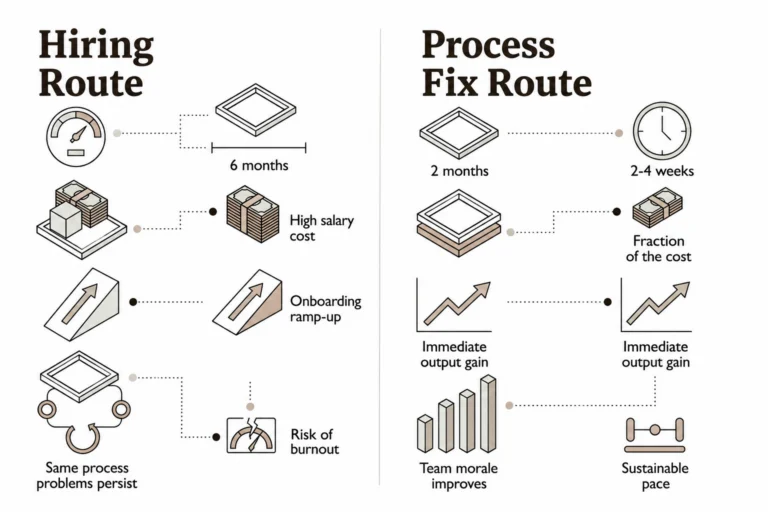
All the while, Hiring Is Actually the Right Call was in progress.
The exact opposite occurs with some teams you’re making a mistake hiring more developers — there’s just more work to do than the hours and no process cleanup will make up the difference. However, that is not the case as is often the case. Most teams are shedding actual capacity that is correctable and adding more manpower doesn’t solve anything, it just gives more people the same problem.
A 40% improvement means that your staff is working for 1.4 teams. It’s important to know before you post a job.
Engineering Key Performance Indicators (KPIs) We Tracked
To ensure these operational adjustments yielded measurable efficiency rather than superficial activity, we established five strict engineering metrics across every sprint:
- Cycle Time: Tracked the exact duration from the moment work began on a ticket to its successful production deployment. Removing PR review lag dropped our average cycle time by over 40%.
- Pull Request SLA Adherence: Monitored the percentage of PRs receiving an initial peer review within the 4-hour window, ensuring code bottlenecks were addressed in real time.
- Rework Percentage: Calculated the ratio of sprint points spent fixing defects or modifying features versus delivering new user value. The Definition of Ready checklist cut this metric by one-third.
- Deployment Frequency: Measured how many production releases the team executed per week after transitioning to automated CI/CD pipelines.
Overcoming Resistance to Workflow Changes
Introducing new processes during a high-stakes, crunch-time project often triggers initial pushback from engineering teams who fear added administrative overhead. We bypassed friction using three simple management practices:
- Enforce the “One-In, One-Out” Rule: Whenever a new process requirement was introduced (such as the Definition of Ready checklist), we eliminated an existing piece of administrative friction (like manual deployment reporting).
- Focus on Developer Autonomy: The daily Plan A/B/C strategy gave engineers immediate permission to pivot when blocked, eliminating the frustrating experience of waiting for a team lead’s approval.
- Visible Quick Wins: Demonstrating immediate time savings—like reducing deployment wait times from 4 hours down to 20 minutes—built instant credibility and team buy-in.
The Compounding Effect of Micro-Optimizations
High-performing engineering departments rarely double output through a single massive operational overhaul. Instead, massive productivity gains stem from eliminating small, recurring frictions across the entire development lifecycle:
- 15 minutes saved per developer daily by pre-planning Plan B tasks.
- 30 minutes saved per ticket by avoiding ambiguous requirements.
- 20+ hours saved weekly across the team through automated CI/CD releases and Jira-Slack integrations.
When compounded over an eight-week sprint cycle, eliminating these small frictions freed up hundreds of hours of raw engineering capacity—enabling the team to deliver an entire product revamp without adding a single new hire.
5-Point Engineering Efficiency Checklist for Founders
Before expanding your engineering headcount, run your current development pipeline through this diagnostic audit to uncover hidden capacity:
- PR Wait Times: Are pull requests sitting unreviewed for longer than 4 business hours?
- Definition of Ready: Do tickets enter active sprints without linked designs, explicit acceptance criteria, and edge-case notes?
- Deployment Automation: Does releasing code require manual intervention from a senior engineer or take longer than 30 minutes?
- Daily Standup Clarity: Do developers leave morning meetings with explicit backup tasks in case their primary deliverable gets blocked?
- Tooling Integration: Are engineers spending time manually updating status boards, posting Slack deployment notifications, or writing manual sprint reports?
Working With Innostax
Develop Web apps, mobile apps, APIs and platforms. Additionally, we support the existing engineering team in delivery, infrastructure, and process — where needed.
We’ve been there too if your team falls behind schedule on a roadmap or if you are running into a critical milestone.