

PHP 8.x with OPcache and JIT delivers production-grade performance for most business web applications, while its modular MVC ecosystem (Laravel, Symfony) supports scaling from MVP to enterprise workload without a rewrite. The combination of mature hosting compatibility, cloud-native deployment support, and a fast patch cadence makes PHP a low-risk, cost-efficient choice for SaaS, e-commerce, and CMS-driven platforms.
- 1 Faster Time to Market: PHP’s simple syntax, large library support, and wide hosting compatibility enable rapid development and deployment, ideal for MVPs and startups.
- 2 Scalable Architecture: PHP supports modular design and seamless third-party integrations, making it easy to grow as your business evolves.
- 3 Cloud-Ready Solutions: Easily integrate PHP with cloud platforms like AWS, Google Cloud, and Azure for dynamic scaling and load balancing.
- 4 Secure and Up-to-Date: Backed by a strong community, PHP receives continuous updates and patches, ensuring your web application remains secure.
- 5 Cost-Effective Development: Being open-source with a wide talent pool, PHP offers an affordable and reliable solution for custom web application development.
- 6 Ideal for Diverse Projects: From SaaS platforms to eCommerce stores, PHP adapts to different business needs with speed and flexibility.
When expanding your business, leveraging the right technology can make all the difference. PHP is important for application development because it is an established, powerful, and highly flexible server-side scripting language. PHP is currently used in many websites and web applications, where large businesses are working smoothly. From its rapid development to its robust scalability, PHP offers a range of advantages for your business to launch quickly and grow effectively.
Why PHP Website Solution Development Is Ideal for Fast Launches?
Here are a few reasons why PHP is ideal for fast launches:
1. Rapid Web Solution Development
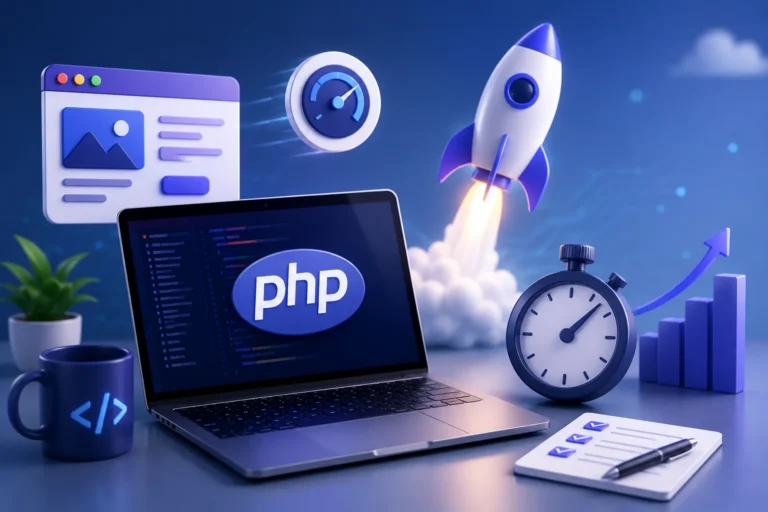
The syntax of PHP is straightforward, making it easier for developers to write and deploy code faster. Moreover, PHP offers extensive documentation, good support from the community, and countless pre-built modules.
Different tools streamline the application development process, to build a fully functional application. For startups and businesses aiming for a minimum viable product (MVP), you can get the agility needed to move from concept to launch in record time with PHP web solution development services easily.
2. Open Source with Extensive Library Support
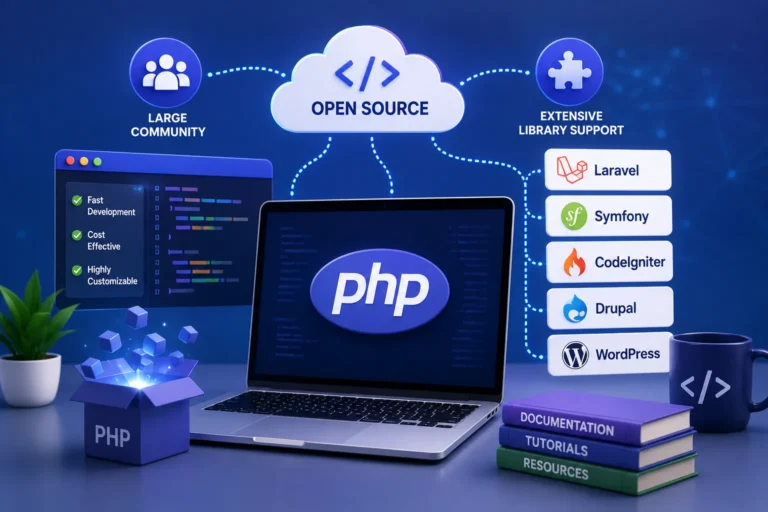
PHP is open-source, which gives you access to a massive ecosystem of libraries and frameworks. These resources enable you to build and iterate products faster. With PHP, you can integrate tried-and-tested solutions that speed up development and reduce bugs.
3. Flexible and Compatible with Most Hosting Services

PHP runs easily on most hosting platforms. This makes web deployment quicker with PHP for website development company. It has compatibility with different databases, including PostgreSQL, MySQL, and MongoDB. This makes it easy for the team to start building immediately without lengthy setup processes.
Total Cost of Ownership: PHP versus Alternative Technology Stacks Essay
Although faster launches are important, the overall cost of ownership of a technology stack throughout the lifetime of a project is vitally important for any company that wants to minimize its expenses.
When it comes to hosting, PHP has a significant advantage over some of its alternatives due to its higher demand and availability on the market. This factor usually makes PHP a cheaper option for developers due to hosting being one of the largest expenses for most clients.
The same demand advantage helps to secure a lower cost and easier hiring of PHP developers. Although some alternative stacks may offer a better initial experience, others will require significantly more effort from the client to be able to find qualified workers.
Finally, the lower cost of maintenance is crucial for any company that wants to minimize its expenses over the lifetime of a product. PHP’s advantages in this area come from an easier learning curve and better debugging tools and practices compared to many of its alternatives.
When PHP Might Not Be The Right Tool
While it’s important to understand what PHP does well, it’s equally important to know when PHP may not be the best choice. Some areas where other technologies may be a better fit.
Applications which require heavy, sustained, CPU-bound computations (some branches of scientific computing, or certain types of machine learning algorithms) may need to be developed in a language more suited to that type of parallel processing, particularly with the advent of PHP’s just-in-time compiler.
Applications which require real-time connections to end-users (some multiplayer game servers, or collaborative tools) may need to be written in a technology which can maintain process persistence, outside of PHP’s traditional request/response model, though newer tools like ReactPHP and Swoole are closing this gap.
How PHP Helps You Scale Smarter?
Launching fast is very important for the business PHP becomes important in the following ways:
1. Modular Architecture for Future Growth
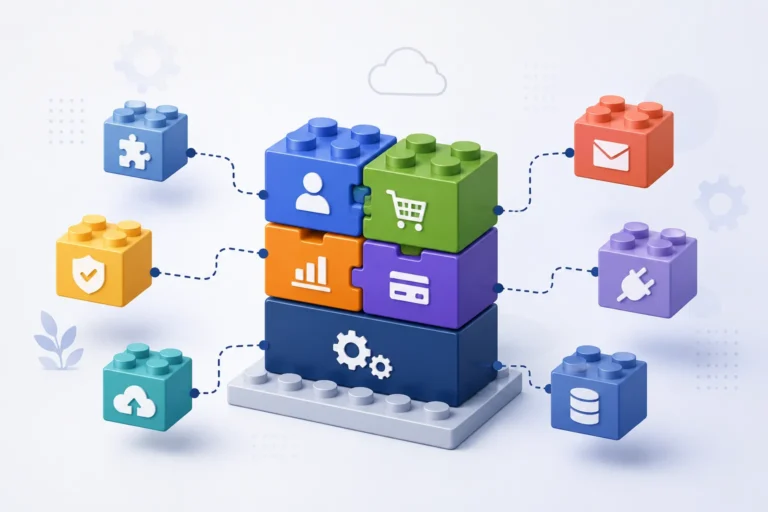
Custom application build-up using PHP web development allows you to build modular and scalable architecture. As your user base grows and the needs evolve too, you can add new features, upgrade your tech stack, and integrate third-party tools without overhauling your existing application.
With well-structured codebases and MVC frameworks, scaling becomes more manageable and less resource-intensive. A seasoned PHP developer will ensure that your application’s core is built with long-term scalability in mind.
2. Cloud Integration and Load Balancing
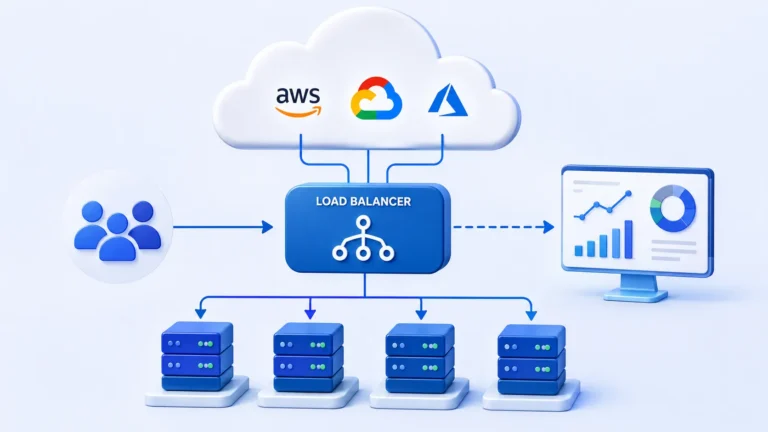
Modern PHP frameworks are cloud-ready and support seamless integration with popular cloud services like Google Cloud, AWS, and Microsoft Azure. This makes it easier to scale your infrastructure dynamically based on traffic and usage patterns. By partnering with a PHP web application development services provider, you can leverage these features to stabilize your increasing user demand.
3. Continuous Updates and Security Patches
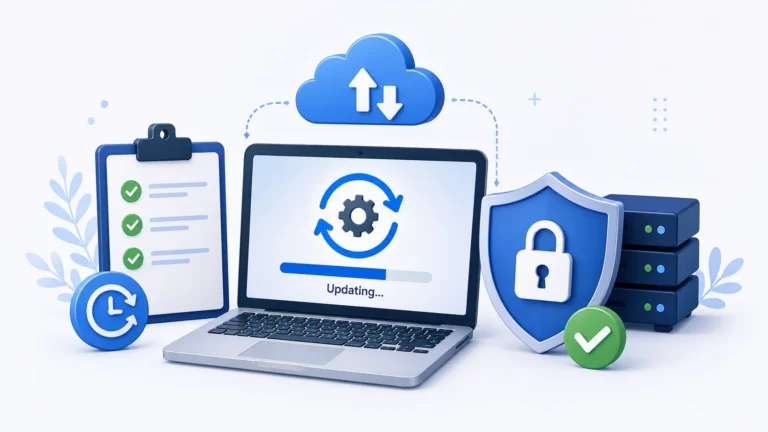
The PHP community is continuously working for enhancement. Frequent updates, security patches, and framework improvements ensure that your application remains secure and industry standards are maintained. This ongoing support is crucial when scaling your app and security.
PHP’s Role in Modern API-First Architectures
Many modern applications are decoupling their frontend and backend more than in the past, and PHP is well poised to take advantage of that trend.
Laravel and Symfony both have excellent support for modern API development, allowing PHP to focus on being a data and business logic layer while your front-end developers work their magic in React, Vue, or building a mobile app.
In addition, an API-focused app allows you to target multiple front-end environments, from web to mobile, with a single set of business logic, saving time and reducing duplication.
Testing Practices That Matter for Production PHP Applications Essay
A PHP application that is expected to scale must be developed using reliable practices. These practices include not only architectural but also testing-related design decisions that need to be made early and often throughout the development cycle. Unit testing with tools such as PHPUnit helps detect regression issues earlier in the development lifecycle. It becomes especially important as a code base grows more complex and individual changes can introduce more unforeseen consequences. Integration testing helps ensure that a PHP application’s interactions with external service are not error prone, as these interactions are a common source of hard-to-reproduce bugs in production.
This is especially true for applications that rely on external services such as payment processing gateways, storage platforms, and other resources that require extra validation prior to being utilized in production.
Choosing the Right PHP Application Development Service Providers
To fully capitalize on the benefits of PHP, you need a skilled team with a proven track record. Here are some qualities to look for:
- Expertise in custom PHP web development
- Experience with cloud infrastructure and database management
- Agile development practices
- Proactive support and maintenance
If you are building a SaaS platform, an eCommerce site, or a content management system, a systematic development process is important to meet your specific goals.
Runtime Mechanics: What Actually Makes PHP Fast in Production
PHP’s speed reputation isn’t just about syntax simplicity, it comes down to how the runtime handles execution under load:
- Stateless Request Lifecycle: Each HTTP request spins up a clean memory space and tears it down on completion. This eliminates the memory-leak class of bugs entirely at the application layer, there’s no long-running process accumulating state across requests, which simplifies debugging under sustained traffic.
- OPcache bytecode caching: PHP re-parses and recompiles scripts on every request without OPcache enabled. With OPcache, the precompiled scripting language bytecode is stored in the shared memory for the life of the request, saving huge amounts of CPU cycles on large-scale high-traffic endpoints.
- JIT compilation (PHP 8+): The JIT compiler compiles hot code paths to the machine code at runtime, which can improve performance of CPU-bound operations, calculations, image manipulation, data munging and other operations, versus standard I/O-bound PHP code. Not that there isn’t value in JIT compilation for business-as-usual CRUD apps, but it’s a smaller gain versus focused compute-intensive workloads.
- Connection pooling via PDO: PHP’s PDO library and connection persistence can help avoid the overhead of opening/closing database connections, which becomes a significant consideration once you get beyond a few hundred RPS.
Architectural Patterns That Support Long-Term Scale
- MVC Separation as a Scaling Discipline: Frameworks like Laravel and Symfony enforce separation between the routing/business logic and data access layers allowing teams to swap out a database layer or add a caching tier without touching controller logic in the codebase
- Service Oriented Decomposition: As a monolithic PHP application grows, bounded context decomposition to decompose it into internal service classes or even separate microservices is straightforward due to PHP’s dependency injection containers (Laravel/Symfony) being designed to encourage loose coupling
- Queue Based Background Processing: Laravel Horizon or Symfony Messenger can be used to decouple long-running processes, email sending, report generation, or third-party API calls from the main application via Redis-based or RabbitMQ message queues, allowing transaction volumes to increase without increasing response latency
- Horizontal Scaling Through Stateless Design: Due to PHP’s lack of in-process statefulness, horizontal scaling on additional servers or containers just requires external session storage (Redis or database-backed sessions) instead of requiring application-layer changes
Security Controls Relevant to Business-Critical Applications
- Input Validation At Infrastructure Level: Laravel’s Form Request Classes And Symfony Validator Component Provide Opinionated Validation APIs That Prevent Direct User Input From Reaching Business Logic/Databases
- Parameterized Queries by Default: Modern PHP ORMs Such As Eloquent And Doctrine ORM Parameterize All Database Queries By Default, Mitigating Sql-Injection Attack Surface That Was Inherent To Older “Raw-Sql” Query Patterns
- Dependency Scanning : The Composer Packaging Tool Has Native Audit Capabilities Via Packages Like composer-audit And Roave-Security-Advisories That Can Surface Known Cve’s In Out-Of-Tree Dependencies
- Patch Rate : The Cpp Core Team Has Stewardship Over Security Patches For The Language Itself, And Typically Releases Security-Focused Point Releases For Active Supported Php Major Versions (Eg 8.x) For About 2 Years Following Its Release Date. This Is An Important Consideration For Enterprises That Must Operate Within Regulated Patching Cycles
Operational Performance: What to Monitor Once Live
- Operational Performance: What to Monitor Once Live Response Time Percentiles (p95/p99): Whereas average response time, while often easier to measure, hides the tail distribution, measuring the p95/p99 helps catch slow database queries or N+1 ORM issues that can manifest intermittently under certain data conditions.
- Queue Depth and Worker Health: If your application does background job processing, the depth of the job queue tends to be a better leading indicator for potential scaling issues than CPU/memory utilization.
- Database Connection Saturation: As PHP is designed to be a stateless architecture by default, every HTTP request will open a new connection to the database (unless connection pooling is set up). Therefore, watching the number of open connections and comparing it to the DB’s max allowed connections ensures that we do not reach a point where new requests can not be processed by the application.
- Opcode Cache Hit Ratio: OPcache hit ratio tends to be low for one of two reasons: either the server doesn’t have enough memory allocated to the opcode cache or the application is constantly invalidating the cache. Both are remediable at the operations level.
Ready to Get Started Application Using PHP?
PHP remains a top choice for businesses seeking a cost-effective, reliable, and scalable solution for web applications. When you invest in expert PHP through trusted web development services, you are setting the stage for continuous innovation and growth. Partner with the experts to discover how custom PHP web development can drive your digital success.