


- 1 PHP supports websites, web apps, CMS platforms, ecommerce stores, and enterprise solutions
- 2 Its open-source nature makes PHP a cost-effective option for web development.
- 3 PHP offers extensive support for databases, APIs, payment gateways, and third-party integrations.
- 4 Frameworks like Laravel and Symfony help developers build secure and scalable applications.
- 5 Popular platforms like WordPress, Magento, and Drupal are built with PHP.
Did you know that some of the most popular content management systems and ecommerce platforms we use are built on PHP frameworks? Released in 1995 by Rasmus Lerdorf, Hypertext Preprocessor or PHP programming language is popularly used by 6-8 million web developers in the world.
Since it is free to use, beginner-friendly, and efficient for cross-platform development, it is being used widely to develop high-functioning and scalable websites, apps, content management systems, e-commerce platforms, and make third-party integrations.
Let’s check out in detail how PHP is useful for obtaining different types of web development services.
Backend Development

Backend development includes developing server side of websites and apps where data management, user authentication, and server logic are handled. Any client requests made go to the server, where they are processed and sent back to the frontend. There are 5 key aspects of backend development, including the following:
- Server management
- Database management
- Security
- API development
- Application logic
PHP is more efficient at handling HTTP requests, integrating databases, and handling server-side logic. It also has many built-in features for data encryption and cross-site scripting protection.
Popular backends developed using PHP: Wikipedia, early versions of Facebook, and early versions of MailChimp
Third-Party Integrations
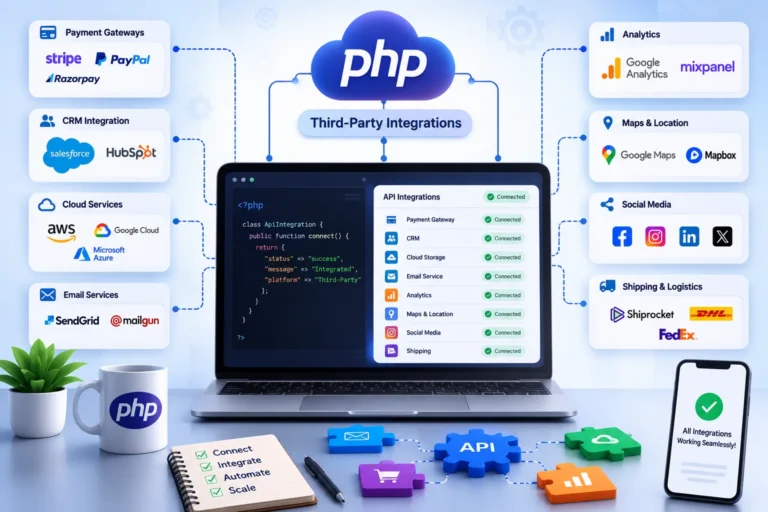
To extend functionality for any website or application, it needs to be integrated with other third-party platforms such as social media platforms, online payment gateways, databases, cloud servers, analytical tools, messaging platforms, email services, and CRM systems.
PHP has an extensive set of libraries and API support to integrate these third-party platforms to existing apps and websites.
Popular third-party services integrated with PHP: PayPal, Facebook, and Google Analytics
Content Management Systems

Websites today work when they are dynamic. It means they require constant update in content and more user interaction. A content management system is a software that helps you build and maintain such dynamic websites with ease.
Due to its server-side efficiency, database integration capabilities, and extensive library, developers can use PHP technology for building flexible and customizable content management systems.
Popular CMS built with PHP: WordPress, Joomla, and Drupal
Ecommerce Development

An ecommerce development platform is ideal for building websites when it ensures security, scalability, and proper database management. PHP is used for making such ecommerce platforms due to its efficient integration with third-party databases, built-in security features, and numerous frameworks offering cross-platform development. Its frameworks also support payment integrations, user authentication, and product management.
Popular e-commerce platforms made on PHP: Magento, PretaShop, and OpenCart
Enterprise App Development
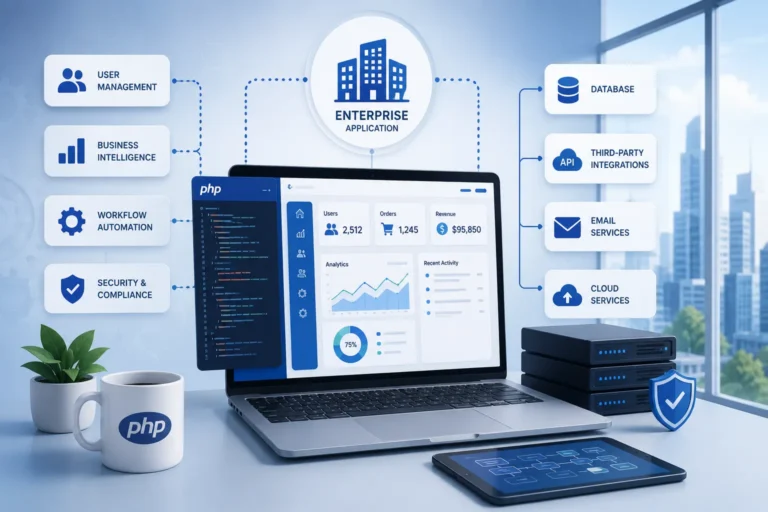
An enterprise app is meant to ease internal communication and management of an organization. From organizing workflows to maintaining extensive databases, it should be capable of everything. Following are some essential features it must have:
- Scalability
- Data protection
- Third-party integrations
- Database management
- Role-based access control
- Workflow automation
- Collaboration and communication tools
- Performance optimization
- Auditing
PHP is an open-source platform, thus making enterprise app development more cost-effective. Its robust frameworks like Laravel and Symfony have built-in modules for database interactions and user authentications. Other features like load balancing, cloud hosting, and caching systems allow it to build scalable and flexible apps.
Popular enterprise solutions built on PHP: Early versions of Slack, Moodle, and SugarCRM
Why Do Companies Continue to Use PHP?
PHP language has been existing for a long time, which makes it beneficial for companies. The experience of coders and programmers, the presence of additional tools, and the developed framework and systems are the reasons why companies continue to use PHP.
Besides, this programming language is easy to deploy and debug on existing hosting. For these reasons, it is not worth switching to another programming language for companies that are using PHP-based solutions.
However, it should be noted that the choice of PHP as the development language depends on certain factors. The volume of code, the capabilities of the system, and the skills of programmers are three main elements that have to be taken into consideration. Thus, PHP can be used in certain cases depending on the particular needs of the company and the task at hand.
Which Web Development Services Will You Need With PHP ?
Although PHP is mainly used in the development and implementation of backend services, this programming language has more capabilities than one might expect. For example, enterprises can use it for developing and deploying ecommerce systems and CMSs, enterprise apps and APIs, web portals, and custom business solutions.
Laravel and Symfony are just two examples of PHP frameworks and external libraries that can be applied to building and maintaining modern web apps. PHP can also be used for upgrading legacy systems that require constant maintenance, optimization, modernization, and improvement.
The selection of particular services depends on the companies’ requirements, technology stack, traffic, and strategic objectives. In this regard, an experienced team can advise you on which programming language, backend development framework, and tools to choose for custom web development.
PHP for Modern Web Applications
PHP has been around for some time and continues to be one of the most popular technologies among developers. The use of PHP is not limited to just coding simple websites or website back-end. Developers continue to use PHP to create applications, dashboards, portals, business solutions, cloud-based systems and platforms which require reliable server-side software.
Laravel, Symfony and other PHP frameworks offer a set of built-in functions that allow the developers to build applications faster and more secure. Also, using PHP in web development allows easier code maintenance and higher scalability in the future. A company can also rely on PHP as a flexible programming language and combine it with other languages and software. For example, PHP back-end could be combined with JavaScript, payment systems, clouds, external API and databases. Thus, PHP would scale better within a company than, say, Java or. NET.
PHP Application Modernization
The thing is that corporations with PHP applications are not obliged to develop them from scratch. Such programs can be upgraded gradually depending on the needs of the company.
For example, it is possible to modify the framework, work with the database of the application, strengthen its security, apply caching mechanisms and do other operations. In this way, PHP applications can be modernized in the most comfortable way for the enterprise without drawing attention to the functioning of the application.
Consequently, using such methods, PHP codes will be able to meet the needs of enterprises and expand in the future.
PHP for Custom Web Apps
PHP can be utilized to develop custom web applications for a company’s specific business logic. By using such technology, businesses can design applications around their peculiarities and workflows rather than adjust their operations according to the limitations of a monolithic platform.
Such software can be used to build customer portals, employee dashboards, booking systems, reports, membership management solutions, and other dashboard-based applications. PHP frameworks allow for developing applications with user management, databases, forms, APIs, and business logic customized to the extent needed. A custom application built with PHP can address a company’s unique requirements or a specific set of existing solutions that lack the necessary features for a business.
Custom PHP applications are particularly valuable in cases when the organization’s business processes are too specific to be covered by generic software. Such applications allow one to design only the necessary functions and features and further integrate them into the existing software ecosystem. In addition, they help in reducing the complexity of an enterprise’s operations and facilitate the introduction of various modifications and updates.
PHP for API & Web Service Development
Nowadays, almost any application uses some APIs to exchange data between disparate systems. Using PHP, you can design programs that act as interfaces for a website or web application and external tools such as payment systems, CRM, databases, etc.
By employing PHP frameworks, you can develop an API that will handle routing and authentication, accept and validate data from external sources. An API layer can be useful when you want to decouple business logic between different systems, for example, separate frontend and backend parts of a web application. Thus, PHP can be used to build custom business applications, allowing companies to integrate new digital services with their existing system, launch independent products, and scale their application architecture.
Which Web Development Services Will You Require with PHP?
PHP is primarily used for backend development services. Even though it is most popular for ecommerce and enterprise solutions, all kinds of blogs, websites, and progressive apps can be made using PHP. Along with being efficient, it has a vast community support that has encouraged many developers to use PHP frameworks. What does your brand require to build for hiring a PHP developer?