

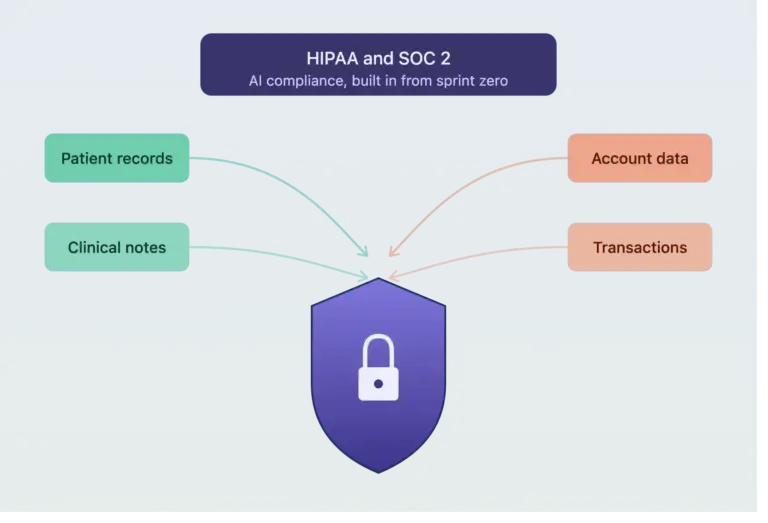
AI features in HealthTech and FinTech move faster than compliance can keep up, and that gap is exactly where teams get burned during a SOC 2 audit or customer security review. HIPAA and SOC 2 aren’t checkbox exercises — they’re architectural decisions about data flow, access logging, encryption, and vendor contracts that need to be made before the first prompt ships. The core moves: minimize PHI sent to models, use a compliance proxy to inspect/redact every model call, confirm BAA coverage per-endpoint (not just per-vendor), and bake AI-specific controls into your SOC 2 scope from cycle one — not as a bolt-on later.
- 1 SOC 2 and HIPAA overlap in AI pipelines — infrastructure controls and PHI controls share the same pipeline, so one control gap can jeopardize both audits at once.
- 2 Only the minimum necessary PHI should ever reach a model call, reducing blast radius if something leaks.
- 3 Auditors and buyers want to see who accessed PHI, why, and in what model interaction — not just that access happened.
- 4 Embeddings, caches, logs, and backups are often overlooked but are still PHI storage under HIPAA and must be encrypted throughout the stack.
- 5 A signed BAA with a provider doesn't automatically cover every API, model, or storage service you use — verify coverage per service, not per vendor.
AI features move fast. Compliance does not. That gap is where HealthTech and FinTech teams get burned, usually after a SOC 2 compliance audit or a customer review surfaces gaps nobody scoped. HIPAA and compliance work for AI systems is not a checkbox exercise you finish in a sprint. It is a set of design choices about data, access, logging and vendor contracts, made before the first prompt ever ships. The focus is on meeting HIPAA and SOC 2 requirements in AI applications, avoiding common mistakes and building products that are ready for review.
Disclaimer: This content provides general technical and compliance guidance and does not constitute legal advice. HIPAA obligations, SOC 2 requirements and vendor terms may vary by organisation, architecture and service configuration. Confirm specific requirements with qualified legal or compliance counsel and review current provider documentation before processing regulated data.
The Intersection of SOC 2 and HIPAA in Modern AI Engineering
SOC 2 and HIPAA solve different problems that now overlap in AI systems. SOC 2 hipaa alignment matters because your infrastructure controls and your patient data controls share the same pipeline. SOC 2 asks whether your systems are trustworthy across security, availability, processing integrity, confidentiality and privacy. HIPAA asks whether protected health information stays protected across every hop, including inference calls to external model providers. AI introduces additional exposure points, including prompts containing PHI, sensitive embeddings in vector stores and outputs that may disclose private data. Even one control gap can put both audits at risk.
Breaking Down HIPAA Compliance Requirements for AI Applications
HIPAA requirements for AI applications usually come down to how protected health information is collected, accessed, stored and shared. The model itself is only one part of the compliance picture. Teams also need to account for the surrounding data pipeline, infrastructure and third-party services.
- Limit PHI exposure: Only send the minimum amount of protected health information required for the specific task.
- Control and log access: Track who accesses PHI, why they access it and where model interactions involve sensitive data.
- Protect data throughout the stack: Encrypt PHI in transit and at rest, including data stored in vector databases, caches, logs and backups.
- Review third-party access: Put the required agreements and safeguards in place with cloud providers, model vendors and other processors that handle PHI.
Strong model performance does not compensate for weak data controls. A gap anywhere in the AI data flow can create a broader compliance issue, so these safeguards need to be built into the architecture from the start.
Critical HIPAA IT Requirements
HIPAA IT requirements did not anticipate LLMs, but the rules still apply. HIPAA security rules mean PHI cannot enter a prompt going to a model provider that lacks a signed BAA. Prompt logs that contain PHI count as PHI storage and must be governed by a defined retention and disposal policy. Note that HIPAA’s six-year retention requirement applies to required compliance documentation and certain audit and access logs, not to PHI itself, so treat those as two separate obligations rather than one blanket rule. Fine-tuning workflows need hard controls around PHI. De-identification should be enforced by the tooling, not left to manual checks.
Why Being SOC 2 Compliant Is the Foundation for AI Trust in FinTech
FinTech buyers ask for the SOC 2 compliance report before they ask about the roadmap. Being SOC 2 compliant tells that buyer your controls have been tested by a third party against defined criteria. For AI features, the SOC 2 Type 2 report is the one that matters, because it covers the operation of controls over time, not just design. Buyers will check whether you monitor model traffic, keep customer data separated across tenants and have a clear response process for model incidents. If the report is silent on any of those, procurement stalls. Bake AI-specific controls into your SOC 2 scope from the first audit cycle rather than adding them later.
Implementing HIPAA IT Compliance in Product Development
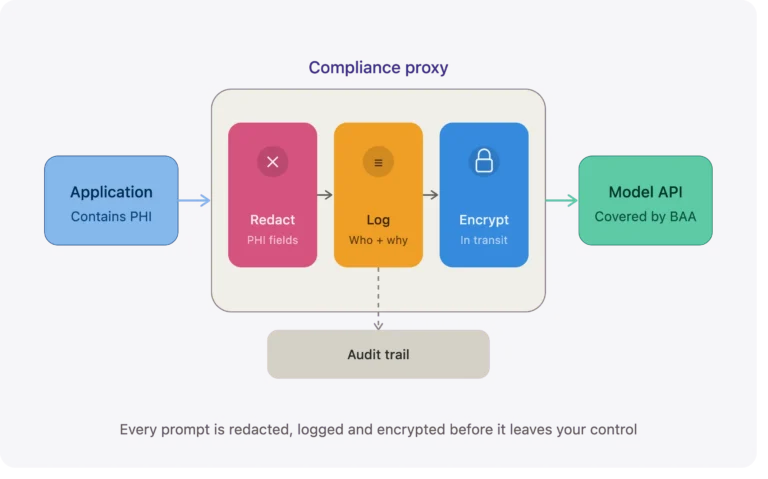
HIPAA IT compliance is easier when you build it in from sprint zero. Start with a data flow diagram that traces every PHI element from ingestion through every model call, cache and log. Add tenant isolation at the database layer, not just the application layer. Use a compliance proxy to inspect every model request, redact sensitive data and stop payloads that do not meet policy requirements. Log every access with actor, purpose and record identifiers. Ship a break-glass procedure for auditors that lets them replay any inference in a sandbox. Teams that skip the proxy and rely on developer discipline fail their first audit.
A Technical Comparison for Tech Founders
Founders often ask which framework to pursue first. The answer depends on the buyer and the data. This table maps the core dimensions.
| Dimension | SOC 2 | HIPAA |
| Scope | Service organization controls | PHI handling under US health law |
| Trigger | B2B SaaS buyer requests | Any workflow that touches PHI |
| Assessment | Third-party auditor, Type I or II report | Self-attestation with periodic risk analysis |
| Data focus | Any customer data | Protected health information only |
| Vendor contracts | Sub-service organization letters | Business associate agreements |
| Renewal | Annual for Type II | Ongoing, with breach notification triggers |
The Role of PII Scrubbing and Data Masking in HIPAA and Compliance
Among HIPAA and compliance controls, removing PII before model input is by far the most common one in practice. Run every prompt through a named-entity redactor that strips 18 HIPAA identifiers. Mask sensitive fields such as account numbers, dates and medical notes before they reach the model. Store the mapping in a separate encrypted vault.
What to Verify with OpenAI, AWS and Azure
A signed BAA is only the starting point when an AI application handles PHI. Coverage varies by provider, service and configuration, so teams need to confirm exactly what is protected before sending regulated data.
- Check service and endpoint coverage: Confirm that the specific API, model, storage service and supporting infrastructure you plan to use are covered under the applicable BAA.
- Review data-use terms: Verify how prompts, outputs and other submitted data are handled, including whether they may be used for model training or service improvement.
- Confirm retention and logging controls: Understand how long data is retained, what audit logs are available and whether your configuration meets internal HIPAA requirements.
Each provider handles HIPAA coverage differently. Teams should confirm the exact AWS services, Azure services and OpenAI API configurations covered before sending PHI.
How Innostax Builds Compliant-by-Design AI for Regulated Markets
Innostax builds AI products for HealthTech and FinTech teams where HIPAA IT compliance and SOC 2 alignment are non-negotiable. Every managed engineering team ships with a built-in tech lead, a compliance-aware architecture review and a multi-layer code review that flags PHI handling issues before they reach production. Our engineers also map every workflow against soc 2 compliance requirements so the audit trail is ready when procurement asks. A UK-based HealthTech company we work with uses this model to move quickly without carrying compliance debt into its next audit cycle. Build the compliance foundation first if your AI application will work with regulated data.
Future-Proofing Your AI Strategy Against Regulatory Risk
AI regulation will keep tightening. Teams that are SOC 2 compliant today, with HIPAA and compliance controls baked into their AI pipelines, spend less time on remediation and more time on product. Design compliance into the architecture, workflows and controls from the start.That is the shift that lets AI products in HealthTech and FinTech ship quickly and pass the audits that gate every enterprise deal.