

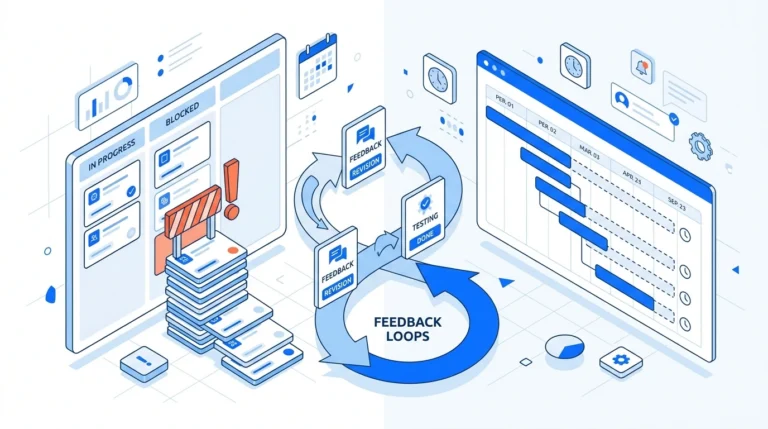
Features take longer than expected for three compounding reasons: scope that expands during development, complexity that was invisible at estimation time, and feedback loops — between QA and dev, between reviewers and code — that multiply the calendar time required to close a ticket.
None of these are execution failures. They are planning and process failures. A developer who takes longer than estimated on a poorly scoped ticket is not slow — the system that allowed vague requirements into a sprint is broken.
The fix is structure: requirements that are complete before development starts, estimation that accounts for edge cases and infrastructure state, work items small enough that drift is visible within 24 hours, and feedback loops that are tight enough to catch problems before they compound. Teams that operate this way consistently deliver on time. At Innostax, managing scope, uncertainty, and execution alignment proactively across 50+ client teams has produced predictable delivery where commitments are met with high accuracy.
- 1 Most feature delays are planning failures, not execution failures. Developers are rarely slow — requirements are usually incomplete.
- 2 Scope change is the leading cause of delays. 78% of software projects experience scope creep (Jobera, 2026). Every change during development must be treated as a new estimate, not absorbed into the original one.
- 3 Hidden complexity is predictable if you look for it. Legacy code, database schema constraints, and third-party integration gaps are discoverable before development starts — if the estimation process requires it.
- 4 Feedback loops multiply calendar time. A single QA rejection cycle can double the time a ticket spends in flight. Reducing first-pass failure rates is the highest-leverage fix available.
- 5 Small PRs and small tasks are not a preference — they are a delivery mechanism. Large branches block progress across multiple features simultaneously.
The Problem: Why Estimates Are Wrong Before Development Even Starts
Feature delays are not randomly distributed. They cluster around the same root causes on almost every project.
The most common pattern: a feature looks small at the ticket level but expands when development starts. Business rules that weren’t documented, exception flows that only become visible during implementation, client expectations that were implicit rather than stated — these are not surprises. They are predictable gaps in the requirements process. The feature was never fully defined; it was estimated as if it were.
A second pattern: complexity that exists in the codebase is not accounted for in the estimate. Legacy code behaves differently from greenfield. Database schemas built for earlier product states may not accommodate new features without migration work. Performance considerations that are irrelevant in early development become constraints at scale. None of this is unknowable — but it requires the estimating developer to look at the actual code, not just the ticket description.
The third pattern: the estimate is made on best-case assumptions. No rework, no QA cycles, no reviewer feedback, no interruptions. Real delivery involves all of these. An estimate that doesn’t account for feedback loops is not an estimate — it is a best-case scenario presented as a commitment.
According to McKinsey research, large IT projects run an average of 45% over budget and 7% over time, while delivering 56% less value than predicted (McKinsey, 2012). The root cause is consistent: optimistic estimation, not poor execution.
The Eight Root Causes of Feature Delays
1. Incomplete Requirements at the Start
The most common cause of delay is a requirement that looks complete at the ticket level but isn’t. When development begins, edge cases, complex business rules, and exception flows surface that were never documented. The developer either makes assumptions — which may be wrong — or stops to clarify, which costs time.
Every feature that enters a sprint without complete acceptance criteria is a delayed feature waiting to happen.
2. Underestimated Hidden Complexity
Estimates are made against ticket descriptions, not against the actual codebase. The codebase often contains constraints the ticket doesn’t mention: legacy code with undocumented behaviour, database schemas that don’t accommodate the new feature cleanly, performance requirements that only emerge under load. These are discoverable during estimation — but only if the estimating developer reviews the relevant code, not just the requirements.
3. Third-Party and Infrastructure Dependencies
Integrating with third-party services introduces a specific type of uncertainty: documentation that doesn’t reflect actual production behaviour. An API that works as documented in a sandbox environment may behave differently under real conditions. Infrastructure that hasn’t been upgraded to support a new feature adds work that wasn’t in the original estimate.
These dependencies are not unpredictable — they are under-investigated. A spike or proof-of-concept (POC) before estimation would surface them.
4. QA and Development Feedback Loops
Development completing on the first pass is the best case. In practice, QA identifies edge cases and regression points that send features back to development — sometimes multiple times. Each round trip adds calendar time that was not in the original estimate.
The QA-dev loop is the most controllable source of delay. Reducing the first-pass failure rate — through clearer acceptance criteria, better test coverage, and developer-led QA checks before handoff — directly reduces total feature time.
5. Code Review Cycles
Code review is a necessary quality gate, but it is also a source of delay when it is not managed as a workflow step. A pull request that sits unreviewed for a day costs the team a day. Substantial review comments that require another iteration add another cycle. When reviewers are occupied with other priorities, the feature waits.
The fix is not to reduce code review rigour — it is to treat PR review as a time-sensitive task with a defined SLA, not as an optional activity done when convenient.
6. Large PRs and Branch Accumulation
A single pull request containing multiple features creates a dependency chain: if one part fails review or QA, everything in the branch is blocked. This is one of the most avoidable sources of delay in engineering teams.
Small, independently deliverable PRs — ideally one feature or one logical change per branch — eliminate this dependency. Progress is visible on higher environments faster, and a failure in one area does not block others.
7. Scope Changes During Development
Client feedback during demos, UAT, or staging reviews introduces changes that are often framed as “small tweaks.” From the client’s perspective, a visual adjustment or a minor workflow change looks cosmetic. From the developer’s perspective, it may require significant rework at a stage when the code is already integrated and tested.
Every scope change after development has started must be re-estimated and treated as a new commitment — not absorbed silently into the original timeline.
8. Context Switching from Unplanned Priority Work
Production bugs, client escalations, and urgent hotfixes interrupt planned feature work. When a developer context-switches from a feature to an urgent fix, the original feature timeline is impacted — but the estimate is rarely updated to reflect this. The feature appears “late” when in reality it was deprioritised by a legitimate interruption that was never accounted for.
Teams that track interruptions separately from planned work have a much clearer picture of actual capacity versus committed capacity.
The Innostax Delay Prevention Framework
Innostax manages feature delivery across 50+ engineering teams using a three-layer framework that addresses scope, uncertainty, and execution alignment before they become delays.
Layer 1: Scope Control
Every feature that enters a sprint must have complete acceptance criteria — not a description of what to build, but a definition of what “done” looks like, including edge cases and exception flows. Requirements that don’t meet this standard are returned to the backlog for refinement, not estimated.
Scope changes that arise during development are treated as new work items with new estimates. The original estimate is not modified — the change is tracked separately, so the impact is visible to stakeholders rather than absorbed silently.
Layer 2: Two-Phase Estimation for Uncertain Work
When a feature involves third-party integration, new SDKs, or significant unknowns in the existing codebase, estimation is split into two phases:
- Spike / POC phase: A time-boxed investigation to validate assumptions, test integrations against real production behaviour, and identify infrastructure constraints. The output is a set of findings, not a deliverable.
- Committed delivery phase: An estimate based on real findings from the spike, not on documentation or assumptions.
This approach ensures that timelines are grounded in reality. An estimate made after a spike is significantly more accurate than one made against a ticket description alone.
Layer 3: Execution Alignment
Even well-estimated work can drift if tasks are too large, progress is not tracked, or blockers are not escalated quickly.
Execution alignment requires three things:
- Task granularity: No work item should exceed 24 hours of effort. At that size, drift is visible within one working day.
- Continuous velocity tracking: Progress is monitored against expected velocity throughout the sprint, not just at the end.
- Same-day blocker escalation: When a developer identifies a blocker, it is escalated the same day — not held for the next standup. A blocker held overnight costs the team a full working day.
The Delay Multiplier: How Small Issues Compound
Feature delays rarely come from a single cause. They compound. A requirement that was 80% complete leads to an assumption during development. The assumption is wrong, discovered during QA. The QA rejection triggers a rework cycle. The rework is reviewed by a reviewer who is now occupied with another priority. The PR sits for a day. By the time the feature ships, it has taken three times the original estimate — and each individual failure looked small in isolation.
| Delay Source | Typical Time Impact | Compounding Factor |
|---|---|---|
| Incomplete requirements | +1–2 days (clarification) | Triggers assumption errors downstream |
| Hidden complexity discovered in dev | +1–3 days | May require scope renegotiation |
| QA rejection (first pass) | +1–2 days per cycle | Can repeat 2–3 times |
| PR review delay | +0.5–1 day per cycle | Blocks merge and deployment |
| Scope change mid-sprint | +1–5 days | Invalidates existing work |
| Context switch (production bug) | +0.5–2 days | Breaks developer flow state |
The compounding effect is why features that were estimated at 3 days regularly take 8–10. No single event caused the delay — the system allowed multiple small failures to accumulate without correction.
Common Mistakes That Make Delays Worse
Absorbing scope changes into the original estimate. When a client requests a change and the team says “we’ll fit it in,” the original commitment becomes meaningless. Every change must be estimated separately and communicated as a trade-off.
Estimating from documentation, not from code. Third-party API documentation describes intended behaviour. Production behaviour is different. Estimating integration work without a spike is optimism, not planning.
Large PRs with multiple features. A single branch containing three features means a single QA failure blocks all three. Break work into the smallest independently deliverable units.
Treating QA as the last step. When QA is the first time a developer’s work is tested against acceptance criteria, rejection rates are high. Developers should validate against acceptance criteria before handoff — QA should be confirmation, not discovery.
Not tracking interruptions. A team that commits to 40 hours of feature work per sprint but regularly absorbs 8–10 hours of unplanned work is operating at 75–80% of committed capacity. Tracking interruptions separately makes this visible and allows for realistic sprint planning.
Waiting for standups to flag blockers. If a developer hits a blocker at 10am, it should be escalated at 10am. Holding it for the next day’s standup wastes a full working day and makes the delay look sudden rather than preventable.
Summary: The Delay Prevention Checklist
| Delay Source | Typical Time Impact | Compounding Factor |
|---|---|---|
| Incomplete requirements | +1–2 days (clarification) | Triggers assumption errors downstream |
| Hidden complexity discovered in dev | +1–3 days | May require scope renegotiation |
| QA rejection (first pass) | +1–2 days per cycle | Can repeat 2–3 times |
| PR review delay | +0.5–1 day per cycle | Blocks merge and deployment |
| Scope change mid-sprint | +1–5 days | Invalidates existing work |
| Context switch (production bug) | +0.5–2 days | Breaks developer flow state |
Innostax is a managed software development partner for B2B SaaS companies and funded startups. With 97% client retention across 50+ deployed teams, Innostax delivers engineering performance — not just development capacity.Learn how we work →