

An AI harness is the infrastructure wrapped around a language model — memory, tool access, permissions, and verification — that turns raw model output into safe, real-world action. As top models converge in capability, the harness (not the model) is what actually decides whether an agent holds up in production. A working one needs four pieces: state/memory, tool orchestration, identity/access controls, and verification loops. Skip any of them and you get an agent that drifts, forgets, or touches data it shouldn’t. When evaluating a vendor or planning a build, scrutinize the harness before the model.
- 1 An AI harness is the software layer wrapped around a model that handles tool access, memory, permissions, and verification — everything the model itself doesn't do.
- 2 The industry shorthand "Agent = Model + Harness" reflects a real shift: as top models converge in raw capability, the harness is what decides whether an agent actually survives production.
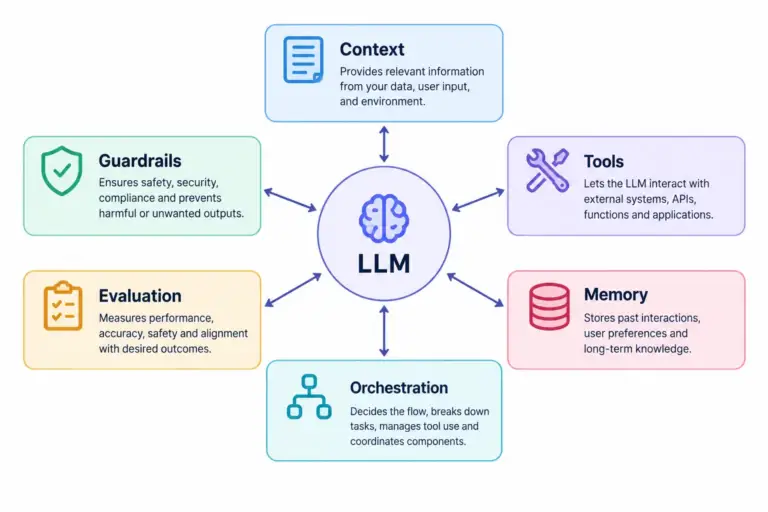
- 3 A working harness needs four pieces in place — state and memory, tool orchestration, identity and access controls, and evaluation loops. Skip one, and it shows up later as an agent that drifts, loops, or touches data it shouldn't.
- 4 When you're evaluating an AI vendor or planning an internal build, the harness deserves more scrutiny than the model. The model is increasingly a commodity; the harness is where the engineering work — and the risk — actually lives.
Introduction
Every engineering leader I talk to this year eventually says some version of the same thing: “our agent worked great in the demo and fell apart in week two.” Nobody blames the model first anymore. They blame the memory that didn’t persist, the tool call that fired without approval, the context that quietly filled up and pushed out something important. That’s not a coincidence. It’s the whole conversation shifting.
For a couple of years, the model was the story. Bigger context window, fewer hallucinations, better reasoning — pick the best one and ship it. That logic is running out of room. Top-tier models are close enough to each other now that picking the “smartest” one barely moves the needle. What moves the needle is the pile of code around the model: what it’s allowed to touch, what it remembers, who signs off before it acts. People have started calling that pile the harness, and if you’re shipping anything agentic this year, it’s worth knowing what’s actually in it.
What Is an AI Harness?
Strip it down and an AI harness is just the infrastructure sitting between a language model and the systems it needs to touch. The model does the thinking part — reads a prompt, works through it, spits out a response. Everything past that point — running a tool, hitting an API, writing to a database, remembering what happened five steps ago, checking whether it’s even allowed to do the thing it’s about to do — none of that is the model. That’s the harness.
A model can talk. It can’t act on its own, and it definitely doesn’t know what it’s allowed to act on. That’s the gap the harness fills.
This is easy to gloss over until you’ve watched it go wrong. A raw LLM has no memory across calls. Give it direct access to something like a production database with no layer in between, and one bad completion can turn into an afternoon nobody wants to have. The harness is the thing standing there checking every move before it happens, writing down what did happen, and pulling the plug before a mistake gets expensive.
Where the Term Came From
Credit for “Agent = Model + Harness” mostly goes to Mitchell Hashimoto, the HashiCorp co-founder, and it spread through the industry fast in 2026 because people needed a word for the part of an agent that wasn’t the model. Claude Code gets brought up constantly as the example everyone points to — the model behind it isn’t wildly different from what you’d get calling the API directly. What’s different is everything wrapped around it: file access, planning loops, sub-agent handoffs, checkpoints where a human has to say yes.
It’s not just a coding-tool thing. Support agents, research assistants, automation platforms — they all hit the same wall eventually. A smarter model doesn’t stop an agent from losing the thread fifty tool calls in, or from redoing work it already finished because a session restarted. Only the harness fixes that.
Harness vs. Wrapper vs. Orchestration Framework
People use these three words like they mean the same thing. They don’t, and mixing them up is a big reason vendor pitches get confusing.
- A wrapper is a thin skin over the model — takes text in, sends text out. It changes the look, not the capability.
- An orchestration framework — LangChain and its cousins — handles sequencing. What runs first, what runs after, how one step’s output feeds the next.
- A harness covers both of those and then some: identity and access management, audit logging, where memory lives, how old context gets compacted down, and the validation logic that decides whether an action is even permitted in the first place.
Engine and car is the analogy I keep coming back to. The model’s the engine. The harness is steering, brakes, the dashboard telling you something’s wrong, the seatbelt. A powerful engine with none of that just goes fast in a direction nobody chose.
The Four Parts of a Working AI Harness
Almost every harness I’ve seen that actually holds up in production ends up building the same four things, whatever the vendor calls them.

State and memory
Anything that runs longer than a few steps needs somewhere to put its progress that isn’t the model’s own context window. Offload it — database, file system, whatever fits — and have a plan for compacting the old stuff down before it piles up and starts crowding out what actually matters.
Tool orchestration
The harness is the one deciding which tools the model can reach for at any given moment, and it’s the one actually running them — parsing what the model wants, executing the call, handing back something structured the model can work with next.
Identity and access controls
This is the piece that gets skipped the most, and it’s the one that bites hardest when it’s missing. An agent should never be able to reach data the person operating it isn’t cleared to see. The model has no concept of “not allowed” on its own — that has to be enforced outside it.
Verification and evals
The checks that happen before a model’s output turns into a real action: validation loops, output parsing, a human in the loop for anything with real stakes, and logs detailed enough that someone can reconstruct what the agent did and why, after the fact. Skip this and you find out about problems the hard way — after they’ve already happened.
Why This Matters More Than Model Choice
A one-point difference on a benchmark leaderboard tells you almost nothing about what happens fifty tool calls into a real task, once small errors have had time to stack up. Long, multi-step reliability comes from the harness keeping the agent on track, not from whichever model edged out another by a fraction of a point on a static test.
That changes how you should be sizing up AI vendors, honestly. If one pitch leads with “we’re on the newest model” and another can actually walk you through their approval workflow, their audit trail, what happens when a step fails — trust the second one more. Especially if it’s touching anything that matters.
Common Mistakes Teams Make
I’ve seen more than one “AI agent” that turned out to be a single API call bolted onto a model with zero memory, zero access controls, and no way to recover if a step failed halfway through. The same handful of mistakes keep showing up:
- Treating the model as the whole system and tacking on tool access later, with no permission layer behind it — the classic “we’ll add security later” move that rarely happens.
- Letting conversation history pile up in the context window forever instead of compacting it, until the agent’s reasoning starts degrading and nobody notices why.
- Not building the audit log until after something’s already gone wrong, which is exactly when you need it and don’t have it.
- Giving the agent the same access as your most privileged human user, because scoping it down felt like extra work at the time.
None of that traces back to the model being weak. It’s the scaffolding around it, and that’s exactly why swapping in a “smarter” model so rarely fixes an agent that keeps misbehaving.
Building Your First AI Harness
If you’re moving something out of prototype and into production, this is roughly the order I’d tackle it in:
- Map what the agent actually needs to do. Not the wishlist — the specific tools, APIs, and data it needs for the task in front of it.
- Lock down access before you expand capability. Decide what it’s allowed to touch and enforce that at the harness level. A line in the prompt telling it not to isn’t enforcement.
- Get state persistence in early. Even a bare-bones external store beats leaning on context window memory the moment a task runs longer than a handful of steps.
- Build the audit trail from the start. Bolting it on after an incident is a much worse conversation to have than just building it in from day one.
- Put a person in the loop for anything irreversible. Money movement, data deletion, anything customer-facing — route it through a human until the agent’s earned some trust.
How Innostax Approaches Harness Engineering
Harness design is where most of the actual engineering time goes on the AI agents we build as part of our AI & Automation work — model selection is usually the easy, short part of the conversation. The harder questions are the ones that decide whether the thing survives contact with real customer data: how does it authenticate, what’s it allowed to touch, where does its state live across a task that spans days, who reviews its work before anything ships.
Whether that’s worth building in-house or bringing in help depends a lot on what you’ve already got. Teams with solid platform engineering can often build the access-control and logging pieces themselves and just need a hand with the agent-specific orchestration on top. Teams starting from less usually do better bringing in someone who’s already built the identity, memory, and verification layers — better than learning those lessons for the first time in production, on a system that’s already live.
Conclusion
The model used to carry the whole conversation. It doesn’t anymore. As the top models keep converging on raw capability, the harness — memory, tools, access control, verification — is what actually decides whether what you’ve built is useful infrastructure or a liability waiting for the wrong prompt to come along. Next time an AI project kicks off with “which model should we use,” it’s worth pausing on a different question first: who’s actually building the harness, and what’s the plan for the first time it gets something wrong?