


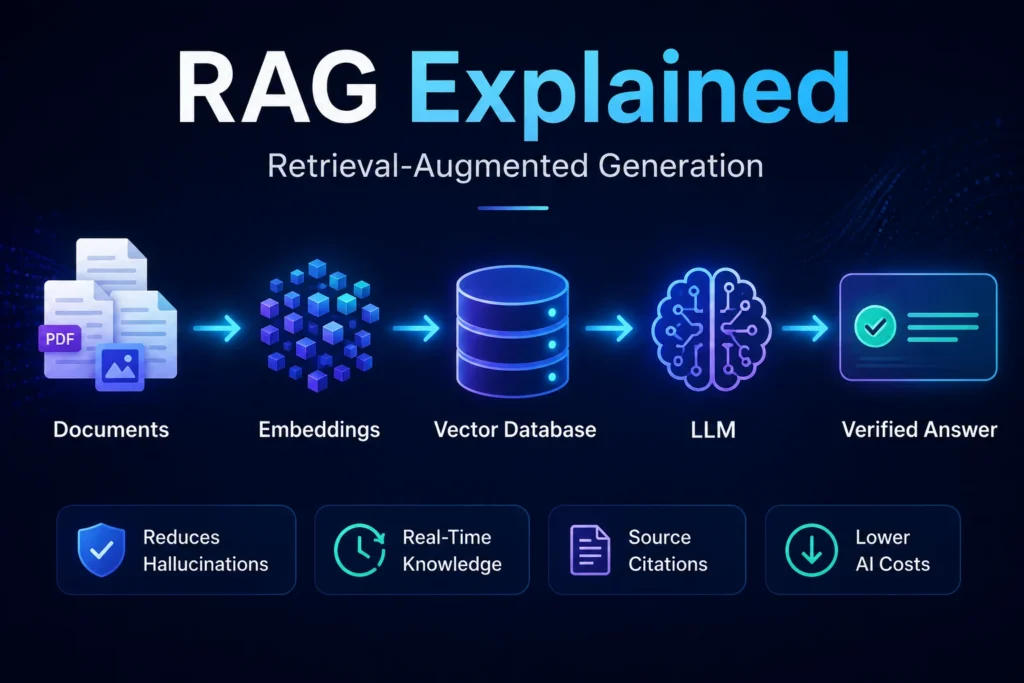
Generative AI often answers with total confidence even when it invents facts: wrong citations, fake features, made-up policies. Retrieval-augmented generation (RAG) fixes that by searching your knowledge base at query time and handing relevant document chunks to the model before it writes. This post covers how RAG works (ingest, embed, retrieve, generate), why citation-backed answers build trust faster than black-box responses, and when RAG beats fine-tuning for facts that change frequently. Ground the model in evidence; stop hoping it memorized the right answer.
- 1 RAG grounds LLM answers in your documents at query time instead of hoping the model memorized the facts.
- 2 Vector databases and embeddings retrieve relevant chunks; the model writes from evidence, not invention.
- 3 Citation-backed answers build trust faster because users can verify the source document and passage.
- 4 RAG beats fine-tuning when facts change often. Reindex docs in minutes instead of retraining for days.
- 5 Use RAG for live facts, docs, and records; reserve fine-tuning for style, tone, and repeatable task format.
What Is RAG (Retrieval-Augmented Generation) and Why It Stops AI From Making Things Up
Generative AI has one embarrassing habit: it invents answers with total confidence. Wrong citations, invented product features, made-up policies. That failure mode kills trust and kills adoption. Retrieval-augmented generation, or RAG, fixes it by grounding every answer in a knowledge base AI can search at query time. Instead of hoping the model memorized the right fact, RAG hands it the fact before it generates. This post covers what RAG is, how it works, why it beats retraining and how to build one that actually holds up in production.
Understanding the Generative AI LLM Hallucination Problem
A generative AI LLM predicts the next token based on patterns in its training data. It has no built-in signal for whether an answer is true. When the training data covers a topic well, the model sounds right and often is right. When the topic is niche, recent or proprietary, the model still sounds right but invents plausible-looking details. In enterprise use, many questions fall in the second category. Customer records, internal policies and product documentation live nowhere in public training data. Without grounding, the model fills the gap with fiction.
How RAG Works: Bridging the LLM Large Language Model With Real Data
RAG connects an LLM large language model to your own data at query time – the core of any serious AI integration effort. The flow has four steps. First, ingest source documents and split them into chunks of a few hundred tokens. Second, convert each chunk to an embedding vector and store it in a vector database. Third, at query time, embed the user question and retrieve the highest-matching chunks. Fourth, pass those chunks to the model as context and generate the final answer. The model still writes the response, but it writes it from evidence you supplied instead of what it half-remembers from training.
The Power of a Knowledge Base AI in Fact-Checking LLMs
A knowledge base AI turns the LLM from a guessing machine into a citation engine. Every answer can point to the exact document and passage it came from. Users see the source and can verify it. Auditors get a paper trail. Support teams stop debating what the AI said because the retrieved context is right there. Products that show citations get adopted faster than products that do not, because the trust barrier drops fast.
Information Retrieval AI vs. Standard LLM Training: Which Is Better?
Teams often ask whether to build an information retrieval AI system or fine-tune through further LLM training. The answer depends on the data and the change rate.
| Dimension | Information retrieval AI (RAG) | LLM training / fine-tuning |
| Fits | Facts, docs, records, live data | Style, tone, task format |
| Update cost | Reindex changed docs, minutes | Full retrain, hours to days |
| Cost model | Storage plus per-query retrieval | One-time compute plus hosting |
| Traceability | Cites source passages | Opaque, no citation |
| Data freshness | Real time | Frozen at training time |
Why Rerunning LLM Training Is Not the Solution for Dynamic Data
Rerunning LLM training every time a document changes is not feasible. Fine-tuning cycles cost engineering time and compute. Every retrain risks regressions on tasks that used to work. Dynamic data needs a retrieval layer, not a new model version.
Building the Stack: Essential Components of Knowledge Base in AI
A production knowledge base in AI systems needs six components. A document ingestion pipeline that handles PDFs, HTML, tables and scanned images. A chunking layer that respects semantic boundaries rather than fixed token counts. An embedding model that matches your domain, general purpose or specialized. A vector database that supports metadata filters and hybrid search. A retrieval layer that reranks results before passing them to the LLM. An evaluation loop that measures answer quality against a labeled test set. Skip any of these and answer quality drops in ways that are hard to debug later.
Information Retrieval AI: Semantic Search vs. Keyword Search
Information retrieval AI works well when semantic search and keyword search run together. Semantic search finds passages that mean the same thing as the query. Keyword search finds passages that share exact terms. Hybrid retrieval combines both and reranks the results. That combination outperforms either method alone on typical enterprise data.
The Business Case: Reducing Software Development Costs With RAG
A generative AI LLM connected to your knowledge base cuts development cost in three ways. You skip expensive fine-tuning cycles. You add new content by updating documents, not code. You reduce support tickets because users get grounded answers instead of vague ones. Teams that adopt RAG early ship AI features faster and iterate cheaper than teams that keep retraining.
The Innostax Approach: Custom RAG Implementation for Enterprises
Innostax builds custom knowledge base AI systems for enterprises that need grounded answers on proprietary data. Our managed engineering teams handle the ingestion pipeline, the embedding and retrieval layers, the reranking model and the evaluation application that keeps quality measurable. Every build ships with a tech lead who has run RAG in production and knows where the failure modes hide. If your generative AI project is stuck at the demo stage because the answers are not trustworthy, talk to us.
Conclusion: Moving Toward Fact-Based Generative AI
The future of applied AI is grounded, cited and auditable. An LLM large language model on its own is a powerful writer, not a reliable source of truth. Pair it with a well-built knowledge base AI and it becomes both. The teams building serious AI products in 2026 are spending more time on their retrieval layer than on their prompt library. That is the shift that separates AI features that survive from AI features that get pulled.