

In-house and outsourced QA catch different bugs, and picking one model alone leaves gaps in production. In-house teams own domain edge cases and product advocacy. Outsourced QA brings fresh eyes, cross-browser and load coverage, and security depth. This post compares bug detection efficiency by category, hidden TCO on both sides, how to vet QA outsourcing partners on a real sprint pilot, and why a hybrid model often beats either extreme. Measure escape rate and coverage trend, not marketing decks.
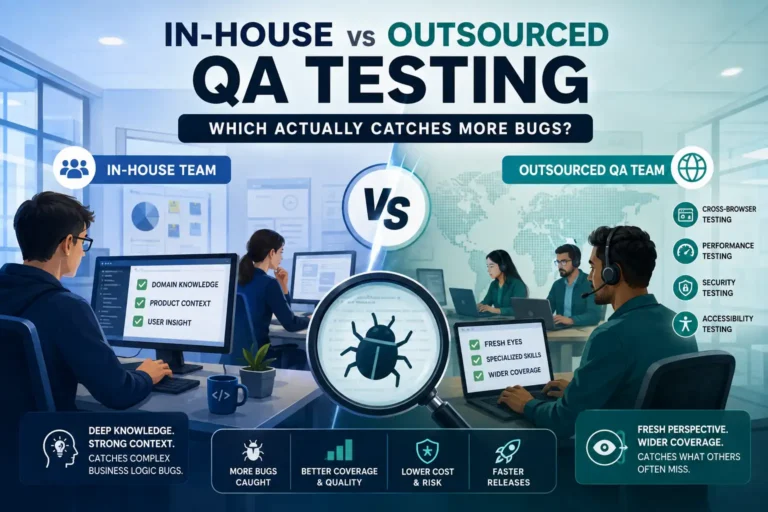
- 1 In-house QA wins on domain edge cases and product context; outsourced QA wins on cross-browser, load, accessibility, and security coverage.
- 2 Modern outsourced QA joins sprints and issue trackers. End-of-cycle handoff is the outdated model that gives the category a bad name.
- 3 Bug detection efficiency matters more than hourly rate. Track escape rate, coverage trend, and defect quality, not invoice size alone.
- 4 Vet QA vendors with a paid pilot sprint. Score escape rate, automation depth, and reporting before signing a long contract.
- 5 A hybrid model keeps in-house product context and adds outsourced fresh eyes, specialized skills, and automation volume.
In-House vs Outsourced QA Testing: Which Actually Catches More Bugs?
The in-house versus outsourced QA debate rarely ends. In-house teams know the product is cold. Outsourced qa services bring fresh eyes and specialized skills. Both models catch different kinds of bugs, and picking the wrong one leaves gaps that show up in production. This post compares the two on the metric that actually matters, bug detection efficiency, alongside cost, security and speed. It also covers the hybrid model that gets the strengths of each without the tradeoffs.
The Evolution of Software Testing Outsourcing in the Agile Era
Software testing outsourcing looks nothing like it did ten years ago. The old model was end-of-cycle: developers finished a build, threw it to an offshore QA team and waited for a report a week later. Modern outsourced testing integrates into every sprint. Vendors join daily stand-ups. Test engineers own tickets in your issue tracker. Automation runs on every PR. The pattern that once introduced delays now removes them. The vendors still operating on the old model give the whole category a bad name. The modern ones are indistinguishable from an in-house team on velocity.
The In-House Advantage: Deep Domain Knowledge and Cultural Alignment
In-house quality assurance testing teams know your product, your users and your risk areas. That knowledge catches bugs no external tester would find, because they require context: which customer segments hit which paths, which edge cases matter to which buyer, which regressions have burned before. Cultural alignment matters too. In-house testers advocate for quality in product meetings, push back on rushed timelines and own on-call rotations. External teams cannot replicate that entirely.
The “Fresh Eyes” Effect: Why You Should Outsource QA Testing
The reason to outsource QA testing is the same reason peer code review works: outside eyes catch what inside eyes miss. In-house teams develop blind spots. Certain code paths get tested reflexively; others get skipped because the team knows the developer would never make that mistake. External testers do not carry those assumptions. They test the boring paths and find bugs on lines nobody looked at. This effect is measurable and compounds when the external team rotates specialists across projects.
Comparing Bug Detection Efficiency: In-House vs. Outsourced QA Services
Bug detection efficiency is the metric that decides this debate. This table shows how each model performs across bug categories, drawn from field observations across delivery engagements.
| Bug type | In-house strength | Outsourced strength |
| Domain-specific edge cases | High | Medium |
| Cross-browser and platform | Medium | High |
| Security and compliance | Medium | High |
| Performance under load | Medium | High |
| Accessibility | Low to medium | High |
| Usability and UX | High | Medium |
| Regression from refactors | Medium | High |
Cost Realities: The Hidden Price of Quality Assurance Testing
Quality assurance testing costs more than salary alone. In-house TCO includes recruiting, training, tool licenses and management overhead. Outsourced pricing looks high per hour and often lower on total cost, especially in year one.
How to Vet QA Outsourcing Companies for High Bug Coverage
Vetting QA outsourcing companies for bug coverage starts with a paid pilot on a real sprint. Score them on escape rate, coverage growth and defect quality. Ask for their test framework: do they write maintainable tests or throwaway scripts? Check their tool stack: modern automation on browser, API, mobile and load. Verify their reporting: coverage numbers alone are meaningless without escape rate context. A pilot answers these questions in one sprint, and no marketing deck can substitute.
The Risk Factor: Security and Data Privacy in Outsourcing
Outsourced QA services touch production-adjacent data and sometimes production itself. Verify the vendor has SOC 2 Type II. Ask about data residency: some verticals require test data to stay in the region. Understand how they handle offboarding: what happens to code and data when a tester rotates off your account. Weak answers on any of these are reasons to move to the next vendor. Strong vendors treat security as a differentiator, not a compliance checkbox, and can walk you through their controls without hesitation.
The Innostax Hybrid Model: Combining In-House Speed With Outsourced Rigor
Innostax runs a hybrid QA model where your in-house team keeps domain and product context, and our outsourced QA services add fresh eyes, specialized skills and automation depth. Our QA engineers join your sprints, own tickets in your tracker and report against escape rate and coverage. Your team keeps the strategic work; ours handles the volume and the coverage growth. Talk to us before your next major release if this pattern fits your team shape.
Metrics That Matter: Measuring the Success of Your QA Partner
The QA outsourcing services engagement that delivers is measurable. Track escape rate, the share of bugs found in production versus caught before. Track coverage trend, not absolute coverage, since directional matters more. Track defect quality: real bugs versus noise. Track mean time from defect to fix. A vendor that improves these numbers quarter over quarter is delivering. A vendor whose numbers plateau or drift is coasting.
What Happens When QA Ownership Is Unclear
One hidden weakness in both QA in-house and QA outsourced models concerns ambiguity around responsibility for specific categories of bugs. When a team splits testing duties between in-house and outsourced QA but leaves it vague what categories of problems each should be testing for, gaps in coverage typically emerge in the intersections between what each team considers their remit.
An in-house QA tester could reasonably expect a cross-browser edge case to be caught by the outsourced QA team, and an outsourced QA tester could reasonably expect a domain-specific edge case to be caught by internal QA, both of whom could be wrong at the same time. This is a risk that comes with trying to create a hybrid model without establishing clear boundaries around whose QA testing covers what; teams that avoid that trap often explicitly document, and return to regularly, what categories of testing each QA team is responsible for, rather than assuming that the original split of responsibilities will always make sense.
The Onboarding Curve Nobody Budgets For
Whether in-house or outsourced, QA testing has a ramp-up period that rarely gets factored into budgets, wherein the new QA team (internal or external) learns enough about the product to begin truly understanding where its bugs are. Internal QA testers need to learn not just the product but its history and pain points, in order to avoid rediscovering the same lessons the company has had to learn the hard way, while outsourced QA testers, for all their skill, need a comparable period to acquire the same contextual knowledge before their testing can become as effective as it theoretically should be, a difference that often manifests most noticeably in the difference between a vendor’s first and fifth sprints.
Companies that assume either in-house or outsourced QA to be immediately productive often find themselves disappointed by early results that don’t reflect the eventual quality of the partnership; factoring in the learning curve for any new QA team, internal or external, is critical to avoiding the disillusionment that comes with low early returns.
Why Test Data Quality Shapes Everything Downstream
A detail that is frequently overlooked in discussions of in-house versus outsourced QA is that, regardless of where testing responsibilities are based, testers are only ever as good as the data they’re testing with, making test data quality one area where in-house QA can have a clear advantage over external QA. Internal testers typically have access to, and thus can base their testing on, actual production data in ways that an outsourced QA team never could, a factor that can make all the difference in the quality of the test cases generated, and by extension the quality of bugs found.
Outsourced QA testers, for their part, are likely to spend the first few sprints using more generic test data before they can begin generating production-quality test scenarios, a disadvantage that can be mitigated in a hybrid QA model by letting the external QA testers supplement rather than replace internal QA resources. The combination of an in-house QA team’s access to production data and an outsourced QA team’s capacity to generate fresh test scenarios with specialized tools often leads to test coverage that neither team could achieve working alone.
The Communication Overhead That’s Easy to Underestimate
While it’s simple enough to imagine an outsourced QA team fitting into a given sprint cycle, the increased communication overhead that such an addition entails rarely gets considered before it becomes a concrete problem. The more layers of QA a project has, the more steps are required to get a single bug fixed, which means that a QA tester discovering a bug in production has to communicate with multiple people (first the product owner, then the developer) before it can be fixed, as opposed to a QA tester in the same office as the developer who can simply ask them directly.
This sort of increase in friction doesn’t cancel out the benefits of an outsourced QA team, but it does create project management headaches that a project manager can mitigate by structuring communication between internal and external QA in a way that minimizes the number of people any given bug has to pass through before being acted on. Teams that see the most success in their outsourced QA arrangements tend to give external QA testers access to the same tools and communication channels (issue trackers, Slack channels, stand-up meetings, etc.) as their internal QA counterparts, as opposed to making them request assistance through a dedicated liaison, the value of which is often sharply discounted by people who find themselves spending too much time in the position of having to relay information from one channel to another.
Conclusion: Choosing a Partner for Uncompromising Quality
Outsourced QA services and in-house teams are not opposed. They cover different bug categories and different risk profiles. The teams that ship the fewest bugs use both, matched to what each does well. Pick a hybrid model where possible, vet outsourcing partners on real work and measure the numbers that predict quality. Quality is a compounding advantage, and the partnership that produces it is worth the effort to get right.