


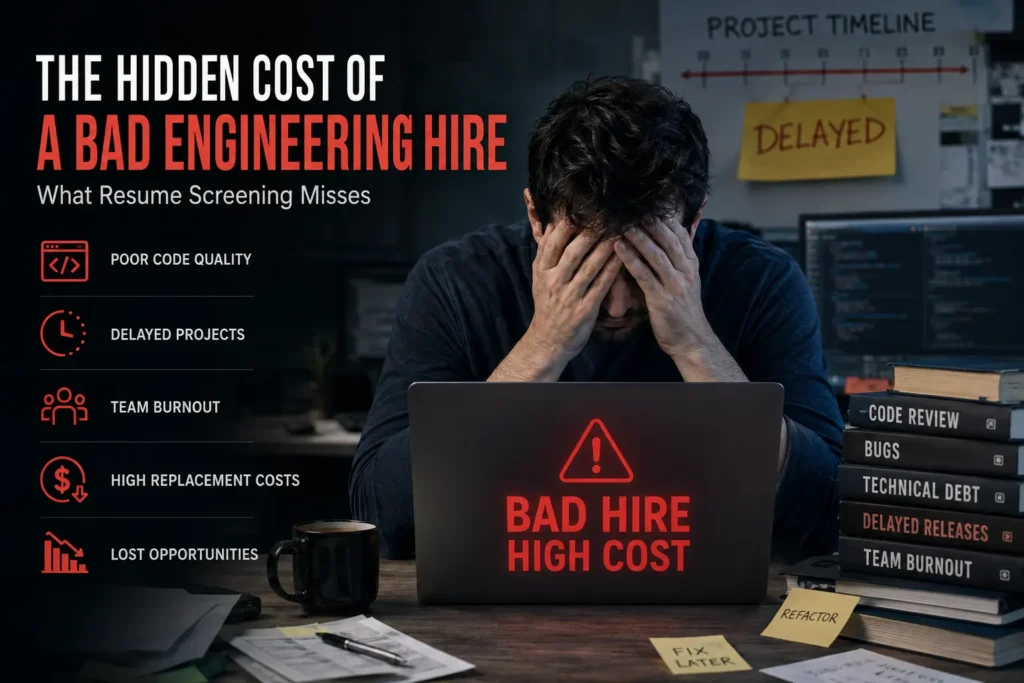
A bad engineering hire costs far more than salary — recruiting, senior cleanup time, delivery slippage, technical debt, and attrition among the engineers who cover the gaps. Yet many teams still filter on resumes, run one algorithmic interview, and hope. This post breaks down what resume screening misses, how poor hires scar your codebase, and what a better process looks like: scored work samples first, rubric-based behavioral interviews, specific reference checks, and a 30-day onboarding plan that surfaces mismatches early. Audit talent with real work, not keywords.
- 1 A bad senior hire can exceed 150% of salary once cleanup, slippage, and senior-engineer drag are counted.
- 2 Resume screening rewards keywords and brand names, not production debugging or clear communication.
- 3 Poor hires leave technical debt in the repo that can take two engineers a full quarter to clean up.
- 4 Strong engineers who cover for weak hires burn out and leave, which is the delayed cost of the original mistake.
- 5 Lead with a scored work sample before live interviews. It surfaces real engineering behavior faster.
The Hidden Cost of a Bad Engineering Hire: What Resume Screening Misses
A bad engineering hire does not just cost you a salary. It costs shipping velocity, code quality, senior time and, eventually, morale. The cost of a bad hire in engineering runs anywhere from 30 percent of annual salary to more than 200 percent when you count the cleanup. Yet many teams still filter candidates by resume, run one algorithmic interview and hope. This post breaks down what resume screening misses when hiring software engineers, and what a better process looks like when the goal is quality delivery.
Calculating the True Cost of a Bad Hire in Your Engineering Team
The cost of a bad hire has four components typical calculators skip. Direct compensation over the tenure. Recruiting cost for the original hire and the replacement. Senior engineer time spent unblocking and cleaning up. Delivery slippage on features the team could not ship. A single bad senior hire held for six months can cost 150,000 US dollars in salary alone, plus another 100,000 in team drag. That is before you count the customers who churned because releases slipped.
Why Traditional Resume Screening Fails When Hiring Software Engineers
Resumes are optimized for keywords, not judgment. Hiring software engineers on resume signals is selected for people who know how to write a resume. It does not select for people who write good code, communicate with product managers or debug production incidents. Recruiters and hiring managers reading 300 resumes for one role default to pattern matching on brand names, years of experience and framework acronyms. That filter passes strong candidates and blocks stronger ones. The signal-to-noise ratio at the front of the funnel is worse than teams admit.
The Technical Debt Trap: How a Bad Hire Compromises Your Codebase
A bad hire does not just fail to ship. They ship the wrong thing and leave it in the repo. Poorly structured modules, tests that pass by accident, features that skip error handling, dependencies added without review. Each of these becomes technical debt the rest of the team pays down for months. Senior engineers spend more time in code review explaining basics. Product managers stop trusting estimates because everything takes longer than promised. The impact compounds. By the time leadership decides to let the hire go, the codebase already carries the scars. Cleaning up after a bad senior hire can take two engineers a full quarter.
Beyond the CV: What Technical Hiring Processes Often Overlook
Technical hiring processes rarely test the skills that separate strong engineers from adequate ones. Many interviews cover algorithm puzzles and system design at a whiteboard. Few cover the reality of production work: reading unfamiliar code, writing tests that actually catch bugs, arguing about trade-offs and communicating with non-engineers. Add those to your loop – alongside the same structured vendor-style screening we recommend for engineering hires – and your signal improves in one cycle..
The Recruitment and Hiring Process: Redesigning for Developer Quality
A redesigned recruitment and hiring process leads with a short work sample, not a long-form resume review. Ask candidates to review a small pull request, debug a real issue or extend a small module. Score the output blind, against a defined rubric. Only then bring the strongest candidates into live interviews. This flips the funnel: you spend less time reading resumes and more time evaluating actual engineering behavior. Teams that make the switch report better hires and shorter time to fill.
Practical Strategies to Hire Software Developers Who Actually Scale
Strategies to hire software developers who scale share five things. Real work samples over puzzles. Behavioral interviews scored against a rubric. Reference checks that ask for specifics, not opinions. Paid trial projects for senior candidates. Onboarding plans that surface underperformance in the first 30 days, not the first quarter.
| Strategy | What it replaces | Why it works |
| Real work sample | Algorithmic puzzles | Tests the actual job |
| Rubric-scored behavioral | Chat-style culture fit | Reduces halo bias |
| Specific reference check | Generic “would you rehire” | Surfaces real issues |
| Paid trial project | Extended interview loop | Two-way evaluation, real code |
| 30-day onboarding plan | Sink or swim | Surfaces mismatches fast |
Morale and Attrition: The Human Cost of a Hiring Mistake
Hiring software engineers who cannot carry their weight burns out the ones who can. Strong engineers who have to redo work, cover for missed commitments and mentor without reciprocation start looking for exits. Attrition among your senior team is the second invoice for the original bad hire.
Why Innostax Prioritizes Vetted Talent Over “Paper Experience”
Innostax runs managed engineering teams where every engineer has been vetted by senior leads, tested on real work samples and paired with a tech lead who owns the delivery. When you hire a software developer through us, you skip the resume lottery and the onboarding tax that follows. We ship engineers who are productive in the first week and stay productive because they work inside a system that supports them.
Conclusion: Moving From Resume Filtering to Talent Auditing
The recruitment and hiring process many teams inherited was built for a different market. Resume filtering worked when the funnel was smaller and the roles were narrower. In 2026, with more applicants and higher variance in quality, hiring software engineers means auditing for talent with real work, not filtering for keywords. That shift is what turns hiring from a risk into a compounding advantage.
If your hiring process is still filtering on resumes alone, talk to us about how we vet for real engineering signals.