


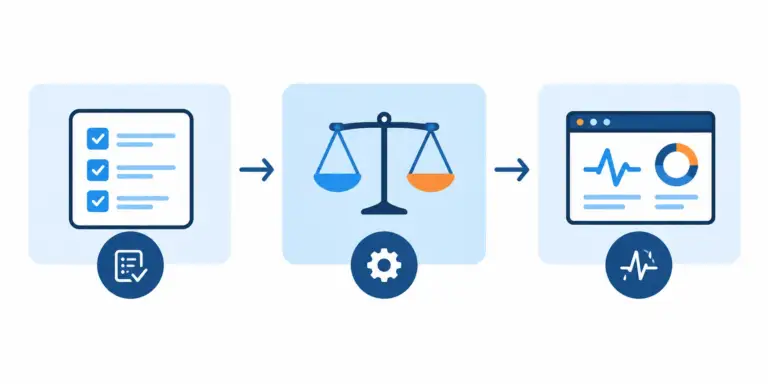
AI evals are structured tests that score how an AI system performs against a rubric, not a fixed expected output, since model responses vary even when the input doesn’t. A working setup has three layers: offline tests before release, automated scoring (rule-based checks plus LLM-as-judge), and production monitoring after release to catch drift. Build it in six steps: define success in plain language, build a golden dataset of 50 to 200 real examples, write the rubric before picking a tool, wire scoring into CI/CD, sample production traffic weekly, and feed real failures back into the dataset. The programs that fail usually skip the human review step, treat evals as a one-time launch gate, or let the eval set go stale instead of growing it.
- 1 AI evals are structured tests that score how well a model or AI application performs against defined criteria: accuracy, relevance, safety, tone, task completion.
- 2 Traditional software testing checks outputs against fixed expected results. AI evals have to grade a range of acceptable answers instead, because model outputs aren't deterministic.
- 3 A working eval framework has three parts: offline testing before release, automated scoring, and production monitoring after release.
- 4 The failure mode that actually kills eval programs isn't a bad model. It's an eval set that stops growing and quietly stops reflecting how people use the product.
- 5 Evals work best wired into CI/CD like any other test suite, not run once before launch and forgotten.
Every team shipping an AI feature eventually hits the same wall. The demo worked. The pilot worked. Then it went live, and somewhere between happy-path testing and actual users, things started breaking in ways nobody predicted. A chatbot invents a return policy that doesn’t exist. A summarizer drops the one sentence that mattered. A coding agent writes something that compiles fine and does the wrong thing anyway.
I’ve watched this happen on more than one project, and it’s almost never the model’s fault in the way people assume. The teams that catch these problems early aren’t running the smartest model. They’re the ones who built a real way to measure whether the AI is actually doing its job, before a customer finds out the hard way. That’s what people mean by “AI evals,” and treating it as an afterthought is probably the single most common mistake I see teams make right now.
This guide walks through what AI evals actually are, why the QA process your team already has doesn’t cover them, and how to build an evaluation framework that catches problems before your users do.
What an AI eval actually is
An AI eval is a test that scores how well an AI system performs a task, using a dataset and a rubric. That’s the whole idea. The hard part is that AI outputs aren’t deterministic. Ask a language model the same question twice and you can get two different, both reasonable, answers. A normal unit test assumes one input always produces one output. Evals have to grade a range of acceptable outputs instead of checking for an exact match.
It helps to think of it as the difference between grading a multiple-choice exam and grading an essay. Multiple choice has one right answer per question. An essay needs a rubric. Did it answer the prompt? Is it factually accurate? Did it stay on topic? AI evals are essay grading, done thousands of times a day, usually by another model acting as the judge.
For engineering leaders, this changes where quality control has to sit. You can’t bolt evals on after the fact the way you might add logging later. They need to be part of how the product gets built from the start, or you end up retrofitting them under pressure after something has already gone wrong in production.
Why this matters more now than it did a year ago
Two years ago, most AI features were experiments: a chatbot widget you could turn off, a summarization add-on nobody depended on. That’s not true anymore. AI now sits inside checkout flows, support escalations, and internal tools that touch financial data, plus a growing amount of code that ships straight to production. When something goes wrong, the blast radius is bigger, and so is the cost of not catching it.
There’s a technical reason evals matter more now too. Models change underneath you. A vendor pushes an API update. A prompt that worked reliably in March starts producing subtly different answers in September, and nobody notices until someone complains. With a baseline eval suite, a model or prompt change becomes a pull request that either passes or doesn’t, the same discipline engineering teams already apply to everything else they ship.
There’s a business case behind this too, and it’s not abstract. Rebuilding trust after a visible AI failure, a wrong medical disclaimer, a fabricated legal citation, a support bot promising something the company can’t deliver, costs a lot more than the engineering hours it takes to build an eval pipeline in the first place.
The three layers of a working eval framework
Reliable AI systems in production tend to get tested at three separate points, not just one.
Offline evals, before release
This is a fixed dataset of test cases, pulled from real user queries plus known edge cases and adversarial prompts, run against the model before anything ships. Each case has an expected outcome or a rubric for grading the response. Offline evals answer one question: is this version better or worse than the last one?
A good offline set doesn’t stay static. It grows every time something breaks in production. If a user finds a way to make the chatbot say something off-brand, that exact case gets added to the suite so it never quietly regresses again.
Automated scoring, LLM-as-judge and rule-based checks
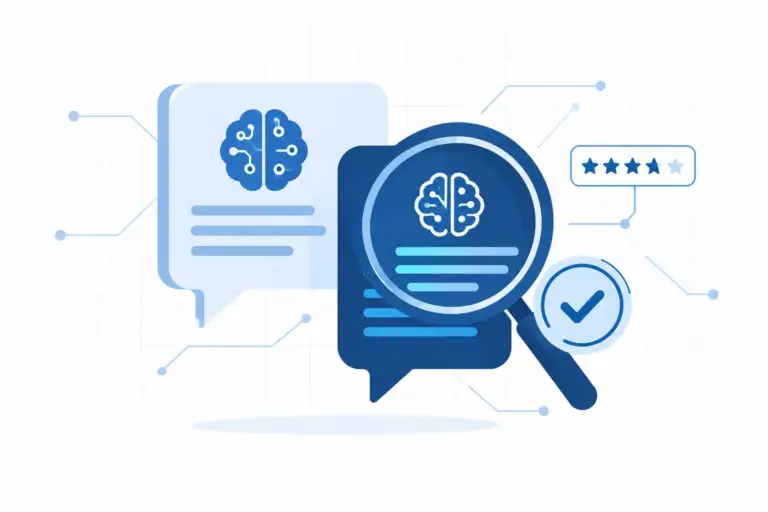
Grading thousands of open-ended responses by hand isn’t realistic, so most teams combine two approaches. Rule-based checks handle whatever can be verified mechanically: did the response include required disclaimers, did it stay under a length limit, did it avoid banned terms, is the JSON valid. LLM-as-judge scoring uses a separate model, prompted with a clear rubric, to grade the more subjective stuff: tone, helpfulness, whether the answer is actually grounded in the source document.
LLM-as-judge isn’t perfect, and I’d be skeptical of any vendor who tells you otherwise. It has its own biases and blind spots. Teams that lean on it heavily still spot-check with human reviewers on a sample of results, especially for anything customer-facing.
Production monitoring, after release
Offline evals only cover the cases someone thought to test for. Production monitoring catches the rest: the queries nobody anticipated, the ways real users phrase things differently than the test set assumed. Usually this means logging a sample of live interactions, running them through the same scoring rubric, and flagging anything below threshold for a human to look at.
This is also where drift shows up. A model that scored well on your offline suite in January can quietly get worse by June, either because whatever it’s grounded in has gone stale or because usage has shifted toward queries the eval set never covered.
Building your first eval pipeline
For a team starting from nothing, the sequence usually looks something like this.
- Define what success looks like in plain language, before you write any code. Get product and engineering to agree on what “good” means for this specific feature. “Helpful and accurate” doesn’t translate into a rubric. Something like “correctly extracts the invoice total and date, refuses to guess when the document is unreadable, never invents a vendor name” does.
- Build a golden dataset. Pull somewhere between 50 and 200 real examples that reflect what the system will actually see, edge cases included. Synthetic data can fill gaps, but it shouldn’t replace real examples.
- Write the rubric before you pick a tool. Decide what a passing response looks like, in writing, before deciding whether to use an open-source eval library, a vendor platform, or a script you wrote yourself. The rubric is the hard part. The tooling is the easy part, even though it doesn’t always feel that way.
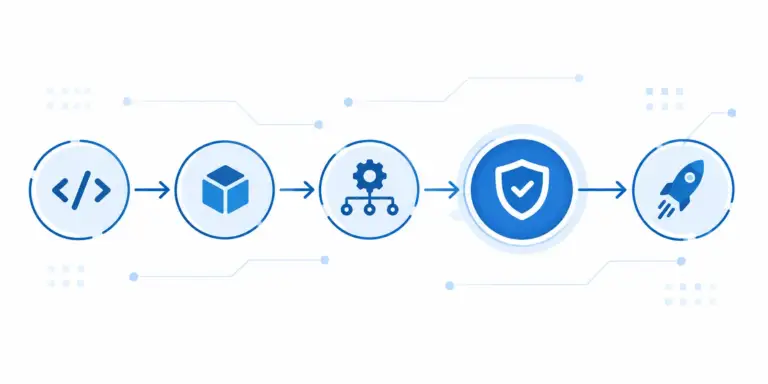
- Wire scoring into CI/CD. A prompt or model change should trigger the eval suite automatically, the way a code change triggers unit tests. Flag anything that drops below threshold before it merges.
- Sample production traffic on an ongoing basis. Set up a lightweight process to pull a percentage of real interactions each week, score them against the same rubric, and route anything borderline to a human reviewer.
- Feed real failures back into the golden dataset. Every failure that happens in the wild becomes a new test case. This is the step that keeps a suite useful instead of stale.
Where eval programs tend to break down
Overfitting to the eval set is the most common one. When engineers can see every test case, there’s a natural pull toward tuning prompts until those specific cases pass without actually improving general performance. Keeping a holdout set the team doesn’t look at while iterating helps with this.
Vague rubrics are another. “Sounds professional” means something different to every reviewer who reads it. Rubrics need criteria you can actually check, or your LLM-as-judge scores turn into noise you can’t trust.
Skipping the human review step causes problems too, particularly on anything with real stakes: legal, medical, financial, anything safety-related. Fully automated scoring is efficient, but a human still needs to look at a sample, even a small one.
Treating evals as a one-time launch gate instead of an ongoing process is a slower failure, but it’s a real one. A pre-launch eval catches the obvious stuff. It won’t catch drift six months later when the model provider changes something upstream or usage patterns shift in a direction nobody planned for.
And it’s easy to forget that cost and latency are eval dimensions too, not just accuracy. A response can be correct and still fail the business if it takes eleven seconds to generate or costs ten times what the budget allows. The eval frameworks that actually hold up score quality, cost, and speed together.
Where this leaves engineering teams building AI features
For CTOs and engineering leaders, the practical point here is that eval infrastructure isn’t something you add on top of an AI feature once it’s working. It’s part of the feature. A team that ships an AI-powered workflow with no way to measure output quality has shipped something it genuinely can’t maintain, because there’s no signal telling anyone whether the last change made things better or worse.
None of this requires reinventing testing from the ground up, and I think that’s the part people miss. It’s the same rigor already applied to normal QA, repeatable cases, clear pass or fail criteria, CI integration, production monitoring, extended to a category of software that behaves differently than the deterministic code most testing tools were originally built for.