



- 1 UI & Navigation – A user-friendly interface with a search bar, clear menus, product filters, and quick access to popular choices ensures smooth navigation.
- 2 Responsiveness – Your e-commerce site must be mobile-friendly, as most online purchases happen on mobile devices.
- 3 Product Images & Videos – High-quality images and videos are crucial to enhance the shopping experience and provide a clear view of products.
- 4 Product Descriptions & USP – Highlight unique selling points (USPs), provide clear descriptions, and list specifications in an easy-to-read format.
- 5 Easy Checkout – Offer a guest checkout option and minimize form fields to improve user experience and reduce cart abandonment.
- 6 Payment Gateway – Provide multiple secure payment options, including wallets, UPI, credit/debit cards, and EMI plans.
Are you looking for an ecommerce web developer? If yes, then your search stops right here! Your primary concern here must be to ensure that your new ecommerce site is not only visible in the search engines but also stands out in the competition. Which is why, when thinking of developing an ecommerce website, you need to have in mind what are the features you cannot compromise on.
So, let’s check our list of dos for designing a new ecommerce website.
UI & Navigation
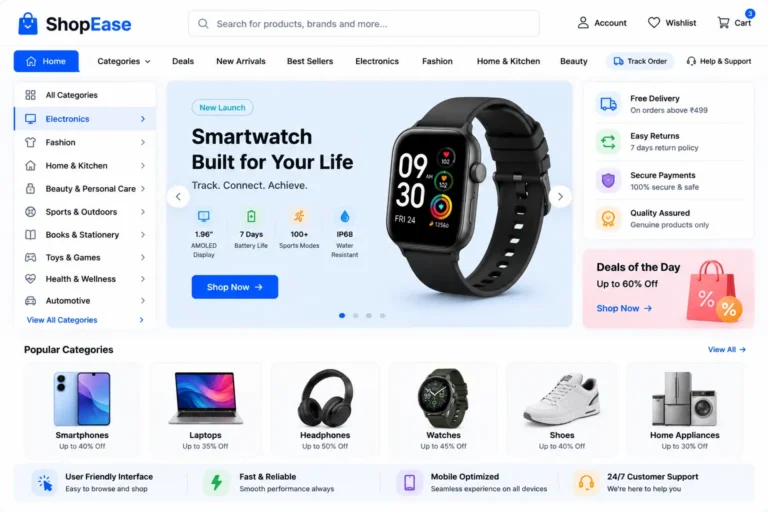
Ensuring a user-friendly interface for smooth navigation is most essential. Users should find it simple to find any product they want on an ecommerce website. Here are some tips on what to add for making navigation easy:
- A search bar
- Simple menu with clear product categories
- Product filters
- Quick access to popular choices and offers
Responsiveness
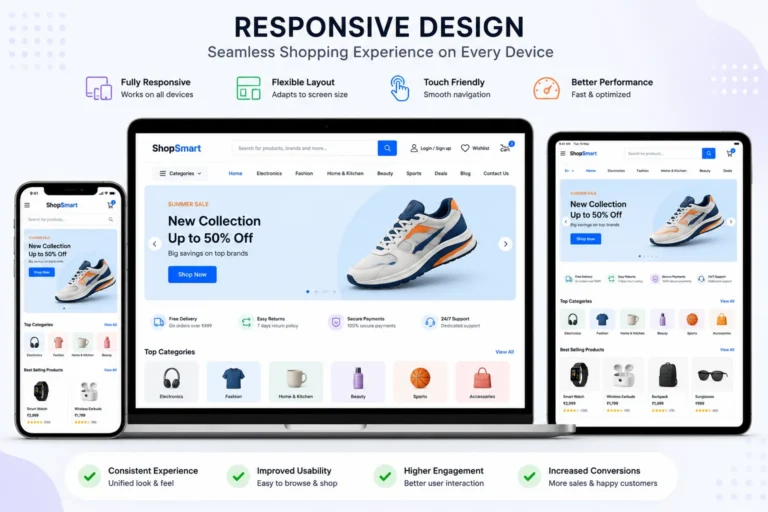
People use multiple devices for surfing products online. As of 2024, 68% of global e-commerce sales come from mobile phones and 30% from laptops and desktops. The rest come from tablets. Thus, ensure your e-commerce website developer makes it responsive for all devices.
Product Images and Videos
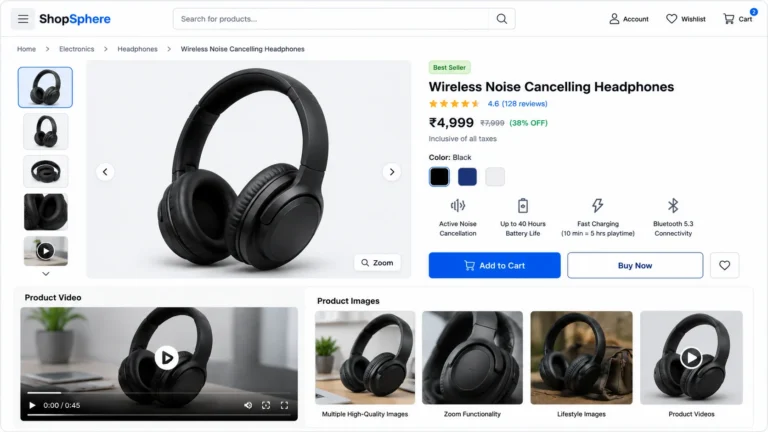
When shopping online, the only means for a user to see the product they’re purchasing is through pictures and videos. Hence, you need to take care of the following regarding your product images and videos:
- Add 3-5 clear, high-definition images shot in white background in every angle
- Add at least one lifestyle image of the product or one with a model
- At least one video of the product that explains its usage should be there
- All images should be lightweight and zoomable
- All videos should be high-definition, embedded, and have the ability to watch in full screen
Product Descriptions & USP

Whether you shop from there or not, you must have seen the interface of Amazon. That’s precisely how a product page should be designed:
- The USP should be highlighted in pointers next to the images
- The main description should be 4-8 lines long and right below the images
- Ensure specifications like product dimensions, weight, size (for clothes and shoes), material (for fashion products), and other details are specified in a tabular format
- Highlight how to use the product in pointers separately
Easy Checkout
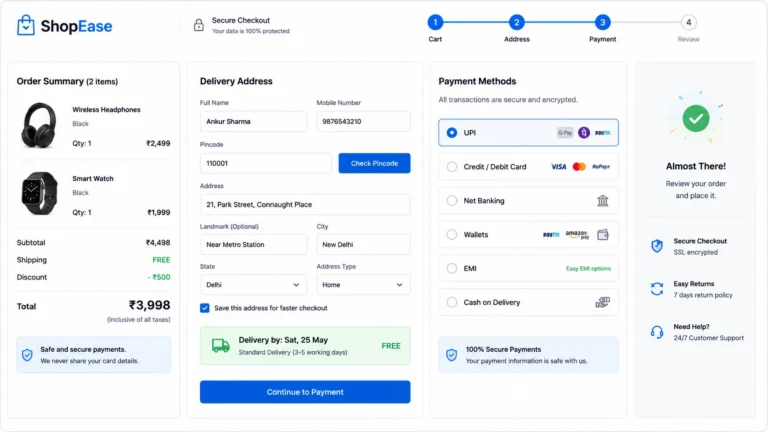
Often users can be irritated when signing up before purchasing is compulsory. It can discourage them from completing the checkout process in the first place. Hence, keep the option for guest checkout open and keep minimum form fields to make the process friendly and quick for the user.
Payment Gateway
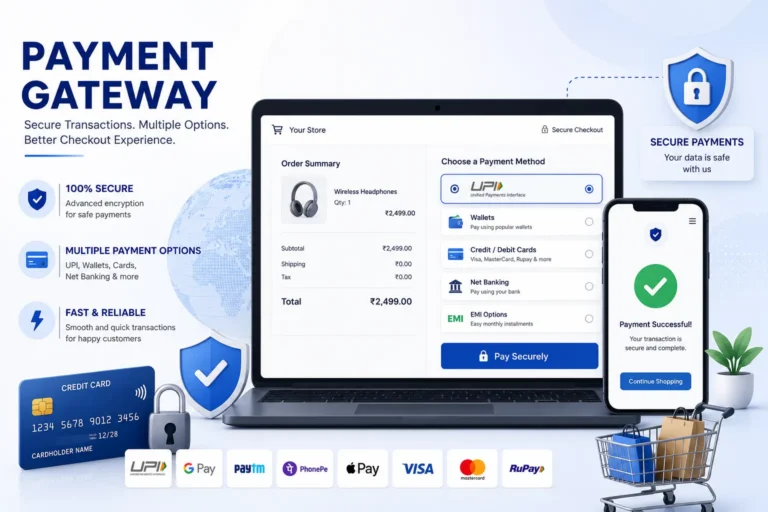
The user needs all possible options of making payments, which include wallets, EMI, UPI, internet banking, credit and debit cards, and pay later options. Integrating a payment gateway that maintains privacy of user information, encrypts sensitive information, and provides all facilities to users is very important for the safety and convenience of users.
Reviews & Ratings
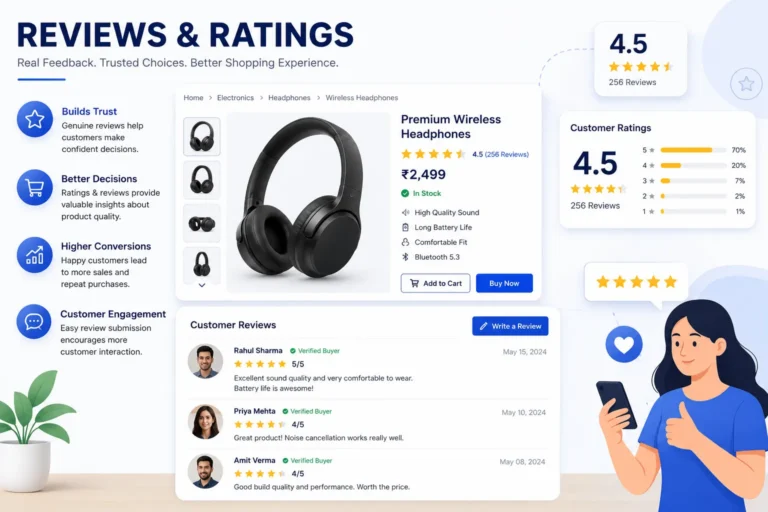
Ideally, a product rating should be highlighted right next to its name, while the written reviews should be available to read right after all descriptions and specifications as the user scrolls down. For the customer to be able to give their own review or rating, place the button either after the written reviews or next to the “Buy Now” button.
Automated Inventory Management
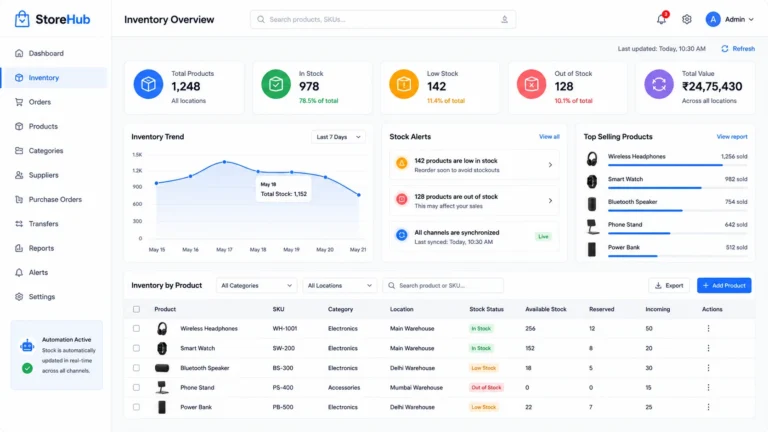
Most ecommerce platforms provide you with plugins to automate inventory management when developing your website. Even if you are using customized ecommerce development solutions, you can ensure that inventory is deducted automatically as sales are made.
Search Engine Optimization
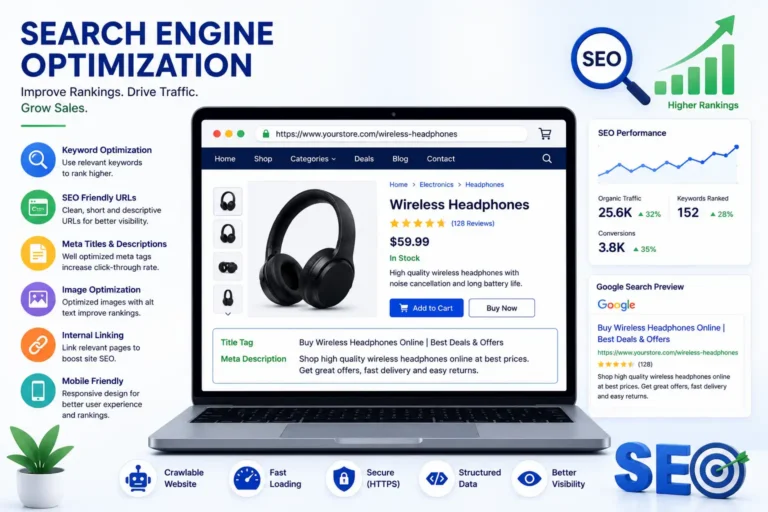
SEO is essential for improving your visibility on search engines. Some of the following factors are important to consider to improve visibility for a newly developed ecommerce website:
- All web pages have content optimized as per target keywords
- All images have alt tags
- All URLs are optimized
- All web pages have meta titles and descriptions
- Internal linking and backlinks for all web pages
Customer Support

It is essential for every ecommerce merchant to have a strong customer support team of their own. Provide your customers with all means to communicate with your team, which should include the following:
- Live chat
- Phone number
- FAQs
- Contact form
More Features to Strengthen Your E-commerce Website
Website Security & SSL
Trust is everything in online shopping. Beyond payment gateway encryption, your site itself needs:
- SSL certification (the padlock icon buyers look for before entering card details)
- PCI-DSS compliance for handling payment data
- Two-factor authentication for customer accounts
- Regular security audits and malware scanning
- Clear privacy policy and data protection disclosures
Personalized Recommendations
Modern shoppers expect the site to “know” them a little:
- “You may also like” and “Frequently bought together” sections
- Recently viewed products
- Personalized homepage banners based on browsing history
- Abandoned cart reminders via email or push notification
Order Tracking & Delivery Transparency
Once a purchase is made, customers want visibility into what happens next:
- Real-time order status (processing, shipped, out for delivery)
- SMS/email notifications at each stage
- Estimated delivery date shown at checkout, not just after purchase
- Easy access to tracking number and courier link
Returns, Refunds & Exchanges
A clear, hassle-free policy reduces purchase hesitation:
- Return window clearly stated on product pages, not buried in T&Cs
- Self-service return/exchange initiation from the order history page
- Transparent refund timelines
- Free or low-cost return shipping where feasible
Multi-language & Multi-currency Support
For brands selling beyond a single region:
- Auto-detected or selectable language based on location
- Local currency display with real-time conversion
- Localized tax and duty calculations at checkout
Site Speed & Performance
Even the best UI fails if pages load slowly:
- Compressed, lazy-loaded images
- CDN usage for faster global load times
- Minimal redirects and clean code
- Core Web Vitals optimization (this also feeds into SEO rankings)
Social Proof Beyond Reviews
- User-generated content (customer photos/videos using the product)
- “X people bought this in the last 24 hours” indicators
- Social media share and follow buttons
- Influencer or press mentions displayed on relevant pages
AI-Powered Customer Support
An extension of the customer support point already covered:
- Chatbots for instant answers to common queries (order status, sizing, returns)
- AI-based product search (natural language or image-based search)
- Smart FAQs that adapt based on what users are asking
Loyalty & Rewards Programs
- Points-based systems redeemable on future purchases
- Referral bonuses for bringing in new customers
- Tiered membership perks (free shipping, early access to sales)
Scalable Hosting & Infrastructure
Especially important during high-traffic events like sales or festive seasons:
- Auto-scaling server infrastructure to handle traffic spikes
- Load testing before major sale events
- Uptime monitoring and quick failover systems
Other Features to Make Your Ecommerce Website User-Friendly
While the above-mentioned features ensure better visibility and user-friendliness of your ecommerce website, there are other extra features that can enhance your website. These include ability to add products to a wish list, having a blog section in the website, and ability to check the delivery date by entering pin code. In other words, developing a good ecommerce website is all about making online shopping a great experience for your target audience.
A Final Word on the Ecommerce Building Checklist
Prioritizing features will always be based on the specific characteristics of your customer base, and not on a generic list. A clothing retailer will prioritize image gallery, magnifier, and lifestyle photography over spec sheets, because an industrial parts directory will have more traffic in the specification area. The list above is very comprehensive, but relative weights should be adjusted depending on the predominant customer segments and the questions they try to answer when interacting with the sales enablement asset.
Ecommerce development is an iterative process, and the next set of features will most likely depend on what did customers actually do on the website. Search queries and abandoned carts will be the true teachers of a long-lasting ecommerce venture, so it is important to analyze these metrics after launch and constantly update the feature list. Year-over-year, the way people buy items online changes, so the checkout process which was ahead of its time five years ago, now represents an obsolete paradigm. It is better to build a prototype which will allow iterative development over time, rather than design a “future-proof” monolithic architecture which will inevitably require significant rewriting several years later.
In short, the generic ecommerce feature checklist which was outlined above should be used as a starting point and then expanded depending on the audience and their behavioral patterns. A balanced approach which utilizes both holistic rules of thumb and deep data-level analysis will yield the most profound results. This article should serve as a general guide, but not a rigid list of features which should be present on any commerce website. Finally, remember that the dynamic nature of the internet environment will require updates even after initial launch, and therefore the discussed best practices are not set in stone but rather represent a reference frame for analysis.