

- 1 PHP’s Popularity: Platforms like WordPress and Shopify rely on PHP for security, performance, and scalability
- 2 Symfony: A high-performance framework with reusable components and strong security.
- 3 Laravel: Simplifies complex web development with built-in authentication and caching.
- 4 CodeIgniter: A lightweight framework known for speed and minimal configuration.
- 5 Phalcon: Optimized for high-traffic applications with minimal memory usage.
- 6 Yii: Ideal for large-scale projects like e-commerce and CMS platforms.
- 7 Choosing the Best Framework: The right choice depends on project needs and expert PHP development services.
Did you know that web development platforms like WordPress and Shopify are based on PHP? Its better security, performance, and ability to scale have made it very reliable for building websites and platforms. However, in order to use PHP technology for web development, you need to choose from 50 frameworks! Sounds a bit much? In that case, we’re guiding you with the best 5 available from which you can narrow down your options.
Final Reasons Why PHP Remains Popular in Server-Side Web Development
It may be worth exploring why this particular server-side programming language continues to be widely adopted at a significant degree several decades after its introduction, instead of being completely replaced by newer alternatives. The most plausible explanation is the aforementioned network effect — the fact that a large proportion of all websites are built with WordPress, which in turn is powered by PHP, creates demand for knowledge of PHP among web developers and hosting providers. However, this factor alone cannot explain PHP’s prevalence in the development of new applications, where it competes directly with other languages.
PHP has evolved considerably since its introduction in 1995. The language version that was used in the early years of WordPress, PHP 4, is barely recognizable as the same tool. Current PHP versions regularly update and improve, and PHP 7 and following iterations in particular, feature heavily sought-after qualities such as better performance, strict typing and additional language constructs, bringing it closer to modern standards. This evolution allows PHP-based applications and services to be developed, maintained and updated in a competitive environment.
A frequently overlooked advantage of PHP is the fact that it does not require any particular hosting considerations. A PHP application can be hosted on a shared server with relatively little technical expertise required on the administrator’s end. This is a significant advantage over alternatives such as Python or NodeJS, which may involve more complex server deployment and maintenance procedures. For smaller-scale applications, where the additional overhead of a dedicated server would be unwarranted, PHP is a natural choice. The same considerations apply to cheaper shared hosting plans, which may be necessary for budget-savvy clients or agencies balancing the expenditures of multiple projects.
How to Avoid Selecting Worst PHP Frameworks
The popularity criterion for selecting a programming framework is not the only consideration when choosing which technology to adopt for developing an application. Several other aspects should be taken into account since one will inevitably use the selected tool for a relatively long period. To begin with, some programming frameworks offer better learning curves than others, which is especially important for working in teams. A framework that seems quite intuitive to an experienced developer can become a problem for someone who has been working with PHP for less than a year. Laravel, for example, is so popular partly because there are many resources for learning it. This popularity is explained by the fact that the framework is quite easy to learn, but this is especially helpful for people who need to quickly familiarize themselves with it because others have already learned it and shared their knowledge.
Next, when selecting a framework, one should think about how long they intend to use it. It is essential to choose a framework that will be supported for as long as possible. This factor is crucial because, in case of some problems, it may be impossible to find people who know the technology. In other words, the longer the framework is supported, the more opportunities there are to find people who know it. This is especially important when working in teams because the loss of one expert can lead to the need to find a replacement. A reliable sign of the popularity of the framework and the presence of qualified specialists working with it is a large number of training materials and answers to questions on forums. A relatively young framework may lack such resources, but this does not apply to established programming languages and tools like PHP.
A somewhat similar issue is the development of the ecosystem around the framework. Sometimes it happens that the framework itself is great, but the lack of an ecosystem means that relatively simple tasks require writing large amounts of code. On the other hand, sometimes all the necessary tools for working with the framework are written by other developers.
Top Frameworks for Web Development in 2025
Over the years, majority of developers have found the following PHP frameworks to be most user-friendly and efficient for website development:
- Symfony
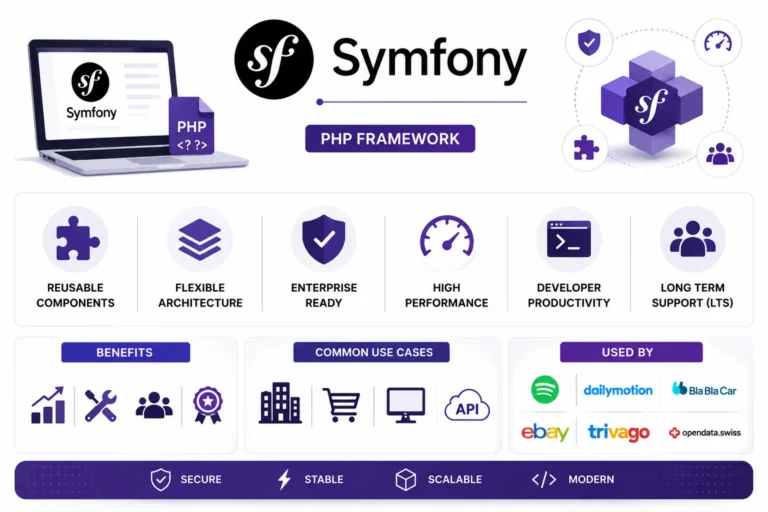
Based on the Model-View-Controller (MVC) architecture, Symfony is used by approximately 45,000 companies being high performing PHP framework. Due to its robust infrastructure, it is used by developers to provide custom PHP development services.
Some of the important features of Symfony include:
- It has modular components that offer many reusable components.
- Due to its flexibility, it is suitable for both full-stack applications and small developments.
- It is very convenient to use APIs efficiently on this platform.
- It provides good long-term support which ensures stability and security.
- Laravel

Powering more than 700,000 websites, Laravel is known for its beautiful syntax, rich set of features, and strong community support. Complex web development tasks can be easily simplified by offering built-in solutions for authentication, routing, and caching. Laravel has made it simpler to develop scalable websites with PHP.
Some of the important features of Laravel include:
- Simplifies database interactions.
- Enables reusable UI components in a cleaner way.
- It has in-built security features for preventing cross-site scripting (XSS), SQL injection, and cross-site request forgery (CSRF) that makes it more reliable.
- Laravel helps in efficient deployment and is scalable to increase the scope of the work.
- CodeIgniter
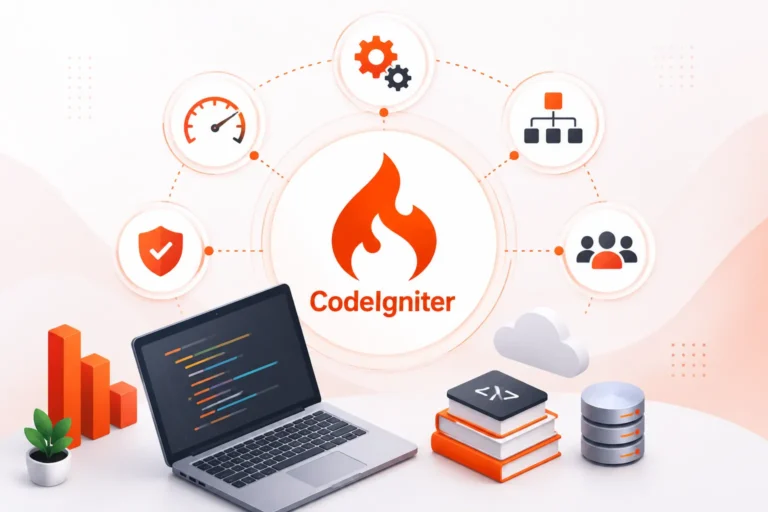
CodeIgniter gives a high performance and it is lightweight structure. It currently powers more than 300,000 live websites due to its simplicity of use and powerful features for building high-functioning websites.
Some of the important features of CodeIgniter include:
- It has an easy setup with minimal dependencies due to its less configuration.
- The MVC architecture ensures cleaner and organized code.
- Being lighter than many other frameworks, its execution speed is faster.
- Its built-in security tools provide encryption and CSRF protection.
- Phalcon
Phalcon is also adopted by many web developers while using PHP. Compared to traditional PHP frameworks, this can give some better performance. If you require custom PHP development services, then Phalcon is a great choice.
Some of the important features of Phalcon include:
- It is made in C and compiled as a PHP extension, which make it faster than traditional PHP frameworks.
- It is optimized for minimal memory usage and is ideal for high-traffic applications.
- It has a well-structured development approach that makes large project development easy.
- Enhances testability and flexibility.
- Yii
Yii is known for its simplicity, and efficiency to develop high-performing apps and websites. It is one of the best options available if you need to develop a large-scale website like an e-commerce solution or a CMS platform.
Some of the important features of Yii include:
- It provides fast performance to boost speed.
- It has Yii code generator that simplifies operations.
- It provides authentication and features of authorization.
- Developers can get started quickly.
Side-by-Side: The Five Frameworks Compared
With all five frameworks covered individually, it helps to see them laid out against each other on the dimensions that tend to actually drive a decision:
| Framework | Best for | Learning curve | Community size |
| Symfony | Enterprise applications, reusable components | Steep | Large |
| Laravel | Rapid development, startups, general-purpose apps | Moderate | Very large |
| CodeIgniter | Small to mid-size projects, quick builds | Gentle | Moderate |
| Phalcon | High-traffic, performance-critical applications | Steep | Smaller |
| Yii | Large-scale platforms, e-commerce, CMS | Moderate | Moderate |
None of these frameworks is universally better or worse than the other – it all depends on the team, the size of the project, and its expected growth in the future. In this regard, both options are advantageous, but in different cases. For example, a team that wants to develop a fast minimum viable product without wasting time will find all the necessary tools in Laravel. At the same time, developers who want to optimize server costs at the level of a big platform will see more advantages in using Phalcon.
A Note on Long Term Support and Community’s Trust
One thing that I feel is not discussed enough when comparing frameworks is the maintainers’ approach to the major version updates. Some frameworks tend to introduce breaking changes with every new major version, requiring heavy refactoring of the existing apps to keep up with the latest version. Others, however, make a point of not breaking anything that worked before at the expense of being slower to adopt new developments in the PHP ecosystem. While both approaches have their benefits and drawbacks, I think it is important to know which side of the debate your preferred framework is on before committing to it for the long term. After all, you do not want to rewrite your app every other year simply because the framework of your choice failed to evolve with the language.
Laravel seems to take a pragmatic approach to the matter, being quick to embrace new features and paradigms introduced with PHP’s major updates while also being quick to require them from its users. While this approach probably keeps Laravel’s codebase fresh and modern, it can also be a disincentive for long-term commitment as every upgrade can be associated with significant rewrites. Symfony, on the other hand, is also eager to adopt new technologies but is more prudent with deprecations, giving developers more breathing room between major version updates.
Which PHP Framework is Best for Your App?
These frameworks offer the best tools for developing efficient and secure websites with PHP in 2025. To choose the right one for your website, all you need is the best web development company with a team of PHP developers.