

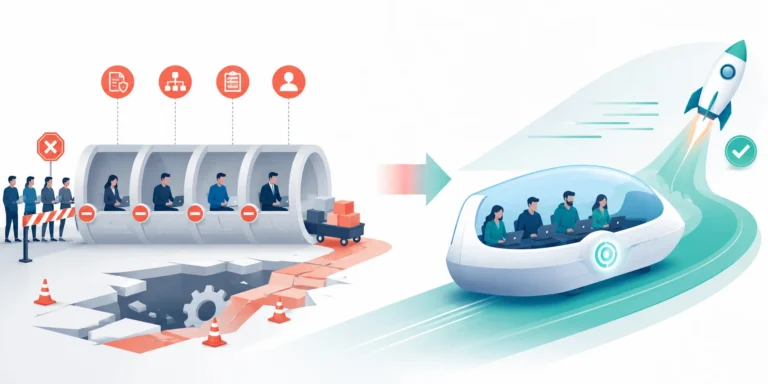
Enterprise IT vendors are slow by design, not by skill built for Fortune 500 compliance needs, they apply the same heavy governance to every client, startups included. Multiple handoffs across account managers, delivery leads, and rotating engineers mean days often pass before work even reaches someone who can code. This delay costs real money: missed market windows and founders stuck managing vendors instead of building product. The fix isn’t a faster traditional vendor it’s a senior-heavy team that owns decisions directly, skipping the escalation chain entirely. That’s the model behind Innostax’s managed engineering pods for SaaS founders.
- 1 Large enterprise IT vendors are slow by design because their processes are built around governance, risk management, and large-scale clients.
- 2 Multiple handoffs create delivery delays, with account managers, delivery leads, and rotating engineers adding coordination overhead.
- 3 Slow delivery can cost startups market opportunities, especially when features take weeks to reach production.
- 4 Founders can become de facto project managers, spending time chasing updates and resolving vendor-related scope issues.
- 5 Managed engineering pods improve ownership, with a dedicated team responsible for delivery rather than relying on fragmented vendor structures.
If you ask most founders why their engineering roadmap is stuck, their answer usually isn’t a lack of ideas; it’s a vendor relationship that’s grinding through layers of process before anything ships.
At Innostax, we hear this constantly from SaaS founders who came from a large IT services vendor: “nothing was technically wrong, it was just always slow.” That’s not a coincidence; it’s how large vendors are structured to operate.
Why Large Vendors Move Slowly by Design
Process Exists to Manage Risk, Not Speed
Enterprise vendors are built to serve Fortune 500 clients with heavy compliance needs, so every engagement inherits layers of governance even when the client is a 12-person startup that needs to ship.
Multiple Handoffs, Multiple Delays
Account managers, delivery leads, and rotating engineers each add a coordination cost. By the time a request reaches the person who can actually write the code, days have often already passed.
What Slow Delivery Actually Costs You
Market Windows Don’t Wait
A feature that takes six weeks to scope and staff at a large vendor might be live in six days with a team that can start immediately and makes decisions without escalation.
Founders End Up Managing the Vendor
Instead of focusing on product and customers, founders often become the de facto project manager chasing status updates and untangling scope confusion.

What Actually Fixes It
Senior-Heavy Teams Skip the Escalation Chain
A small, senior team can make technical and scope decisions quicker, without routing every choice through a layered approval process.
Managed Pods That Own the Outcome
This is precisely why Innostax builds around AI-native managed engineering pods for SaaS founders ,senior-heavy teams that own delivery, built for quick turnaround , the team is structured to make delivery decisions directly, not escalate them.
Speed Is a Structural Choice, Not a Personality Trait
Large vendors aren’t slow because the people are bad at their jobs. They’re slow because their organizational structure was built for a different kind of client.
If your business needs to move fast, the fix isn’t finding a faster version of the same model. Rather, it’s choosing a team structured for speed from the start.
For startups weighing this decision, firms like Innostax, Simform, or TatvaSoft each take a meaningfully different approach to how fast a team can actually move.
The One Hidden Cost of Context Switching at Large Vendors
There is one particular hidden cost of context switching across multiple clients that is not often spoken about, but is absolutely integral to any evaluation: the opportunity cost in terms of the speed of any given task.
A big IT services vendor will have dozens of concurrent engagements at any given time. An individual engineer may spend her week working on 3-4 different projects.
This means that any time she switches her context from your code back to the code for another client, she will spend some time re-familiarizing herself with it.
She also has to recall whatever domain knowledge she may have had from working on it previously.
This represents an enormous opportunity cost that is not visible anywhere on a bill. However, it is dramatically visible in the speed of time-to-delivery of any particular task.
Dedicated engineers do not have this particular opportunity cost, which is why they routinely order of magnitude faster than big vendors’ engineers.
How Contract Structure Shapes The Behavior of Vendors
The commercial structure of a particular engagement is, in many ways, the defining characteristic of a good or bad vendor.
For big vendors, the default mode of operation for a given engagement with a small tech company is either staff-augmentation or time-and-materials contracting.
Both are effectively designed to make the client pay more by delivering value slower.
A good vendor, however, will recognize the desire of a small company to accelerate the pace of development and move to outcome-based contracting.
This makes them financially benefitted from faster time-to-delivery and lower costs.
In practice, this means that to get speed from a vendor, a small company will have to negotiate a dramatically different relationship without superfluous middle management.
That means effectively contracting an entire team of engineers who then report directly to the customer’s technical leadership.
What It Actually Means To Have an Owning Team
There are many differences between organizations that promise to have an owning team for a given engagement and those that don’t.
In practice, it boils down to the presence or absence of decision-making autonomy.
An owning team makes the technical decisions and implements them the same day, rather than having to escalate everything up and down the management hierarchy before anything can ship.
It makes the necessary technical risks visible to the customer in simple terms, rather than having to filter them through a project manager who will likely not have the technical competence to effectively evaluate the true cost of any decision.
It takes responsibility and accountability for shipping on time, even if it was not the team that initially scoped and estimated the work scope for a particular project.
These are just a few ways in which an owned team makes visible, in day-to-day operations, the key differentiating factors between a good and a bad vendor.
Why Senior Engineers Help You Move Faster (Even When They’re Not Working On Your Code)
The obvious reason why senior engineers help in terms of speed is that they are faster than juniors.
There is another reason, however, which stems from their presence on the team. It also accelerates the team and improves the technical quality of the output: the ability to make decisions on the spot.
Any significant decision, no matter how small it may seem, has to pass through the senior engineers for evaluation before it can be implemented.
This is ultimately beneficial for quality but adds overhead.
Additionally, teams of more experienced engineers tend to have fewer but more substantial mistakes, as compared to teams with a mix of seniors and juniors.
A junior engineer needs more hand-holding to avoid make avoidable errors, but such hand-holding slows everybody down.
In many cases, a team of seniors may be able to outpace a much larger team that contains a mixture of juniors and seniors.
The
The Interview Process Reveals More Than the Pitch Deck
Founders evaluating a new engineering partner tend to be obsessed with the vendor’s pitch deck, case studies, and portfolio.
But the true nature of the relationship is revealed in the early scoping conversations where the contract is negotiated.
How quickly does the prospective team ask clarifying technical questions about the actual product versus generic questions about high-level scope?
Are they willing to push back on aggressive timelines, or are they willing to sign off on anything to get funded?
A team that is ready to move quickly when they are engaged will reveal themselves by asking more detailed questions.
They will also give more practical technical guidance on challenges and tradeoffs. They will be willing to push or compromise with real alternatives versus saying, “we’ll figure it out during discovery.”
Founders who focus on this process rather than the pageantry of the proposal document will have a much more realistic idea of what to expect during day one of the engagement.
Why Communication Frequency Matters More Than Quantity
You’ve probably noticed that the faster-moving teams seem to communicate more often.
But the signal that matters most isn’t the frequency or the channel. It’s what gets said and when.
Many VCs fall into the trap of believing that longer, more frequent status reports represent valuable time spent.
But what large vendors usually produce is a summary of the hours worked and deliverables produced. That can actually be less useful to a founder trying to make a decision.
A faster-moving team will tend to report decisions they’ve made, near-term risk they’ve uncovered, and engineering tradeoffs they’re considering.
This is more useful than general status updates on hours billed versus hours budgeted.
It’s a huge time saver for founders to receive only what they need to know in order to make a decision rather than digging through reams of documentation.
That is why a communication cadence aimed at a founder’s decision-making cadence is so critical.
Startups should be especially attuned to this when evaluating a new vendor. The communication style during the sales process is frequently an indicator of the project health reporting they can expect once work has begun.
Tired of Waiting on Layers of Process to Ship a Feature?
At Innostax, we build senior-heavy managed pods that start fast and own delivery end to end, no escalation chain required.
Schedule a Free Delivery Speed Assessment →
Let’s find out how fast your roadmap could actually move.