


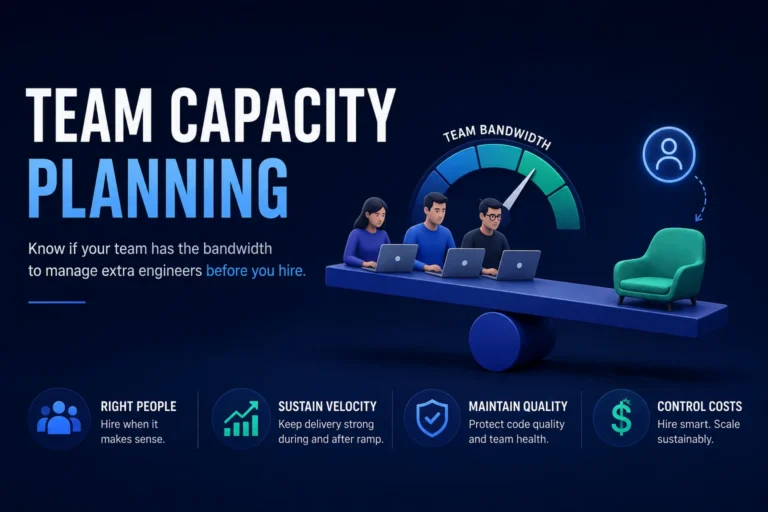
Hiring more engineers is the default fix when delivery slips, but adding people to a team with no bandwidth to absorb them slows shipping before it speeds it up. This post explains team capacity planning beyond headcount: the mentorship tax new hires place on seniors, five signs you actually need to hire, the 30-60-90 onboarding ratio, span of control limits, and a decision matrix for hire versus optimize. Name the trade-off before the requisition opens, not after the new hire starts asking questions.
- 1 Adding engineers when seniors are already at full mentorship capacity slows delivery before it speeds it up.
- 2 Three sprints of growing backlog plus burnout on seniors usually means hire; one sprint means optimize scope first.
- 3 The 30-60-90 rule: one senior mentor can onboard one engineer per quarter without slipping their own work.
- 4 A lead guiding more than six engineers well is rare; beyond that, guidance thins and quality drops.
- 5 Name the velocity versus quality trade-off before the requisition opens, not after the new hire starts asking questions.
How to Know If Your Team Has the Bandwidth to Manage Extra Engineers (Before You Hire)
Hiring more engineers is the default response when delivery slips. It is also, often, the wrong move. Adding engineers to a team that has no capacity to absorb them slows delivery further before it speeds it up. Team bandwidth management is the discipline that answers the real question: can your current team handle the ramp cost of a new hire without losing the shipping velocity you already have? This post walks through team capacity planning, the signs that scaling now is the right move and the framework we use to decide.
Why Team Capacity Planning Is More Than Just Headcount
Team capacity planning is not a spreadsheet of names and story points. It is a view of what the team can absorb in addition to delivery. Every senior engineer has a fixed budget of hours per week. Some of that budget goes to coding. Some go to review. Some go to design discussions. Some go to mentorship. Add a new hire and the mentorship line grows at the expense of the others. If the team was already at 100 percent, adding a hire reduces delivery for the next quarter. Real capacity planning models the mentorship draw before the requisition opens, not after the new hire starts asking questions.
The Hidden Cost of Bad Timing in Hiring
Everyone knows about cost per hire. No one talks about the cost of hiring at the wrong time, which is much harder to quantify, but often much higher.
Here’s how it manifests: a new hire who cannot ship independently yet represents lost hours across the team, during the time when another team member was covering for them. Another sign is code quality: rushed reviews due to a heavy onboarding load result in a higher quantity of rework, which would have never been budgeted for. And then, there is the case when a new hire is dropped in a team where there is no capacity to mentor them effectively, and as a result, said new hire quits in month eight — and now you have to start all over again. The lost productivity during their time on board plus the extra cost of rehiring far outweighs the original six-week training period.
This all fails to be represented in a hiring dashboard, but will show up, in lost velocity, months after the new hire has departed.
5 Critical Signs You Need to Hire Developers Immediately
The signs you need to hire developers are usually loud but often misread as process problems. First, the backlog grows faster than the team burns it down for three sprints in a row. Second, senior engineers work weekends to hold delivery dates. Third, code review turnaround exceeds two business days on a regular basis. Fourth, incident response is dominated by the same two engineers because nobody else knows the system. Fifth, roadmap items get quietly cut because there is nobody to build them. Any three of these together mean hiring, not just process.
Reading Your Metrics before Your Gut
The five signals above are all indeed tell-tale signs, but they are each subjective, in that they require judgment as to when they become unacceptable. A better approach is to pair them with objective metrics that indicate the same thing. For example:
| Metric | Healthy | Getting shaky | Time to act |
| Cycle time (commit to merge) | 1–2 days | 3–4 days | 5+ days |
| Sprint carryover | Under 15% | 15–30% | Over 30% |
| Senior engineer coding time | 60%+ of the week | 40–60% | Under 40% |
| On-call pages per engineer/month | 1–3 | 4–6 | 7 |
If two of the metrics above are crossing into “time to act” and three of the five signals from before are present, it’s time to stop second-guessing and start hiring.
Evaluating Your Developer Onboarding Capacity: The 30-60-90 Rule
Developer onboarding capacity is the number of new engineers your current team can absorb in a given quarter without losing delivery. The 30-60-90 rule sets the ratio. In the first 30 days, a new hire consumes 40 percent of a mentor’s time. In days 60, 25 percent. In days 90, 10 percent. One senior mentor can effectively onboard one new engineer per quarter without slipping their own commitments. Any faster and both the mentor and the new hire suffer, and delivery slows for both.
What goes wrong when you fail the 30-60-90 ramp
Teams who ignore the 30-60-90 math and overload a mentor with two or three new employees tend to get similar symptoms, in roughly this order,
The first few weeks go great, everybody thinks they’re acing the ramp up, until week four or five, when the mentor’s own productivity begins to slip, because they’ve been spending all their time helping junior engineers. This isn’t a junior engineer problem, it’s a senior engineer problem, since that mentor’s review cycle is now getting bottlenecked by their juniors, slowing down the whole team.
By week ten or twelve, most of those new engineers are stuck in second gear, not because they’re bad at their jobs, but because nobody was actually giving them focused attention. They’ve been getting their questions answered, triaged across three different mentors, but that’s not really the same as having somebody who’s actually focused on helping you.
The fix isn’t necessarily slowing down the pace of hiring, especially if these engineers are already on board, but maybe staggering those on-boarding periods by six or eight weeks, instead of cramming them all in at once, or finding a second senior engineer to split the mentoring load between, instead of putting it all on one person.
The Framework for Engineering Team Scaling: Velocity vs. Quality
Engineering team scaling forces a trade-off between short-term velocity and long-term quality. Hiring aggressively raises headcount fast but risks quality dropping while ramps are underway. Hiring conservatively holds quality but leaves the roadmap short. The right answer depends on where the product is: pre-fit teams should hold quality high with slower hiring; post-fit teams growing revenue can accept a short quality dip to add capacity. Naming the trade-off explicitly beats pretending it does not exist.
Team Bandwidth Management: Measuring the Management “Span of Control”
Team bandwidth management includes a span of control. A senior lead can guide four to six engineers well. Beyond that, guidance.
The Decision Matrix: When to Hire More Engineers vs. When to Optimize
When to hire more engineers is a decision that benefits from an explicit matrix. This one maps the signals to the right response.
| Signal | Duration | Right response |
| Backlog growing | One sprint | Optimize scope |
| Backlog growing | Three sprints | Hire |
| Review latency high | One week | Adjust review rotation |
| Review latency high | One month | Hire mid-level engineer |
| Incident load high | Ongoing | Hire on-call rotation coverage |
| Roadmap items cut | One quarter | Optimize priorities |
| Roadmap items cut | Two quarters | Hire |
Brooks’s Law and the “Onboarding Tax”: Why Timing Your Hire Matters
Brooks’s Law says adding people to a late project makes it later. Team capacity planning respects that. Hire before the crunch, not during.
Staff Augmentation: Scaling Without the Bandwidth Bottleneck
Staff augmentation solves the bandwidth bottleneck in engineering team scaling. Instead of hiring one engineer and paying the full mentorship tax, you bring in a managed engineering team from Innostax with its own tech lead. Delivery capacity goes up. Your senior engineers keep their coding time. The new team ships in the first two weeks because they land pre-vetted, pre-trained and paired with a lead who owns their ramp. That model beats hiring one-by-one when the roadmap will not wait, and it lets you test the capability without a six-month commitment to a permanent hire.
Conclusion: Scaling Your Engineering Team With Data, Not Guesswork
Engineering team scaling done well starts with team capacity planning that models the mentorship draw honestly. It uses the signs from the backlog and review loop to decide when to hire. It uses staff augmentation when direct hiring cannot happen fast enough without hurting quality. Teams that pick their scaling model deliberately grow revenue faster than teams that hire in a panic and untangle later.
Span of Control is Not Universal
Although four to six is a good rule of thumb, it’s important to remember that scale isn’t always directly linked to the amount of work being done by the team.
The team building something new from the ground up can usually go higher than seven or eight if you’re a greenfield team, due to the lower amount of shared context needing to be transferred and therefore less to account for in the individual team member’s head. Legacy and maintenance teams, conversely, will tend to lean towards three or four, as a staggering amount of the information about how and why a system works the way it does is living in the head of the lead. Infra and platform teams will also tend to lean towards the lower end of the range, not necessarily due to a higher difficulty of work, but rather due to the higher cost of error and lower ability to mitigate it through review.
An organization can have every single team operating at 4:6 and still have leads that are working beyond their capacity.
Hire on a Calendar, Not in a Panic
Teams that avoid Brooks’s Law pitfalls exhibit one common habit: planning hiring ahead of time, rather than panicking in response to what’s on fire that quarter.
In practice, this manifests in a capacity check at the end of each quarter, before sprint planning begins, where someone asks who has headroom for mentoring, as opposed to assuming that there will be someone available. It means not hiring someone for the six weeks before a launch, since getting them up to speed and shipping a major product at the same time tends to be a losing proposition. It means naming the mentor before opening up a requisition, so that there isn’t a panic around finding one after the fact.
All in all, a small change to hiring procedures which, nonetheless, represents the huge difference between the hiring function being a reaction to the needs of the team or the team having planned ahead to accommodate it.
Hire on a Calendar, Not a Panic
The teams I’ve seen that never fall victim to Brooks’s Law in the first place generally have one trait in common: they plan hiring ahead of time rather than in response to panic.
In practice this usually looks something like a capacity check every quarter (before the planning even happens, someone actually asks who has room to mentor and who doesn’t), not bringing on new hires in the six weeks leading up to a big launch (ramping someone up while cutting off another release is a great way to have both fail), and identifying the mentor before the requisition ever opens (don’t put off finding a mentor until after the offer has been accepted).
It sounds like a small change, but it’s the difference between hiring being an impediment to the team or a pre-planned allocation.