


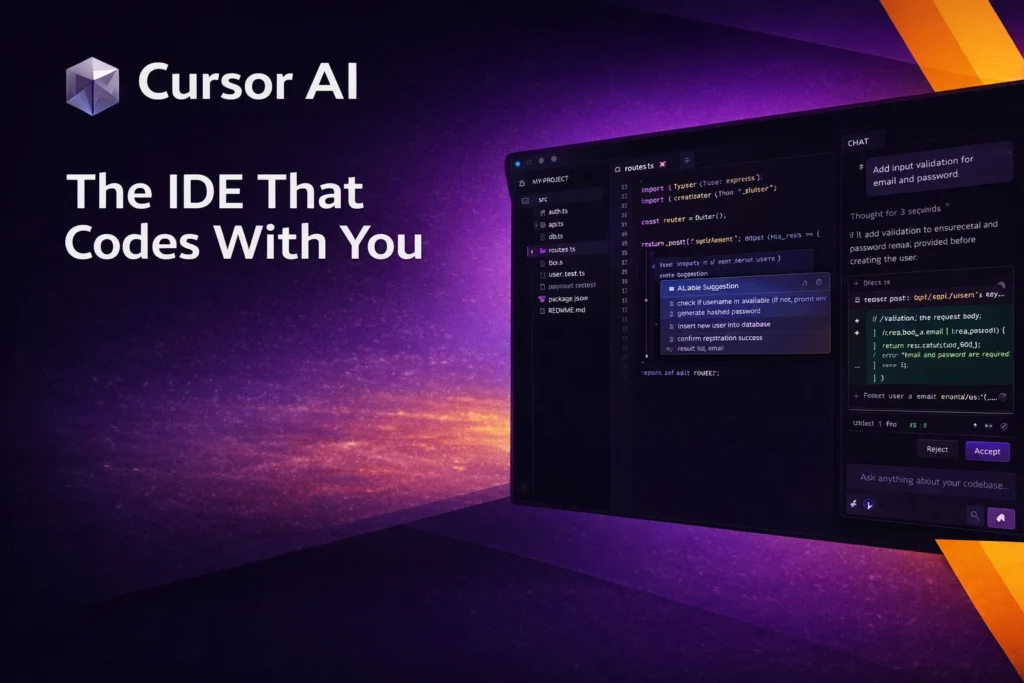
Cursor AI is an AI-first code editor based on VS Code, built by Anysphere Inc. and co-founded in 2023 by four MIT graduates. Unlike plugins, it runs LLMs like Claude, GPT, and Gemini directly inside the editor — enabling real-time suggestions, autonomous multi-file editing, bug detection, and refactoring without context-switching. Developer teams using Cursor report 20–40% faster feature delivery and 20% fewer production bugs.
- 1 Cursor AI is an AI-native IDE (VS Code fork) with built-in LLM collaboration — not a plugin.
- 2 Agent Mode executes multi-file, multi-step tasks autonomously.
- 3 Priced from free (Hobby) to $200/month (Ultra); Teams at $40/user/month.
- 4 Used by engineers at OpenAI, NVIDIA, Shopify, Coinbase, and 50%+ of Fortune 500.
- 5 Honest limitation: requires internet — no offline or air-gapped support.
What is Cursor AI?
Cursor AI is an AI-native integrated development environment (IDE) — an editor built around AI collaboration from the ground up, rather than adding AI as a plugin — based on Visual Studio Code. As opposed to AI coding plugins, which are external to the editors, Cursor is built around AI collaboration, i.e. autocomplete, multi-file editing, agentic task execution and codebase-wide context are part of the editor, rather than extensions of the editors.
Cursor, which was founded by Michael Truell, Sualeh Asif, Arvid Lunnemark, and Aman Sanger, is the fastest SaaS company to date to achieve $100 million of annual recurrent income, having done so 12 months after its founding by MIT graduates in 2023.
“The best LLM applications have an autonomy slider: you control how much independence to give the AI. In Cursor, you can do Tab completion, Cmd+K for targeted edits, or you can let it rip with the full autonomy agentic version.” —Andrej Karpathy, CEO, Eureka Labs
Why Software Teams are Moving to Cursor AI in the year 2026
It is difficult to disregard the numbers. In a 2025 survey by Pragmatic Engineer, it was determined that at least 85% of professional developers currently in the workflow use some form of AI tool. The survey conducted by the developer of Stack Overflow also indicates that 84% of professional developers currently or intend to use an AI coding assistant.
The level of integration is what makes Cursor stand out against competitors. Cursor knows how all your code fits in, rather than proposing the next line of code in isolation. Such a difference produces quantifiable results:
- Based on the report by developers, there is 20-25 percent time savings during the common activities such as debugging and refactoring.
- Complex, full-stack projects see 30–50% reductions in development cycle time
- The number of context switches during coding session is reduced by a factor of 40% by engineering teams.
- At Cursor firm-wide developer onboarding times have in 30-50% reduced.
NVIDIA’s CEO Jensen Huang called Cursor his “favorite enterprise AI service” and reported that 100% of NVIDIA’s engineers now use AI coding assistance with a “remarkable boost” in productivity.
“At Innostax, Cursor AI is now part of our everyday engineering workflow. In practice, roughly 90–95% of the code written across projects is AI-assisted, helping teams move faster while maintaining consistent code quality standards.“
Main features of Cursor AI:
Tab Completion (Cursor Tab)
Cursor Tab is the proprietary autocomplete model of Cursor, as opposed to a generic code suggestion engine. It is not just the completion of the current line but it is an understanding of your next move depending on the context of the surrounding codes and the most recent changes. According to developers, it is autocomplete on steroids.
Inline Edit (Cmd/Ctrl + K)
Inline Edit is the precision tool used by Cursor to make specific changes in a function block of code that has been selected. Highlight a function, describe the change you want in natural language, and Cursor presents a color-coded diff you can accept, reject, or partially apply.
Multi-File, Multi-Step Execution ( Agent Mode )
Cursor’s flagship capability that accepts a high-level goal in natural language and autonomously writes, edits, tests, and runs code across multiple files, which is its flagship and the greatest point of difference with tools like GitHub Copilot.
Codebase Context Chat AI (Cmd/Ctrl + L)
Cursor uses codebase indexing — reading and mapping your entire project so AI suggestions account for all files, not just the open one — to power an AI Chat panel that acts as a project-sensitive collaborator that can be interrogated in natural language.
Background Agents and Automations
Released in 2025, the Automations platform of Cursor enables teams to make AI agents respond to events – not only when triggered by humans.
Cursor AI Pricing: Plans Compared (2026)
In June 2025, Cursor transitioned from a fixed-request model to a credit-based billing system tied to actual model API costs. Here is the current pricing structure:
| Plan | Price | Best For | Key Inclusions |
|---|---|---|---|
| Hobby (Free) | $0/month | Students, explorers | Limited Tab completion; limited premium requests |
| Pro | $20/month ($16/mo annual) | Daily developers, freelancers | Extended limit Tab; Access to frontier models |
| Pro+ | $60/month | Power users | 3× Pro credit pool |
| Ultra | $200/month | Heavy agents, large codebases | 20× Pro credit pool; priority feature access |
| Teams | $40/user/month | Teams of 3+ | All Pro features + SSO + SAML/OIDC, centralized billing, admin controls, usage analytics |
| Enterprise | Custom pricing | Large organizations | Custom limits, on-premise options, SCIM, dedicated support |
When to choose Cursor:
Teams that want deep, multi-file agent workflows, flexible model selection, and a full IDE experience. Best for complex, greenfield or large legacy codebases.
When to choose GitHub Copilot:
Teams already embedded in the GitHub ecosystem, or those who primarily need fast autocomplete within existing IDE setups without switching editors.
When to choose Windsurf:
Organizations that want on-premise deployment, open-model support, or are cost-sensitive and need a capable free tier.
Cursor AI vs. GitHub Copilot vs. Windsurf: Feature Comparison
| Feature | Cursor AI | GitHub Copilot | Windsurf (Codeium) |
|---|---|---|---|
| Type | AI-native IDE (VS Code fork) | VS Code / JetBrains plugin | AI-native IDE |
| Multi-file editing | ✅ Native (Agent Mode) | ✅ Agent Mode (2025) | ✅ Cascade |
| Terminal execution | ✅ Yes | ✅ Limited | ✅ Yes |
| Codebase indexing | ✅ Full project | ✅ Partial | ✅ Full project |
| Privacy Mode (zero retention) | ✅ Yes | ✅ Yes | ✅ Yes (self-hosted) |
| SOC 2 Type II | ✅ Yes | ✅ Yes | ✅ Yes |
| Individual pricing | $20/month | $10/month | $15/month |
| Team pricing | $40/user/month | $19/user/month | $30/user/month |
| Enterprise | Custom | $39/user/month | $60/user/month |
Integrating Cursor AI into Your Development Process
Step 1: Installation and configuration
Download Cursor from cursor.com. Because it is a VS Code fork, all existing VS Code extensions, themes, keybindings, and settings transfer automatically. Integrate your version control (GitHub, GitLab, Bitbucket) and current CI/CD pipelines when first configuring.
Step 2: Begin with Tab, Advance to Agent
Tab completion is where new users should start – no prompting is needed and typing speed is enhanced immediately. When at ease, use Inline Edit (Cmd+K) to do refactors on a case-by-case basis. Multi-step, multi-file There is a mode called Reserve Agent Mode that allows you to describe a goal at a high level and have Cursor arrange how to accomplish it.
Step 3: Pair with Continuous Integration
Integrate the capability of Cursor to propose and produce test cases into your CI pipeline. Set up Cursor to do the automatic tests at the end of commits generated by Agents. This completes the feedback between code generated by AI and verified behavior.
Step 4: Review Every Diff
It is never advisable to merge AI-generated code without reviewing it. Check out each change using Cursor colored diff previews. When you are working on high stakes refactors, write in a feature branch and commit frequently. The bug finder can be used to surface regressions before shipping ( Command Shift P → bug finder ) and to verify your commits against the main branch, built into Cursor.
Real-World Use Cases:
Rapid Prototyping
The full features of a high-level natural language description can be scaffolded by Cursor Agent Mode, into login systems, REST API endpoints, database models, and so forth. With Cursor report building, teams are able to use hours to build a report that took days to prototype before.
Legacy Code Modernization
Individual engineers at Coinbase refactored and upgraded whole codebases in days (not months) with Cursor. The context window codebase-wide allows Cursor to recognize old patterns and propose newer ones without sacrificing business logic.
Automated Testing
Cursor can create unit test suites by looking at existing function signatures and propose edge cases that the developer might be missing. This, combined with CI automation, minimises the testing bottleneck within the high velocity teams.
Onboarding New Developers
While new employees can explore new codebases with Cursor to read and comprehend unfamiliar code through natural language queries, teams report 30-50% faster onboarding without having to wait to look at documentation or get a walkthrough with a senior engineer.
Limitations and Honest Caveats
Cursor AI is powerful, but it cannot substitute engineering judgment. Teams should be aware of
Hallucinated Code
Cursor, as with any other LLM, can produce plausible-looking but incorrect code, particularly with niche APIs or complicated algorithmic logic. Every product has to be checked by a human.
Context Window Limits
Large monorepos can go beyond context window limits and the AI may lose track of files far away. This is alleviated by scoping to particular modules.
Privacy Risk of Sensitive Code
While Privacy Mode disables code retention, teams working with trade secrets or regulated data should confirm Cursor’s data handling with their legal team before onboarding.
Connection to Internet
The features of Cursor AI are based on the cloud API calls. Normal plans do not support offline or air-gapped development.