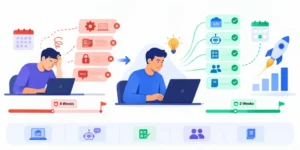


AI agents in 2026 are autonomous pipelines acting on real systems — not smarter chatbots. The tooling got reliable enough for production, but most teams are deploying them wrong because they skip the ownership conversation entirely.
Agents don’t replace roles. They eat the low-judgment work — PR context gathering, security reviews, PM research — so people can spend time on the work that actually needs them. The failure mode nobody sees coming is schema drift: upstream systems change quietly and agents start producing garbage before anyone notices.
Three things that actually matter: name an owner before anything ships, build observability in from the start, and decide upfront which workflows are your edge and which are overhead. Build the first. Buy the second.
- 1 Agents in 2026 aren't smarter chatbots — they're autonomous pipelines that act on real systems, with or without a human watching
- 2 The teams getting real mileage out of agents settled the ownership question before writing any pipeline code
- 3 Agents don't replace roles; they clear out the low-judgment work that was eating the time meant for the high-judgment work
- 4 Schema drift is the failure mode nobody designs for and the one that causes the most damage quietly
- 5 Build where your process is genuinely yours; buy everywhere else — that line matters more than the framework you pick
Introduction
Some engineering decisions don’t leave room to get it wrong. When a competitor ships a feature your team scoped three quarters ago — with half your headcount — you stop asking why and start asking what they changed.
More often than not in 2026, part of the answer is agents.
Not chatbots. Not autocomplete. Agentic systems — autonomous processes that take a goal, break it into steps, call tools, make decisions, and loop until the job is done or they hit something they can’t resolve. The kind that run overnight, file tickets, review PRs, scan codebases, and hand humans a summary in the morning rather than a queue of tasks to slog through.
We’ve spent the last 18 months working with engineering orgs across the spectrum — 20-person startups to 3,000-person enterprises — watching how this plays out in practice. And the pattern is consistent: the teams winning with agents aren’t the ones who deployed the most. They’re the ones who figured out one thing before writing a single line of pipeline code — what problem they were actually solving, and who was responsible for the output.
The Infrastructure Caught Up. That’s What Changed.
It’s worth being specific about what shifted, because “AI is getting better” doesn’t explain the pace of adoption we’re seeing.
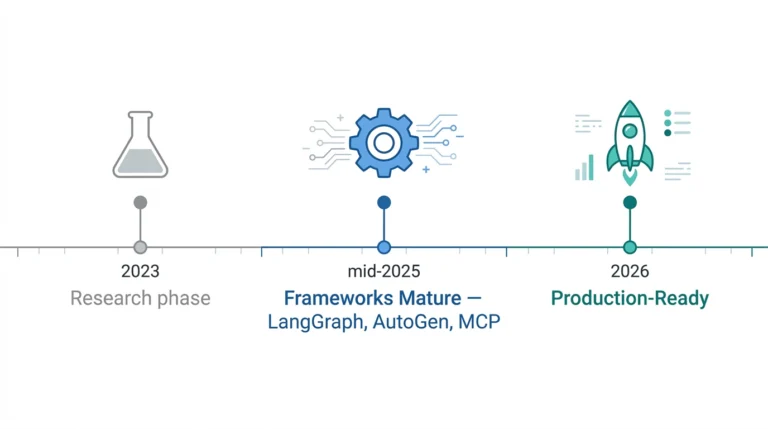
By mid-2025, frameworks like LangGraph, AutoGen, and Anthropic’s tool use API had dropped the barrier to building a working multi-agent pipeline from “research project” to “a good engineer and a week.” MCP (Model Context Protocol) gave agents a standardized way to connect to external systems — Jira, GitHub, Notion, Linear, Salesforce, databases — without rebuilding the integration layer for every new connector.
Memory layers matured. Agents can now maintain context across long-running tasks — tracking the state of a codebase refactor over days, not just a single session. Reliability improved enough that teams started trusting agents with actions that actually had consequences: merging code, filing bugs, sending alerts, updating records.
The models didn’t get dramatically smarter in isolation. The tooling got reliable enough for production. That’s a different kind of threshold. It’s the one that turns a demo into something you’d stake a delivery on.
Most CTOs we talk to understand this conceptually. Where they get stuck is the step after: what does running agents in production actually change about how people work — and who owns what when something goes wrong?
How Agents Are Actually Changing Day-to-Day Work
The popular narrative is that agents replace jobs. That’s not what we’re seeing in engineering organizations. What we’re seeing is closer to this: agents eliminate the low-judgment work that was crowding out the high-judgment work — and that changes what a productive day looks like for almost every role on an engineering team.
For engineers, the biggest shift is in context-switching overhead. A senior engineer who used to spend 90 minutes before a PR review gathering context — reading commit history, tracing which tickets a change relates to, checking for dependency conflicts — can now have an agent surface that context before the review starts. The engineer still does the review. They just stop spending an hour becoming qualified to do it.
The same applies to on-call. Agents that monitor logs, detect anomalies, correlate signals across services, and draft a first-pass incident summary before an engineer even opens their laptop aren’t replacing the on-call engineer — they’re eliminating the worst 45 minutes of that engineer’s night. That matters for retention as much as productivity.
For product managers, agents are changing the cost of research. Synthesizing customer feedback across Intercom, Slack, support tickets, and usage data used to take a PM half a day. An agent pipeline that pulls from all four sources, clusters themes, and drafts a prioritized summary takes about twenty minutes to run. PMs still own the judgment calls — what to prioritize, what to push back on, what the data is missing. They stop spending time collecting and formatting the inputs.
For operations and platform teams, the shift is in coverage. A team of three platform engineers physically cannot review 400 PRs a week for security anti-patterns, dependency drift, and configuration errors. An agent can. It files tickets for the findings that need human attention and closes the ones it can resolve automatically. The platform team reviews the summary and handles the escalations. Coverage goes from “what we have bandwidth for” to “everything.”
None of this looks like replacement. It looks like scope expansion — the same number of people covering meaningfully more ground because the agent handles the work that doesn’t require their judgment.
The Part Nobody Plans For
In traditional software, ownership is obvious. A service has a team. That team gets paged at 2am, handles incidents, reviews changes. One-to-one.
Agents don’t fit that model. A single pipeline might touch ticketing, code review, documentation, and deployment notifications. When it misbehaves — and at some point it will — who owns it? The platform team that built the scaffolding? The product team that defined the goal? The engineer who last touched the prompt?
We watched this go sideways with a client last year. Their QA automation agent started filing duplicate bug reports after an upstream API changed its response schema. Nobody caught it for six days. Not because the team was careless — because nobody owned the agent’s behavior specifically. They owned the components it called. That’s not the same thing, and the difference matters when something drifts.
The fix isn’t complicated, but it requires a decision before anything ships: assign one person to own agent output review. Not the person who built it — a rotating reviewer, the same way you’d own a monitoring dashboard. Their job is catching drift, not architecture. But that role has to exist before go-live, not after the first incident report.
Teams that formalize this structure see a consistent pattern: problems get caught in days instead of weeks, because someone is actually looking. Teams that skip it find out about problems from downstream effects — a customer complaint, a corrupted record, a deployment that went somewhere unexpected.
What Else We’ve Seen Move the Needle
Observability wired in from day one, not retrofitted. LangSmith, Weights & Biases Weave, and Anthropic’s tracing APIs all handle this. Agents that drift silently cause more damage than agents that fail loudly. If you can’t see inputs, outputs, latency, and error rates in a dashboard, you don’t actually know what the agent is doing in production. You find out from symptoms.
Prompts treated as code. Version control, testing, review — the same workflow as any other production artifact. Teams that keep prompts as freestanding text strings spend a lot of time re-debugging the same failure modes with no diff history to work from. A prompt change that breaks a pipeline a week later with no version history is the same category of problem as deploying without logging.
Schema validation at the edges. External systems change. APIs update response shapes. Notion adds fields. Linear changes how it represents ticket status. An agent that worked cleanly last month starts producing garbage because a dependency shifted underneath it. The fix is treating agent inputs as typed contracts with explicit validation steps, not strings you’re assuming stay stable.
Human-in-the-loop checkpoints for consequential actions. Full autonomy isn’t always the goal. Many of the most reliable agent deployments we’ve seen use a hybrid model: the agent handles research, drafting, and low-stakes actions autonomously, but escalates to a human before anything irreversible — a production deployment, a customer-facing communication, a financial record update. The escalation point is a design decision, not a failure of the agent.
Model selection benchmarked on actual workloads. Claude Sonnet 4 and GPT-4o handle tool calls differently, and those differences compound over long chains. Latency, context window behavior, and tool-use reliability interact in ways that aren’t obvious until you’re five steps deep in a real pipeline. Test against your actual workload, not a vendor benchmark that was designed to make the model look good.
Build vs. Buy: The Decision Most Teams Get Wrong
As the agent tooling market has matured, the build vs. buy question has gotten more complicated. In 2024, the answer was almost always “build” — the vendor landscape was thin and the integrations were shallow. In 2026, there are credible off-the-shelf agent products for sales workflows, customer support, code review, and documentation that work reasonably well out of the box.
The question isn’t which is cheaper. It’s where your competitive differentiation lives.
If agents are running workflows that are table-stakes for your industry — standard customer support routing, basic CI/CD health checks, generic documentation summarization — buying is probably right. Maintaining a custom agent pipeline for something a vendor does adequately is an ops burden that doesn’t give you an edge.
If agents are touching the workflows that make your product or engineering org genuinely different — the way you scope work, the way you handle customer escalations, the way you manage releases — buying a generic solution means your differentiated process runs on someone else’s architecture. That’s where building matters, and where the investment pays back.
The teams we’ve seen make the wrong call here almost always underestimate the maintenance cost of building custom agents for commodity workflows. The ones who get it right draw a hard line between “this is our edge” and “this is overhead” before they write any pipeline code.
The Results We’re Seeing
- Pre-sprint prep time: 6–8 hours → under 2 hours (sprint planning pipeline, Series B SaaS, 180 engineers)
- Security issue detection: 3x increase vs. quarterly manual reviews (nightly scan pipeline, fintech, 12-person platform team)
- Deployment pipeline coverage: 40% → 95% after adding agent-assisted release validation
- On-call MTTA (Mean Time to Acknowledge): down 35% with agent-generated incident summaries pre-loaded before engineer response
- PM research cycle: half-day → 20 minutes for cross-channel customer feedback synthesis
- Zero ownership-related incidents in teams that assigned reviewers before go-live, vs. multiple in teams that skipped that step
The common thread across all of these isn’t a specific framework or model. It’s the org model — ownership assigned, observability wired in, scope kept tight — being sorted out before anything ships.
When Agents Aren’t the Right Call
There are workflows where agents genuinely don’t fit, and pushing them in anyway creates more problems than it solves.
Outputs that are hard to validate automatically. If the only way to know whether the agent did a good job is to have an expert review the full output every time, you haven’t reduced workload — you’ve added a review step to a process that was already being reviewed. Agents work best where success criteria are verifiable, ideally programmatically.
Processes with high-stakes edge cases. Some workflows have a long tail of scenarios where the right answer depends on context a model won’t have. Medical record handling, legal document review, customer escalations involving sensitive personal situations — these warrant human judgment not because agents are dumb, but because the cost of a wrong call is asymmetric and the edge cases are genuinely hard to anticipate.
When the underlying process is broken. An agent running a bad workflow runs it faster and at scale. If the sprint planning process produces bad tickets because of unclear product thinking upstream, an intake agent will process and organize those bad tickets more efficiently. The problem moves faster; it doesn’t go away. Fix the process first, then automate it.
Regulated environments without a compliance framework for AI actions. In industries with audit requirements, every agent action that touches a regulated workflow needs to be logged, attributable, and explainable. That’s solvable, but it’s a pre-requisite, not a retrofit.
The question before any agent deployment: can you write a clear acceptance criterion for this task? If you can’t, an agent will fail in harder-to-diagnose ways than a human doing the same work.
Working With LeaderStack
We work with engineering leadership teams on technical strategy, agentic architecture, and the organizational design that makes both stick. If your team is evaluating where agents fit in your stack, scoping a pilot, or trying to untangle a deployment that didn’t go as planned, we’ve been in that situation before.