

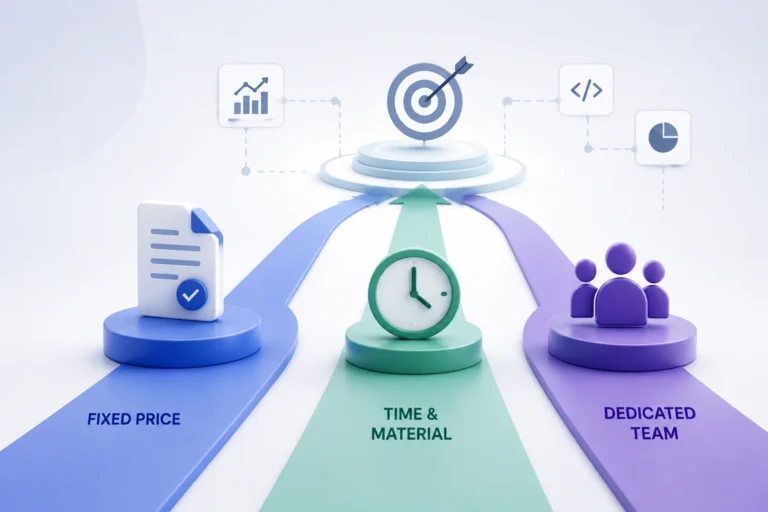
Fixed price, T&M, and dedicated teams aren’t competing options – they solve different problems, and the mistake buyers make is forcing every project into one model. Fixed price works when scope is genuinely stable, but turns hostile once requirements move, since every change becomes a contract negotiation. T&M trades cost certainty for flexibility – right for discovery-stage work, but risky without budget discipline and regular burn review. Dedicated teams buy continuity, but only pay off with enough sustained work to keep the team productive. The real question isn’t “which model is best,” it’s “which stage is this project in” – and Innostax runs a hybrid approach, shifting models as a product moves from discovery to scale.
- 1 Fixed price, T&M, and dedicated teams solve different problems - treating them as interchangeable is the root cause of most engagement-model friction.
- 2 Fixed price needs stable scope to work; once requirements shift, a product discussion becomes a contract discussion, and hidden risk (vendor contingency, change-request costs) surfaces.
- 3 T&M gives buyers room to adapt without renegotiating scope, but requires active ownership - sprint/monthly budgets and regular burn review keep flexibility from becoming wasted spend.
- 4 Dedicated teams sell continuity, not unpredictability - the real trade-off is commitment: the model only makes sense with enough sustained work to keep the team productive.
- 5 Project stage is a better starting point than budget: discovery favors T&M, a scoped MVP favors fixed price, and a steady growth-stage roadmap favors a dedicated team.
Software projects usually start with a commercial decision long before the first sprint begins. The fixed price vs time and material debate, along with the dedicated team option, covers the three most common engagement models, but they solve very different problems.
The trouble starts when buyers treat them as interchangeable. A fixed-price contract can create friction when requirements are still moving. T&M can become expensive when priorities are loose. A dedicated team can be wasteful when there is not enough sustained work to justify it.
The better question is not which model is best. It is which engagement model fits the shape of the work, the level of uncertainty and the amount of ownership the project requires.
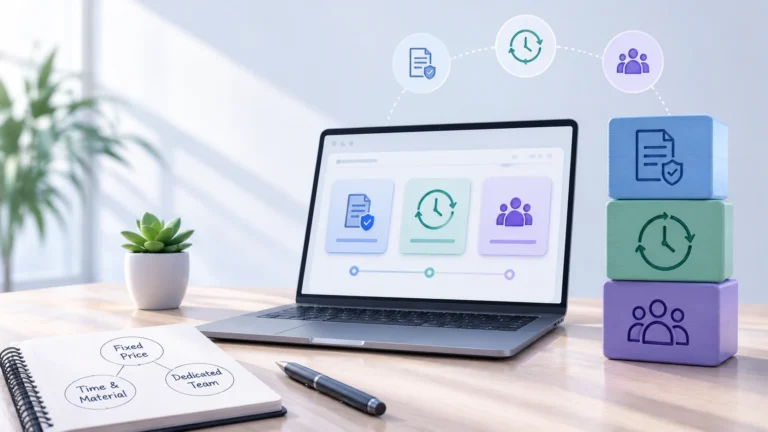
Decoding Modern Software Delivery Models for 2026
Software delivery has become more iterative, but commercial models have not always kept pace. Teams release more frequently, requirements change earlier and product decisions are often made during delivery rather than before it.
Fixed price still works when scope is clear and unlikely to move. T&M gives teams more room to adapt when requirements are still taking shape. Dedicated teams suit longer engagements where continuity and product knowledge matter. Instead of defaulting to one model, buyers need to assess how much is known upfront, how often priorities may change and how closely the delivery team needs to stay involved over time.
1. The Fixed Price Contract
A fixed-price contract sets the scope, timeline and commercial value before delivery begins. For buyers, the appeal is obvious. The budget is easier to approve and the expected outcome appears clear. That clarity holds only when the underlying scope is equally clear.
Once requirements begin changing, the commercial model starts working against the project. New requests have to be estimated, approved and added formally. Vendors protect the margin they committed to. Buyers push back on anything that looks like additional cost. A product discussion can quickly become a contract discussion.
Fixed price works best when the team knows what needs to be built, the acceptance criteria are clear and major changes are unlikely. That makes it useful for defined MVPs, migrations, integrations and contained product enhancements. It is a much weaker fit for work that depends heavily on discovery.
The Hidden Risks of Fixed-Price Agreements
The biggest risk is not always the headline price. It is what gets added around it. Vendors may include more contingency because they are carrying scope risk. Change requests can become expensive. Gaps missed during discovery may surface only after development begins. Even small changes can slow delivery if they require commercial approval.
Fixed price can offer strong budget predictability, but only while the agreed scope remains stable. Once requirements change materially, the final cost can move with them.
2. The Time and Material Model
A time and material contract takes the opposite approach. Instead of fixing the final cost upfront, the buyer pays for the engineering time used. That makes the model easier to work with when the product is still changing. Features can move in and out of the backlog without reopening the contract each time. Teams can respond to user feedback, technical findings or shifting priorities as part of normal delivery.
The tradeoff is that flexibility reduces certainty around the final spend. Buyers may know the hourly or daily rates in advance, but the total cost depends on how much engineering time the work ultimately requires.
A T&M engagement without clear ownership can keep consuming hours without producing enough value. Strong engagements put controls around flexibility. Teams work within sprint or monthly budgets, review burn regularly and make scope trade-offs as the work progresses.
Used well, T&M gives buyers room to change direction without turning every adjustment into a commercial negotiation.
When T&M Is Cost-Effective
T&M is usually a strong fit when:
- Requirements are still being defined
- Discovery is part of the engagement
- Priorities are likely to change during delivery
- The team needs to test ideas before committing further
- Engineering capacity needs to increase or reduce over time
It works best when the buyer is actively involved in prioritisation and the vendor provides clear visibility into where time is going.
3. The Dedicated Team Model
A dedicated development team sits closer to an extension of the buyer’s own engineering function. Instead of staffing one defined project, the vendor assigns a team that stays with the product over a longer period. The buyer sets priorities, shapes the backlog and works with the same engineers across releases.
The value is continuity. Engineers who stay on the same product learn its architecture, recurring issues, business rules and decision history. They spend less time rebuilding context and more time applying it. That becomes especially useful when the roadmap extends across quarters rather than weeks.
Commercially, dedicated teams are also easier to plan around. Costs are usually structured around the team or individual roles each month rather than individual deliverables. That makes monthly expenditure relatively predictable as long as the team composition remains stable.
The total cost of the engagement still depends on how long the team stays in place. The tradeoff, therefore, is not unpredictability but commitment. A dedicated team only makes sense when there is enough consistent work to keep it productive.
Managing a Dedicated Remote Development Team
Remote teams do not need more meetings. They need clearer operating habits. Ownership should be visible, decisions should be documented and blockers should surface quickly. Shared issue tracking, regular sprint reviews, clear technical leadership and well-defined communication routines matter more than the number of calls on the calendar. Periodic in-person sessions can help with planning or relationship building, but they should support the delivery model rather than compensate for poor day-to-day communication.
Choosing Between Software Pricing Models
The differences become easier to see when the models are compared against the same delivery questions.
| Dimension | Fixed Price | Time and Material | Dedicated Team |
| Scope flexibility | Low | High | High |
| Budget predictability | High when scope is stable | Low to medium | High month to month |
| Best fit | Defined delivery | Evolving work | Ongoing product development |
| Change handling | Usually negotiated | Managed within backlog | Managed within team capacity |
| Buyer involvement | Moderate | High | High |
| Ramp-up | Usually project-specific | Relatively quick | Moderate |
| Exit flexibility | Medium | High | Low to medium |
The distinction on budget is important. Fixed price provides the clearest view of total project cost when the scope is unlikely to change. T&M provides less certainty because total spend depends on the time used. A dedicated team gives buyers a predictable monthly run rate, although the eventual total depends on the duration of the engagement.
The table is useful, but it should not replace judgement. Two projects with similar budgets can still need completely different commercial structures depending on how much is known at the start.
The Innostax Hybrid Approach
Projects do not always stay the same shape from discovery through scale, so the engagement model does not have to remain fixed either. Innostax uses different commercial structures across different stages of delivery. Early discovery may run on T&M when requirements are still being tested. A tightly scoped MVP may move into fixed price once the outcome is clearer. Products with established roadmaps can then shift to dedicated teams as continuity becomes more valuable.
Hybrid models can also work within the same engagement. A core dedicated team might own ongoing product development while specialist or short-term work is handled through T&M. The important part is reviewing whether the model still fits the work. A contract structure that made sense six months ago may no longer be the right one today.
Which Model Aligns With Your Project Stage?
Project stage is often a better starting point than budget when choosing an engagement model. Different phases create different levels of uncertainty and different demands on the delivery team.
- Discovery and prototype: T&M works well because requirements are still taking shape and the team needs room to test assumptions.
- MVP with clear scope: Fixed price can work when features, timelines and acceptance criteria are already well defined.
- Growth-stage product: A dedicated team becomes more useful when the roadmap is steady and product knowledge needs to carry from sprint to sprint.
- Enterprise platform: A dedicated team can handle ongoing development, while T&M can support short specialist initiatives or temporary spikes in work.
- Legacy modernisation: Dedicated teams are often a stronger fit because understanding older systems, dependencies and business rules takes time.
The model should reflect the stage the product is in now, not the way the engagement happened to start.
Keep the Contract Aligned With the Work
An engagement model sets the commercial rules, but it does not determine whether the project will work. Fixed price still needs good discovery. T&M still needs budget discipline. A dedicated team still needs a clear roadmap and active product ownership.
The stronger vendor relationships are usually the ones where both sides are willing to revisit the structure as the project changes. If the scope becomes clearer, the model may need tightening. If uncertainty increases, the engagement may need more flexibility. The contract should support the work rather than force the work to fit the contract.
Not Sure Which Engagement Model Fits Your Project?
Picking the wrong model costs more than the contract itself in rework, missed deadlines and scope fights nobody planned for. Innostax scopes your project’s stage, uncertainty and risk profile first, then recommends the engagement model that actually fits, not the one that’s easiest to sell.
Book a free 20-minute scoping call and get a model recommendation for your project, no obligation.