

- 1 Open-Source & Cost-Effective: PHP eliminates licensing costs, making it budget-friendly for startups and SMEs.
- 2 Large Talent Pool: Businesses can easily find skilled PHP developers worldwide.
- 3 Cross-Platform Compatibility: PHP works seamlessly across major operating systems and servers.
- 4 Faster Development: PHP frameworks like Laravel and CodeIgniter speed up project delivery.
- 5 Robust Security & Performance: PHP offers strong security features and high-speed performance for dynamic websites.
- 6 Scalability & Customization: PHP is perfect for both small websites and enterprise-level apps, offering endless customization options.
- 7 Strong CMS Support: Powering WordPress, Joomla, and Drupal, PHP supports various content management systems.
- 8 Excellent Community Support: An active global community ensures continuous improvements, troubleshooting, and innovation.
PHP is one of the most widely used server-side scripting languages for website development. Businesses seeking reliable, scalable, and cost-effective web solutions still turn to PHP for website development. In this post, we’ll explore why PHP remains relevant and how it benefits businesses in today’s digital ecosystem.
There has been a massive evolution in PHP over the last few years. From a basic scripting tool to an object-oriented programming language, PHP has always met changing technological demands. Its widespread use and active community ensure that PHP is used in development services are readily available and consistently reliable.
Why PHP Still Powers Millions of Websites?
Following are some of the biggest benefits of using PHP frameworks for website development:
1. Open-Source and Cost-Effective
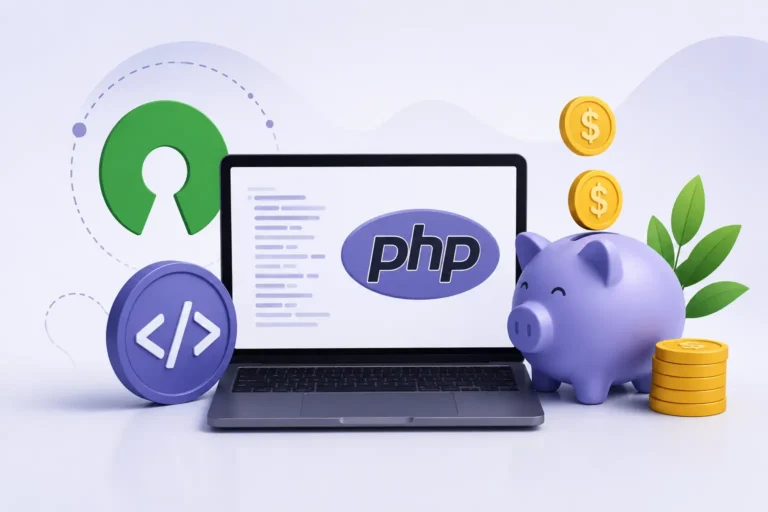
One of the biggest advantages of PHP is that it’s open-source and there are no licensing fees. Businesses, especially startups and SMEs, can save their budget for more important activities like marketing, or scaling.
2. Large Skilled Professionals

PHP has a vast and global developer community, so businesses can easily find skilled professionals. They can also get a PHP development company to build their desired website for their business. You can easily get a large pool of talent that is rich and experienced.
3. Cross-Platform Compatibility
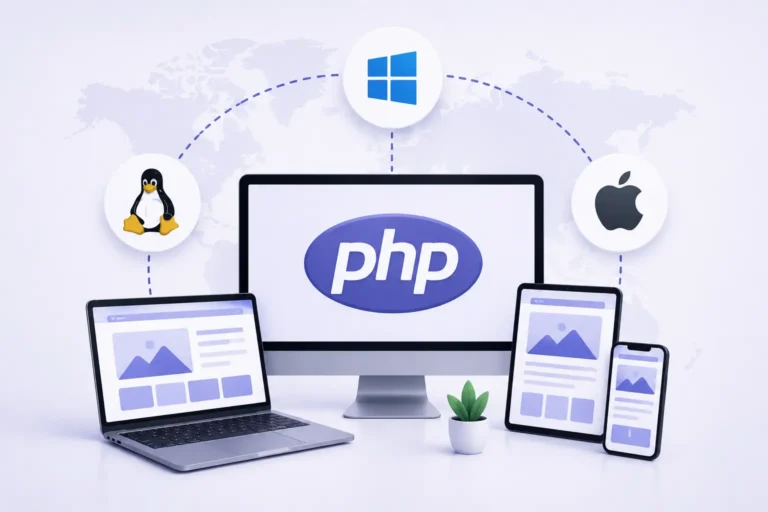
PHP can run successfully on some of the major operating systems. It’s also compatible with almost every server, from Nginx to Apache. This flexibility makes PHP ideal for businesses that want a solution that can work smoothly across different environments.
4. Faster Delivery
PHP is a simple and massive ecosystem of frameworks (like Laravel, Symfony, and CodeIgniter). It significantly speeds up the development process. For businesses, this means faster development and the ability to scale quickly without much overhead.
5. Strong Frameworks and CMS Support
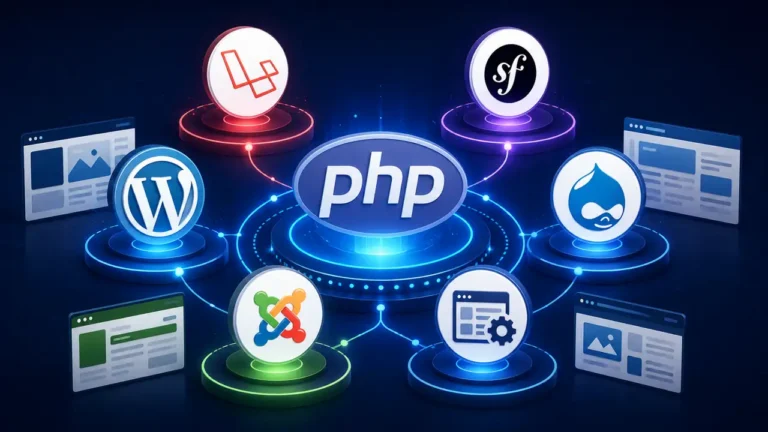
PHP is the backbone of several content management systems like Joomla, WordPress, and Drupal. If your business needs a CMS then PHP is a better choice for website development services . Frameworks like Laravel offer modern tools and best practices, which make PHP as modern and powerful as any newer language.
Business Benefits of PHP Website Development
As a business owner, following are some of the benefits you’ll find for your website and app when you build it with PHP:
1. Scalability

PHP offers excellent scalability, that allows developers to build everything from simple landing pages to complex enterprise-level applications. This makes PHP a future-proof investment for businesses expecting to grow.
2. High Performance

Scripts run faster, and memory usage is lower using PHP technology for website development services which makes it ideal for high-traffic websites.
3. Robust Security

PHP offers strong security tools and best practices. By using PHP for application development companies, it is easy to guard against SQL injections, cross-site scripting, and other vulnerabilities.
4. Customizability
Whether you’re running a membership platform, an eCommerce store, or a custom SaaS product, PHP allows extensive customization. You get a rigid framework or licensing restrictions to build a website as per your business needs.
5. Excellent Community and Support
PHP is one of the most active communities in the world. It is for troubleshooting a bug, implementing a new feature, or integrating a third-party service by using PHP technology.
Choosing the Right PHP Web Development Company
The right team will understand your requirements and business goals, recommend the best frameworks, and deliver a scalable solution.
When evaluating a PHP expert development company, consider:
- Their portfolio of past PHP projects
- Client testimonials and reviews
- Technical expertise and certifications
- Post-launch support and maintenance services
PHP Myths That Need Retiring
There is an idea, which exists in the world, that PHP is dying or old already, but it is an incorrect perception that needs to be refuted. In fact, PHP underlines some of the heaviest websites on the planet, including Facebook, Wikipedia, Slack, etc. PHP 8 introduced performance boosts and new types that allow developing applications competitive with any modern language. PHP never lost its relevance, it simply does not generate the same level of marketing as other languages do. For businesses, the practicality and track record of PHP matter much more than the coolness factor.
The myth about PHP not being able to scale is also completely unfounded. Some people think that PHP is only good for small-scale development: any large-scale application built with it will necessarily suffer from performance issues. This thinking does not consider that PHP projects that failed to scale were built incorrectly or that they were supported on underpowered servers. Any competent developer can take proper PHP application architecture and deploy it on servers that will support the load.
PHP Development Practices in a Nutshell
For many, PHP is spaghetti code written in disorder, but this mindset is a relic of the past: the modern Laravel framework, PHP’s framework following all best practices, allows developers to work with a consistent and well-rounded set of tools. It introduces the community-driven approach to developing applications. The same framework provides developers with a good set of routing and ORM tools, as well as extensive testing utilities.
Additionally, PHP has Composer, a dependency manager that allows organizing code efficiently and PHP project development now involves using well-maintained external packages. Developers take care of writing tests that check whether the code works correctly, and static code analysis helps them find potential issues before they ship the software. Thus, PHP development practices are on par with those of any other modern programming language. Most of the criticism of PHP stems from the fact that people associate PHP projects with bad practices.
PHP as Choice: Pros and Cons
There are no programming languages that are universal and that can be used for any tasks: some of them are better suited for specific purposes, and others are more general. The same is true for PHP: it has its strengths, and there are areas where other programming languages may be more advantageous.
PHP is ideal for building content-heavy web applications or sites with blogs. It allows you to build enterprise-level e-commerce solutions. It is appropriate for WordPress-based applications and APIs that use a CMS as their backend. PHP is a good choice for startups that want to minimize risks and have working software as soon as possible. Additionally, since PHP is open-source, there is no need for expensive licenses. Moreover, a rich pool of PHP developers allows for lower overall development costs.
Meanwhile, PHP is not the best choice for applications that require real-time communication: such projects may involve heavy server loads, for which Node.js, for example, is better suited. PHP is not optimized for such cases; therefore, it is better to choose another programming language for applications with intense multiplayer interaction. Similarly, PHP is rarely used for data science and machine learning software development, since these areas are dominated by Python.
PHP Application Lifecycle: Beyond Deployment
The end-goal of PHP project development is not a website launch. The importance of Ongoing maintenance is hard to overestimate: software applications require regular security updates, which helps prevent breaches and vulnerabilities. Since PHP’s ecosystem is well-established, it is easier to find qualified developers who will maintain the application: they will update core PHP functions and dependencies, thereby ensuring stability and security. All of this is part of the PHP application lifecycle.
Modern PHP development practices are continuing to evolve. The same applies to the tools and programming practices that developers use. Developers should always strive to update their skills so that they stay relevant: PHP projects, in particular, and software projects in general, are highly dependent on the quality of the team that maintains the code. Organizations that do not invest enough in maintenance and updates eventually face technical debt: this debt occurs because the codebase becomes inconsistent with the current best practices. One of the reasons for PHP’s reputation as an unreliable technology is that developers often use it incorrectly.
Migrating an Old PHP Application Without Rebuilding it from Scratch
One of the real-world challenges businesses face is not developing a new application from scratch, but rather taking aPHP site or application built some time ago using a much older technology stack and trying to decide how best to evolve it. In most cases, this doesn’t involve rebuilding it from scratch – thanks to PHP’s intrinsic backwards-compatibility starting from version 7, most upgrades can be done incrementally and without rewriting the application’s core logic in PHP or another language.
The typical process involves bringing the codebase under control – getting it to run cleanly under a modern PHP version and resolving any deprecation warnings and issues before embarking on a larger upgrade. Then, businesses can look into evolving the application one layer at a time, wrapping legacy code in new patterns, adopting the architectural style of a chosen framework incrementally, or breaking out individual modules and components to modernize their codebase without taking a larger toll on the business. While such an iterative approach may take longer to plan, implement and document, it is generally much less disruptive to the business than a full rewrite. For most companies with a legacy PHP application running on an older version of the language or a deprecated framework, it is a good idea to invest in an audit and determine which parts of the application can be salvaged for the time being, and which would benefit from being redesigned or rewritten.
Modern PHP Applications Usually Feature More Than One Language Stacks
Very rarely do companies develop applications using a single programming language these days, and PHP is usually deployed as one element of a larger technology stack. A common scenario involves PHP and JavaScript frameworks being used in tandem; typically, one powering the application and business logic in the back-end and the other providing a more dynamic interface for users and consuming the former’s endpoints as a front-end framework. This approach, which sometimes goes by the name of decoupled or headless CMS, allows companies to get the best of both worlds and deploy new functionality faster while retaining the stability and performance of a mature back-end.
This is especially common with CMSs such as WordPress and Drupal, where their respective core codebases and accompanying content management features are exposed via APIs which in turn are consumed and sometimes modified by separate applications. More broadly, it means that a PHP application is not necessarily a stand-alone piece of software any longer but rather part of a larger system which also features components written in Python, Node.js, or other modern programming languages.
PHP – A Right Choice for a Business Website
For businesses seeking cost-effective, scalable, and high-performance web solutions, PHP technology for website development is a smart choice.
If you are considering building or revamping your website, PHP is a better option. Partner with an experienced web development company to take your digital presence to the next level helping to grow your business.