

DevOps managed services have equalized the playing field in terms of capability and cost to an in-house team, which is why the default assumption of ‘just build it in-house’ is no longer often the right choice. In-house DevOps offers maximum flexibility but suffers from a talent acquisition challenge (senior level hires take 6+ months to fully productive) and opportunity costs of capital tied up in the person. Outsourced managed services offer faster team onboarding, scaling, and proven expertise in a domain the provider has experience in at the expense of flexibility and control. The math almost always works out better for managed services from a total cost of ownership perspective when you consider the recruiting costs, training, premium pay for on-call coverage, and opportunity costs of capital for an in-house team. According to Innostax, a fast-growing team should almost always start with managed services, while more established teams with a strong recruiting pipeline can build their in-house capabilities. The most common recommendation is a hybrid setup, where the internal team leads architecture design efforts, and the managed team executes and provides on-call support.
- 1 DevOps scope has expanded (K8s, IaC, secrets management, observability, cost optimization, security posture, platform engineering) — one hire can't cover it all, and a specialist team takes ~6 months to build.
- 2 Managed DevOps services now run production for FinTech/HealthTech at compliance levels many in-house teams can't match.
- 3 The core in-house risk is the "talent scarcity trap": hard-to-hire senior engineers, retention pressure, and ~6 months to first productive contribution.
- 4 Outsourcing trades some control for speed — a full team in week one instead of month six — plus built-in scalability and pre-solved problems.
- 5 Use the decision matrix: in-house fits when you have time, an existing senior lead, strong talent access, low scaling volatility, custom compliance needs, and fixed opex; managed fits the opposite profile.
- 6 AWS/cloud DevOps is its own specialty — managed providers bring reference architectures (landing zones, cost governance, multi-account/cross-cloud setups) that take in-house teams a year to develop.
- 7 TCO comparisons favor managed once you count in-house's hidden costs (recruiting, training, on-call premiums, hiring-gap delivery cost) — especially in the first two years.
- 8 A hybrid model — internal lead for architecture/priorities + managed team for execution, on-call, and specialist skills — is Innostax's recommended balanced approach for growing teams.
- 9 Before signing with any DevOps services company, vet them on team composition, on-call/escalation process, MTTR, compliance handoffs, fee structure, IaC repo ownership, and onboarding time.
Every engineering leader hits the DevOps question eventually. Do you build the capability in-house or bring in a DevOps services company that does it as a service?
The answer used to be simple: build it if you could afford to. In 2026, that’s no longer true. DevOps talent is scarce, cloud costs are volatile, and platform expectations have grown significantly.
DevOps managed services now compete directly with in-house teams on both capability and cost. This post walks through the trade-offs, the hidden costs, and the framework we use to help clients decide.
The State of DevOps Engineering Services in 2026
DevOps services in 2026 cover far more ground than they did five years ago. A single provider or hire now needs to handle:
- Kubernetes and container orchestration
- Infrastructure as Code (IaC)
- Secrets management
- Observability and delivery metrics
- Cost optimization
- Security posture
- Platform engineering
Hiring one engineer who covers all of this is expensive and slow. Hiring a team of specialists can take six months and a strong recruiting pipeline. That’s why a managed provider offering a full stack of proven DevOps solutions has moved from a niche option to a serious mainstream choice.
What Are DevOps Managed Services? (And Why They Have Changed)
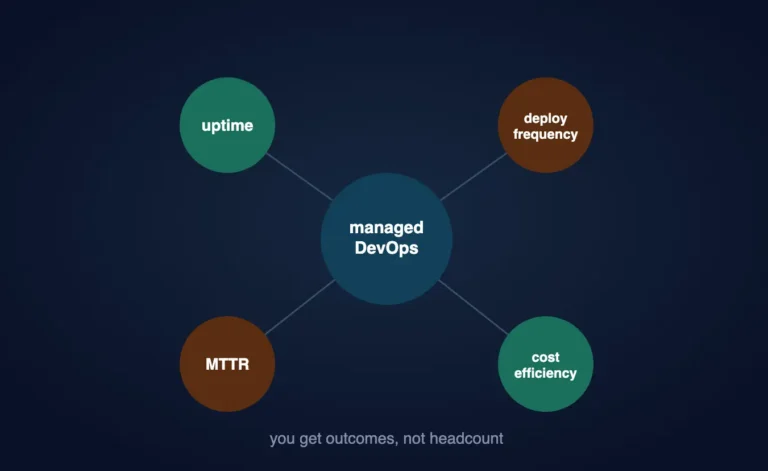
DevOps managed services deliver the DevOps capability as a service. A team of engineers, processes and tooling shows up ready to run your platform. The provider handles hiring, training, on-call, tool licensing and continuous improvement. You get outcomes: uptime, deploy frequency, MTTR, cost efficiency. The model has matured. Managed providers now run production for FinTech and HealthTech companies at compliance levels many in-house teams cannot match.
The In-House DevOps Model: Control vs. The Talent Scarcity Trap
In-house DevOps engineering services give you full control over process, tooling and priorities. They also require you to solve the talent problem yourself. Senior DevOps engineers are among the hardest hires in the market. Once hired, retention is a constant concern. Time to first productive contribution is often six months. Every gap in the team, from Kubernetes to cost optimization, is a hiring project. Teams that underestimate the talent scarcity trap end up with a partial DevOps function and outsized platform risk.
Evaluating DevOps Outsourcing Services: Speed, Scalability and Expertise
DevOps outsourcing services shift the trade-off. You get a full team on week one instead of month six. Scalability is handled by the provider: more capacity means adding hours, not opening requisitions. Expertise comes bundled: the provider has already solved the hard problems on other client accounts. The trade-off is control. You have less say over individual hiring, and the provider’s process becomes your process. For many teams growing quickly, the trade-off is worth it. For teams with a specific compliance or architectural need, hybrid models fit better.
Decision Matrix: In-House vs. Managed DevOps Services Company
The choice between in-house and a DevOps services company depends on a few clear factors. This matrix maps them.
| Factor | In-house fits | Managed fits |
| Time to capability | 6+ months acceptable | Weeks |
| Team size today | Existing senior lead | No DevOps hire yet |
| Talent market access | Strong | Weak |
| Scaling volatility | Low | High |
| Compliance needs | Highly custom | Standard SOC 2, HIPAA |
| Budget stability | Fixed opex preferred | Variable opex OK |
The Cloud Perspective: AWS DevOps Services and Multi-Cloud Environments
AWS DevOps services and cloud DevOps services more broadly have matured into their own specialty. AWS Control Tower, cost governance, multi-account setups and cross-cloud networking all require specific expertise. Managed providers who focus on AWS bring reference architectures that would take an in-house team a year to develop. For multi-cloud shops, the provider’s cross-cloud experience is often the deciding factor. In-house teams can match this level, but only after long, expensive learning cycles.
The Hidden Costs: Total Cost of Ownership (TCO) Comparison
TCO comparisons between managed services and in-house teams often surprise engineering leaders.
In-house TCO includes:
- Salaries and benefits
- Recruiting costs
- Tools and licensing
- Training
- On-call premiums
- The delivery cost of ongoing hiring gaps
Managed services cost is mostly captured in the monthly service fee, plus internal coordination time.
In-house looks cheaper when you only look at the salary line. It usually loses on total cost once you factor in the hidden items above. Comparing managed service pricing against a fully loaded in-house TCO typically favors managed services, especially in the first two years.
The Hybrid Strategy: Why Innostax Recommends a Balanced Approach
Innostax often recommends a hybrid model. Keep an internal DevOps lead who owns architecture and priorities. Bring in managed DevOps engineering services from Innostax for execution capacity, on-call rotation and specialist skills. The internal lead keeps control. The managed team delivers scale. Neither side runs alone and the trade-offs flatten. This model fits growing teams that need capability now but do not want to hand off the platform entirely.
Key Questions to Ask a Prospective DevOps Services Company
Ask any DevOps services company these questions before signing. What is your team composition per client account? How do you handle on-call and escalation? What is your MTTR on production incidents? How do you manage compliance handoffs? What is included in the base fee and what is variable? Who owns the IaC repos, you or us? How do you onboard a new client, and how long does it take? Answers to these separate serious providers from ones that will disappoint you at month three.
The Warning Signs You’ve Waited Too Long to Decide
Most teams don’t make a deliberate choice between in-house and managed DevOps upfront. They tend to fall into one model based on circumstance, and only revisit the decision when something goes wrong. A few signs that this has already happened:
- Tribal knowledge risk. One engineer holds the entire platform’s knowledge in their head, with no documentation that could survive a vacation, let alone a departure.
- Deploy anxiety. Deploys have quietly become something the team dreads, rather than a routine part of the process — a sign that risk has grown out of control.
- Unexplained cost creep. Infrastructure costs slowly climb over time, and no one can clearly explain why, suggesting a breakdown in cost governance.
These problems rarely appear suddenly. They build gradually enough that a team normalizes them, until an outage or a costly fix forces the issue. Recognizing these signs early is key to making a deliberate choice, rather than being forced into one.
Why the Right Answer Often Changes as a Company Grows
This isn’t a decision you make once and forget. A ten-person startup’s DevOps needs look nothing like what they’ll need scaling to fifty people, or serving customers across multiple continents instead of one.
In the earliest days, when a senior engineer can hold the whole architecture in their head, either model tends to work fine. As complexity grows, though, the assumptions that made one model attractive start to break down.
This is exactly why the hybrid model tends to succeed long-term: it lets a company scale its operations alongside its actual needs, instead of fixating on one philosophy and growing around it. Teams that choose a model, then reevaluate as they grow — rather than doubling down out of habit — tend to come out ahead.
What Changes the Calculation for Regulated Industries
Companies operating under heavier regulatory scrutiny face a different set of risks. In most industries, a mistake leads to dissatisfied customers and lost revenue. In finance or healthcare, the same mistake can draw regulatory attention.
This changes what “control” actually means. In less regulated industries, control usually means having the final say on architecture decisions. In a heavily regulated industry, it means being able to demonstrate exactly how decisions are made, and which engineers have access to which data.
This is why many regulated companies do well with a managed provider that already has the process, tooling, and experience needed to satisfy auditors. They’re effectively purchasing an existing level of compliance maturity, rather than building one from scratch. That said, not every provider has deep experience with every industry’s specific requirements — so this needs to be evaluated case by case.
Conclusion: Choosing the Right Model for Your Growth Velocity
The choice between DevOps outsourcing and in-house managed services depends on your growth velocity, talent access, and compliance posture.Fast-growing teams with weak DevOps talent access should generally start managed, and consider building in-house later.
Established teams with strong recruiting pipelines can build in-house from the start. Many teams land somewhere in the middle, and benefit most from a hybrid approach. We run both models with clients and can help you figure out which one fits. Reach out before the next platform incident forces the decision for you.