

- 1 React Native allows building native-like apps for iOS and Android using one codebase.
- 2 Businesses benefit from cost-efficiency, faster development, and near-native performance.
- 3 The development process includes requirement gathering, UI design, component reuse, state management, testing, and deployment.
- 4 Tools like React Navigation, Jest, and Detox streamline app development and debugging.
- 5 An experienced React Native development company can help ensure seamless delivery and app store launch.
Are you a business owner who is planning to make an app with React Native? If yes, then these are some of the aspects regarding it. Businesses would want to deliver seamless apps that can work across multiple platforms. However, building separate apps for different platforms can be costly and time-consuming. So, you can use React Native to build an app that can work across multiple platforms. It is one of the popular frameworks for building cross-platform apps. Here, we will explore how cross-platform apps are made with React Native and why it is used widely.
What is React Native?
React Native is an open-source framework that allows developers to build mobile applications using JavaScript and React. It has the ability to render apps natively on both iOS and Android platforms, with a better user experience or performance. React Native compiles directly to native code which means users get the smoothness and responsiveness they expect from a native app.
React Native vs. Flutter vs. Native Development: Which Should You Choose?
There are other frameworks for building cross-platform mobile apps besides React Native, and most companies that want to build such apps consider using Flutter or native platforms. Each has its advantages and drawbacks, and the choice between them depends on the situation.
Flutter is Google’s alternative to React Native; it uses Dart programming language, and unlike React Native it does not rely on native components – Flutter has its own UI engine that renders its own components, giving apps built with it more consistent look and feel across platforms. It also has excellent performance when it comes to graphics-heavy apps, but it has steeper learning curve and is not as widely adopted as React Native.
The native approach means using platform-specific languages (Swift for iOS and Kotlin for Android) and generally offers the best performance and user experience but requires writing two significantly different code bases for the two platforms, resulting in longer development time and higher costs – this approach should be used when there is a need for apps that use some specific platform features.
In most cases apps that do not have graphics-intensive components and do not need to use specific platform features can be developed faster and with better cost-efficiency using React Native while still providing good user experience; apps that need to use graphics-intensive features should be developed natively.
Process of Building a Cross-Platform App with React Native
Building a cross-platform app with React Native has different stages. Let us see through the typical process used by React Native by the mobile app development companies:
1. Requires Gathering and Planning

While developing a React Native app project, understanding the client’s needs is very important. This includes defining the app’s core features, identifying target users, and deciding which platforms the app will support.
A reliable React Native web application development services provider will also provide third-party integrations of native modules. This planning phase ensures the app meets both user expectations and business goals.
2. Designing the User Interface
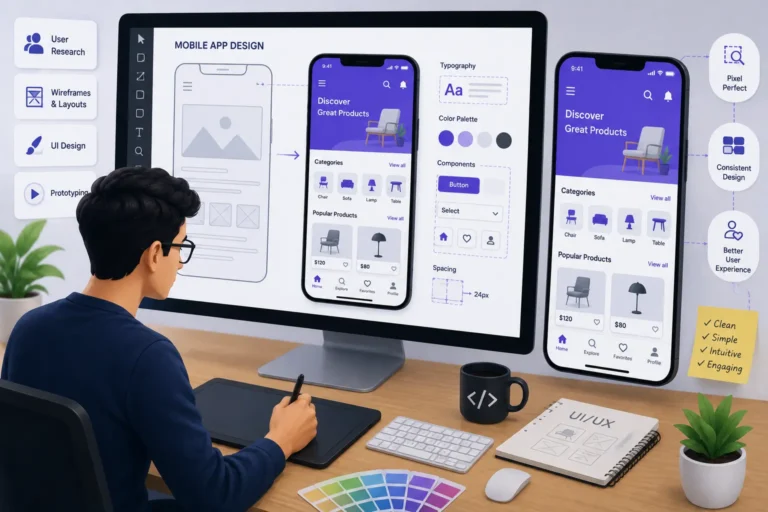
React Native’s strength is that it can give a consistent look and feel across platforms. React Native supports platform-specific styling using conditional logic which makes the appearance and behavior of UI components better.
3. Development with Reusable Components
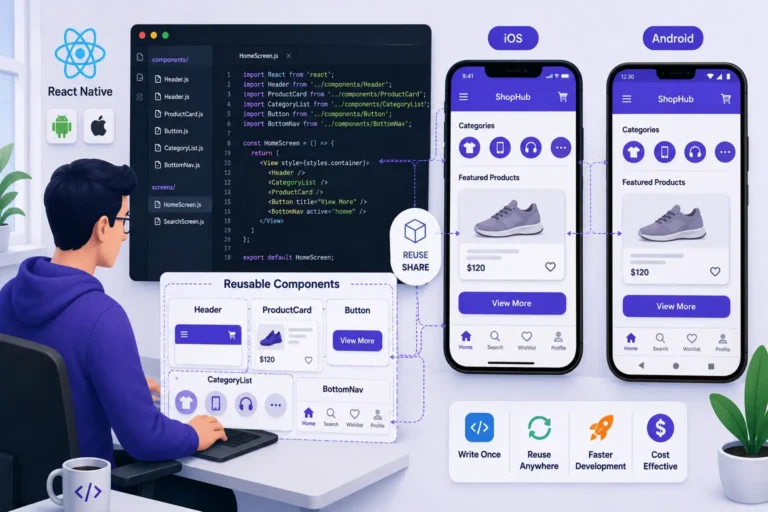
The main benefit of React Native being used for application development services lies in component-based architecture. The reusable components can be used and shared across platforms. This modular approach speeds up development and reduces maintenance efforts.
4. State Management and Navigation
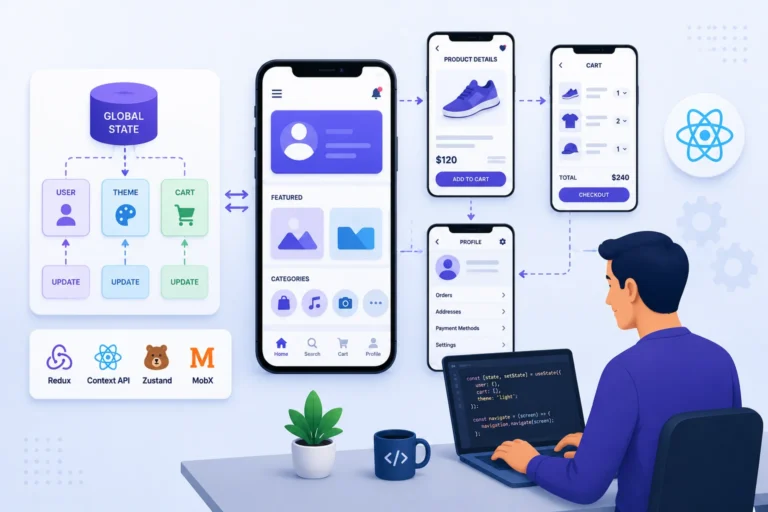
React Native apps can use different libraries for state management. For navigation, developers can use React Navigation, which supports tab, stack, and drawer navigators. Efficient state handling ensures helps user interactions, app data, and API responses are managed effectively.
5. Testing and Debugging
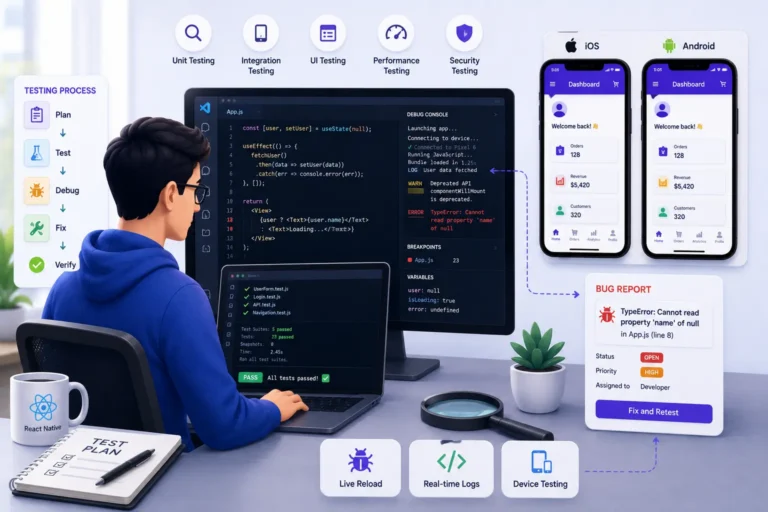
Quality assurance is important when using React Native for any app development technology. Automated testing tools like Detox (for end-to-end testing), Jest (for unit testing), and Enzyme (for component testing) can be used. React Native allows developers to instantly see code changes without recompiling the app. This helps in speeding up the development.
6. Deployment and App Store Submission
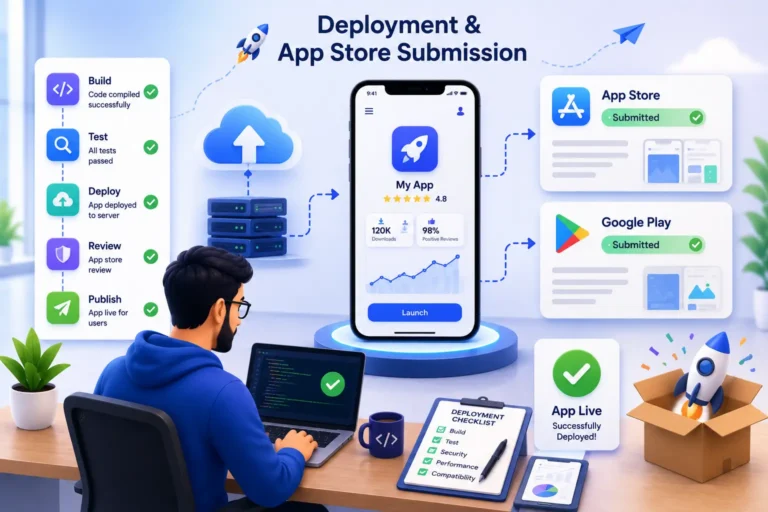
After completion of development and testing, the app is prepared for launch. React Native integrates easily with continuous integration and deployment tools. A trustworthy React Native web solution application development services provider will handle submission processes for both the Apple App Store and Google Play.
Common Challenges When Building with React Native — and How to Solve Them
React Native eliminates a significant amount of the complex processes involved with cross-platform development, but it sacrifices some degree of control and flexibility.
The compatibility of native modules may be an issue for more complex applications that need to utilize advanced smartphone capabilities or cutting-edge system API’s that may not be supported by React Native natively and require additional modules to be written in Swift, Objective-C, or Kotlin.
Performance optimization can be an additional task for applications that use particularly graphic-intensive or animation-heavy UI’s, as React Native’s JS thread can add extra overhead to rendering processes not found in native apps. This can usually be mitigated by using the React Native Reanimated library, which offloads animation-specific processes to the native thread.
Development may also involve the necessity of resorting to third-party developed libraries, which can entail an additional risk if the library is not well-maintained or becomes obsolete before the compatibility with new versions of React Native is established.. This risk, however, is virtually inherent to any cross-platform framework, and experienced developers will assess the stability of a library before using it in a project.
Finally, application size may be heavier than that of a purely native application, as the React Native framework itself must be bundled with the application, although this difference is negligible for most modern mobile devices.
Why Businesses Must Choose React Native for Cross-Platform App Development?
There are many reasons why businesses and developers choose React Native over other frameworks. Some of them are listed below:
- Cost-efficiency by avoiding duplicate teams for different platforms
- Faster development due to code reusability
- A Rich ecosystem of libraries and Strong community support
- Near-native performance for demanding applications
Companies looking for reliable solutions often turn to a mobile app development company providing React Native services with proven expertise in building high-performance cross-platform apps.
How Much Does It Cost to Build a Cross-Platform App with React Native
Cost is usually the first question that bothers every business owner that has come to the idea of developing a React Native app for the first time. After all, many organizations tend to make a number of compromises while building their applications due to wrong estimations. When calculating the final price, there are several factors that should be taken into consideration.
First and foremost, one should know that the application’s complexity is the main component of the final price. It directly impacts the app development team’s size, the time needed to build the product, and the number of additional services required to support the project. Second, the time spent on the designing of UI/UX should also be taken into account. In that case, if one wants to make one’s UI components, the learning curve would be rather steep, and it would take more time and effort to make them look native. Third, many organizations forget about the cost of maintaining and updating the application that can be even higher than the initial cost.
Hiring the React Native app development company to create the product from scratch is a great idea. These companies have years of experience in this sphere, which makes them able to reduce the cost of development significantly. Besides, if your application is designed right the first time, there will be no need in making any substantial alterations to the code, which, in turn, implies lower maintenance costs.
How Long Does It Take to Build a React Native App?
In addition to the previously discussed concern about the cost, another factor that determines the organization’s ability to plan the launch of the software is the timeline, which is also influenced by choosing the React Native framework. It should be understood that whereas developing the same application in React Native takes less time than building native iOS and Android apps, the time required for development still varies significantly depending on the application’s complexity.
A simple app with only a few screens and no backend integration can be built within several weeks after setting the requirements. The applications with user authentication, API, and moderately customized UI/UX will require more time to be developed and extensively tested on both platforms because of the necessity to perform extra test cycles. This way, the most time is spent on applications with animations, offline support, and complex logic because of the necessity to test them on real devices in order to reveal the differences in animations and behavioral logic.
Finally, the time allocated to design, develop, and test the application depends on the launch date since Apple’s App Store review is a relatively long procedure compared to Google Play. Thus, it is better to plan the launch date considering this aspect in mind. Altogether, it is better to plan the timeline for React Native application development on the safer side since missing the deadline is always a stressful situation for everyone involved.
Get Ready To Make Cross-Platform App Using React Native
React Native enables developers to create native-like experiences with one codebase, reducing both time and development costs. If you are looking for React Native mobile app development services, then you can reach large users on both iOS and Android without compromise. If you’re ready to take your idea to the next level, partnering with an experienced team is beneficial.