


- 1 Unified JavaScript Stack: MERN uses JavaScript across client and server sides, streamlining development and debugging.
- 2 Real-Time Performance with Node.js: Node.js supports high concurrency, perfect for apps like live chats and multiplayer games.
- 3 Interactive UIs with React: React enables real-time UI updates without page reloads, enhancing user experience.
- 4 Flexible Data with MongoDB: MongoDB handles real-time data efficiently, ideal for social feeds and analytics.
- 5 Express.js Middleware Efficiency: Express handles API routing and real-time data flow, optimizing performance.
- 6 Seamless BaaS Integration: Tools like Firebase and AWS Amplify complement MERN for faster deployment and scaling.
- 7 Scalability and Community Support: MERN’s strong developer ecosystem ensures robust support, learning resources, and growth potential.
Firms looking to make real-time apps would like to use reliable tech to build a strong app. To meet several demands, coders are increasingly using MERN stack web app development.
It is a strong combination of MongoDB, Express.js, React.js, and Node.js. Several MERN stack real-time apps, including e-commerce sites, are successfully running.
In this blog post, we will explore here more about the MERN stack and why it is preferred by many coders for real-time apps.
Why Choose MERN Stack for Real-Time Web Apps
Here are some main reasons that the MERN stack might be the best choice for real-time apps:
1. JavaScript Setup
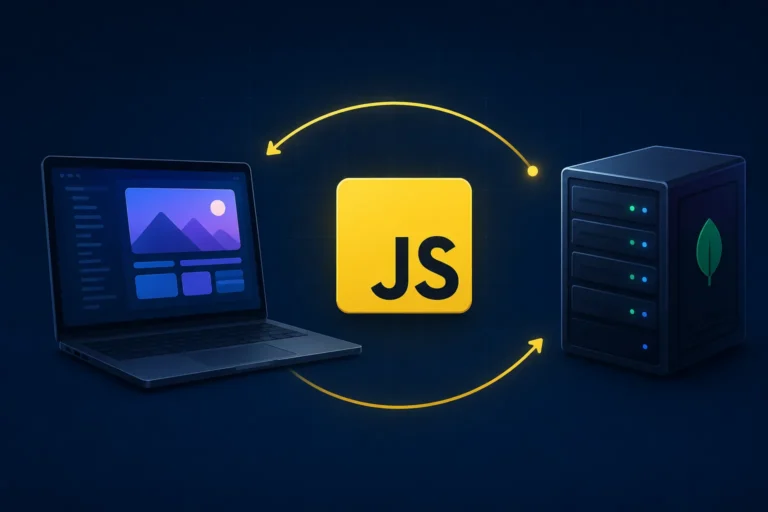
At the core of MERN is JavaScript, which is used consistently across the stack.
Both client-side and server-side code are written in the same language, which makes development and debugging faster.
While building real-time apps using MERN, this homogeneity becomes a massive edge. Coders can work smoothly across the stack, improving teamwork and reducing any problems with setup issues.
2. Node.js Supporting Real-Time
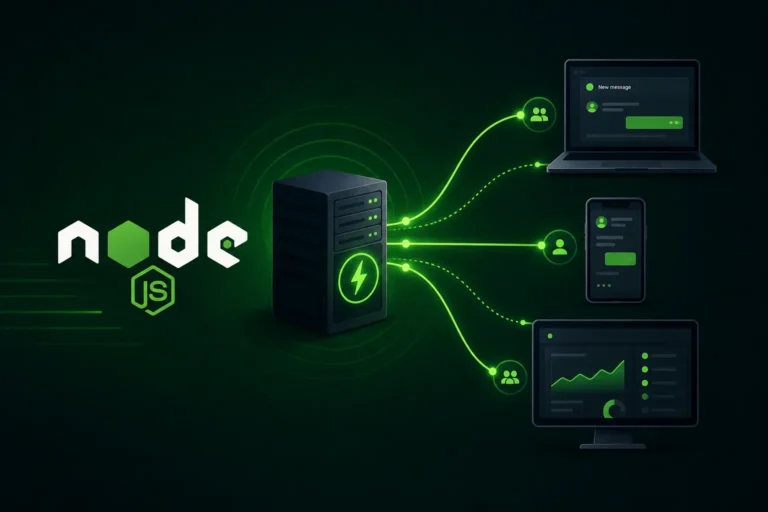
Node.js has a very good real-time tool in the MERN. It is built on Chrome’s V8 JavaScript engine, and Node.js can handle concurrent links with less overhead.
Whether it is for building an online multiplayer game, a live chat, or a collaborative document editor, Node.js offers the speed to keep everything running smoothly.
3. React for Dynamic User Views
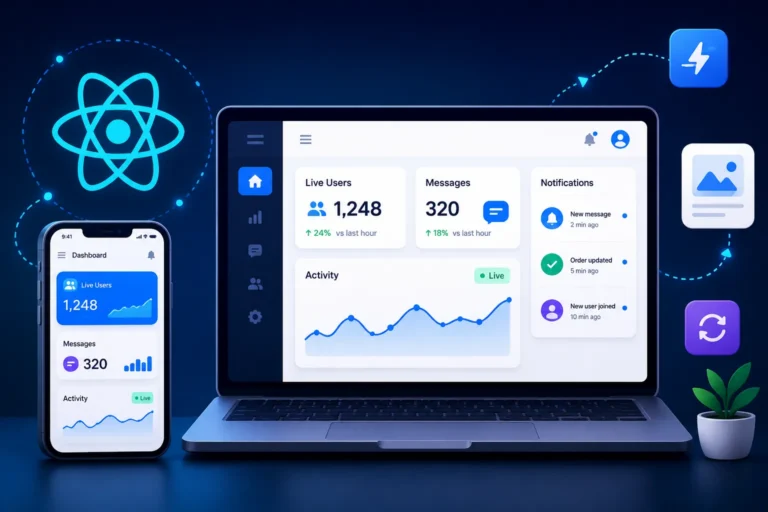
React’s virtual DOM and component-based design make building active UIs easier, which can update in real-time without full-page reloads.
For MERN stack web app development, React plays an important role in enhancing user skill. Coders can make sure that real-time data changes are immediately seen in the UI.
4. MongoDB for Flexible and Real-Time Ready
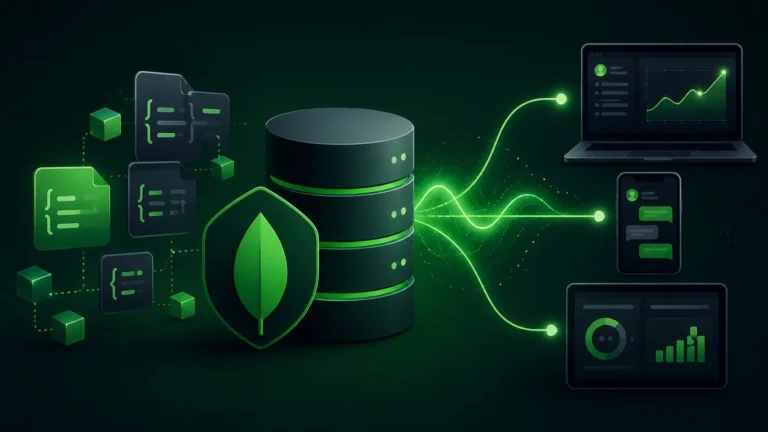
MongoDB is highly suitable for storing and getting data in real-time apps. It allows rapid iteration, which is perfect for modern apps that evolve quickly.
In real-time use cases such as social feeds and live analytics, MongoDB supports fast data reads/writes and horizontal scaling.
5. Express.js for Fast and Lightweight Middleware
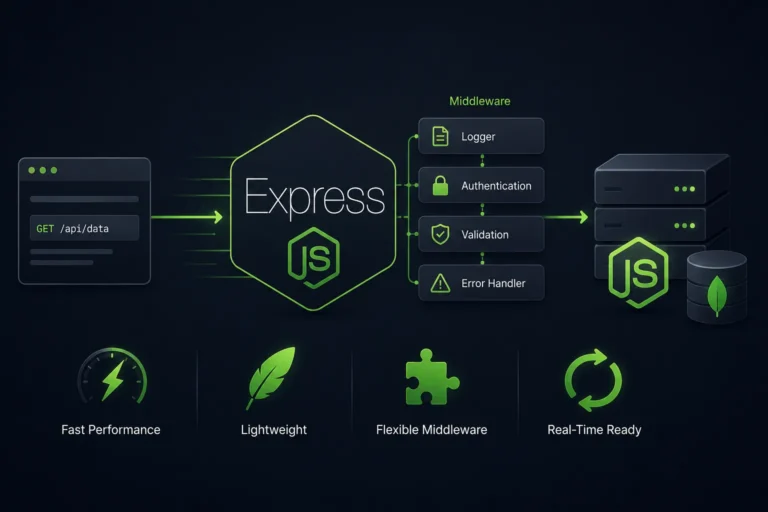
Express.js serves as the glue between MongoDB and Node.js in the MERN. The API development is simplified, which can handle routes and middleware, and supports a modular structure.
In real-time apps, Express can manage WebSocket links and data flow fast. Sending real-time updates or handling thousands of concurrent users, express.js gives the speed needed at the backend.
6. Backend as a Service (BaaS) for MERN Apps
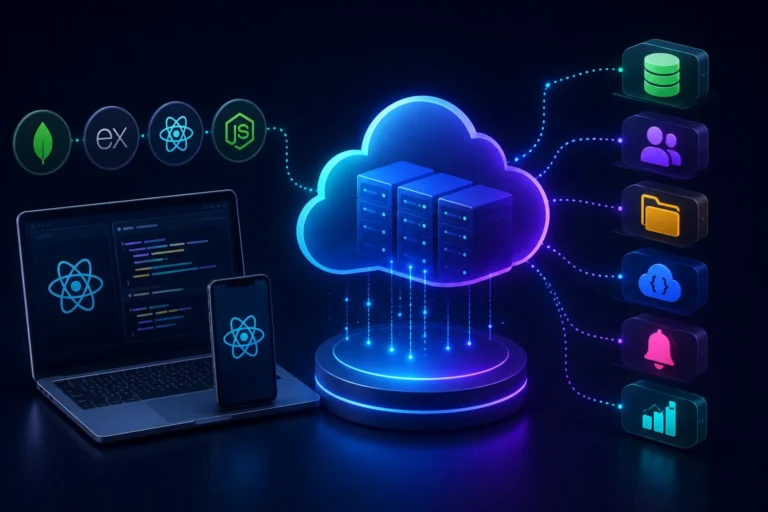
Services like Firebase or AWS Amplify offer features such as real-time databases, login, and cloud functions.
It can be integrated easily with a MERN design. Using BaaS alongside MERN offloads the setup concerns and focuses the team on building dynamic features.
This approach can significantly reduce time and still leverage the power of the MERN stack.
Coders here can easily pair the MERN stack with Backend as a Service (BaaS) for MERN apps to expedite real-time app development.
7. Scalability and Community Support

MERN stack is widely adopted and supported by a lot of coders. This translates to extensive guide and tutorials.
If you are new, you can refer to MERN stack tutorial content to guide you. Also, each component of the MERN stack is designed to scale.
Common Challenges while Building Real-Time Apps with MERN
While the MERN stack has its strengths, a project that utilizes it may have some unique challenges to consider.
The first one may come from the fact that most of the components that are used are built on Node.js. While this part of the tech stack allows for writing performant code, a single Node server is not able to process a huge volume of traffic.
Also, when deploying the app, special measures should be taken to make sure that the talk between all the servers that host the app are handled correctly. This task usually involves an more service such as Redis Pub/Sub to be set up.
Another potential issue is related to maintaining the state between clients and the server. This factor is especially important for real-time collaborative projects, where many users can make changes simultaneously.
While MERN apps are flexible and customizable enough to be able to handle such situations, it always requires extra effort and attention. In some cases, more measures such as using Operational Shift or Conflict-Free Replicated Data Types should be taken.
MERN apps face the same common issues that all MongoDB-based apps have with regard to schema design.
While the dynamic nature of MongoDB’s schemas is, perhaps, the reason for their popularity among coders, designing a solid schema and properly adding indexes is a crucial part of developing any real-time app.
Real-World Use Cases of MERN
Aside from the perks that MERN apps have over other real-time apps, there are several verticals where real-time apps that utilize MERN have distinct perks.
First, MERN apps can be used to power chat and messaging services. The nature of such products inherently involves handling large amounts of traffic, which is easier to do because Node.js was developed with this exact use case in mind.
Also, the ability of React to update the user interface in real time without the need for the whole page to reload is critical for the user skill in such apps.
Second, MERN can be utilized to power collaborative apps that involve some sort of real-time document edition or similar features.
Again, React’s ability to update the user interface fast is crucial, as is the ability to update only the elements that have changed. This allows for such apps to be responsive, even when dealing with large amounts of data.
Third, MERN can be used to build real-time dashboards and analytics platforms.
MongoDB’s ability to handle heavy loads is crucial for such a use case, as is the dynamic updating of the user interface that React gives.
Fourth, MERN-based apps can give real-time data for apps or sites that require it.
The aforementioned qualities of MERN allow for such projects to utilize the real-time tools of Node.js and React.
Finally, MERN can be used for use cases that involve multiplayer interaction or require social features.
The ability of Node.js to handle many links at once is utilized to the fullest extent when building such apps. This property is crucial for such apps, as they, in essence, always require links between more than one user to function.
Comparison to Other Real-Time Tools
Compared to a similar stack that makes use of Python, MERN has clear perks in terms of real-time tools. The reason for this lies in the fact that Node.js was specifically developed to utilize JavaScript’s asynchronous and non-blocking features.
Thus, when compared to Python, which was designed as a general-purpose programming language, Node.js has clear perks in terms of real-time apps. As such, a MERN stack has clear perks over a Django or Ruby on Rails stack in this regard.
However, compared to a Java-based stack, such as the Spring Boot tool, the perks of MERN are less clear. While a Java-based stack may require more hardware resources, it is likely to give better stability under heavy traffic. Also, the learning curve for Java is rather steep, which makes Java-based apps harder to develop than their MERN counterparts.
This factor also makes full apps harder to develop for less skilled coders in a reasonable amount of time. However, in some cases, a Java-based fix, when paired with proper tools, can give better stability under heavy traffic and have better overall speed.
Speed Setup Strategies for Production MERN Apps
Getting a MERN app up and running is one task, but making sure that it is performant in both speed and ability to process an actual production load of data and users is a whole other beast. For a React frontend, this means code splitting, which ensures that only the necessary JavaScript for the current view is sent down the pipe to be parsed by a browser, rather than forcing a user to parse the entire app, and memoization to prevent unnecessary component re-renders when the info they display isn’t changing. These optimizations have a huge impact on the perceived speed, especially on slow links or with large amounts of data that need to be rendered.
The Node.js backend then needs to take edge of clustering to make sure that one is using all of the work power offered by one’s server, since vanilla Node.js only uses one core by default. Similarly, serving cached data whenever appropriate decreases the load on the database, especially for real-time dashboards where the base data is accessed frequently. MongoDB’s setup comes down to making sure that indexes are set up properly on all queried columns, as queries on unindexed columns will become prohibitively slow when the size of the collection increases. Finally, speed is best approached as a steady process, rather than waiting for users to report slowdowns or waiting for an audit to happen. Addressing speed issues before they arise generally have rewards far outnumbering the costs.
Security Best Practices Specific to MERN Apps
When it comes to real-time apps, MERN is not substantially different from any other stack in that it requires that some extra security measures be taken. Most notably for real-time apps, WebSockets have to be secured, since unlike regular HTTP requests, their link is not established anew with every request, but lasts between page loads or throughout the duration of the app. As such, measures such as ensuring a user has valid login credentials have to be taken at the level of the link, rather than relying on login at HTTP level. In case of Express.js, many of the standard precautions apply that would be taken for any other API, such as input validation, rate-limiting, proper CORS configuration.
MERN apps, however, have to take extra precautions when dealing with MongoDB, which is more prone to NoSQL injection attacks than more old SQL databases. Finally, making sure that API keys and environment variables are not committed to a public repository is an important security measure, which is all too easy to overlook in the rush to deploy new features. Taken together, such precautions can greatly decrease the likelihood of a security breach, while also allowing one to respond to it should it occur. In practice, however, it is best to make sure that such breaches do not happen in the first place by designing secure apps from the ground up rather than trying to retrofit them later.
Real-Time App Is Better with MERN
MERN web app development offers the tools and speed needed to build scalable and engaging real-time apps.
With JavaScript end-to-end, real-time data handling, the MERN stack gives a solid base for giving modern user experiences.
If you are building a chat app, live trading platform, or any real-time dashboard, MERN gives you the versatility and speed to bring your ideas to life.
Check into a MERN stack tutorial, set up your environment, and see for yourself why MERN is the popular choice for the real-time web. MERN is for sure to build the desired real-time app for your business.