

- 1 High Performance with Non-Blocking I/O: Node.js handles multiple API requests efficiently, ideal for real-time and data-intensive apps.
- 2 Full-Stack Development in JavaScript: Write frontend and backend in the same language, reducing development time and improving collaboration.
- 3 Native JSON Support: Seamless integration with REST APIs and easy data exchange across platforms.
- 4 Microservices-Ready Architecture: Scale easily by breaking apps into smaller, manageable services.
- 5 Rich Ecosystem with NPM Modules: Accelerate development using thousands of pre-built packages for common API features.
- 6 TypeScript Integration: Add type safety and better maintainability for robust, enterprise-grade API-driven applications.
- 7 Modern Deployment Strategies: Use Docker, CI/CD, serverless, or PM2 to ensure your APIs remain scalable, resilient, and easy to manage.
With the rise of cloud computing, API-driven application development is getting great demand across the business. Although there are various options, Node JS web app development is chosen by many developers. If you’re building modern web solutions that rely more on RESTful APIs or GraphQL, choosing Node.js will be the smartest decision you can make. This guide will help you know, why Node.js is becoming ideal for businesses for building API-driven web applications.
The Growing Demand for API-Driven Web Apps
API-driven web applications separate the frontend from the backend. Multiple clients (web, mobile, IoT) can consume the same backend services with this architecture, which improves scalability and maintainability. In such systems, lightweight execution, performance, and real-time data processing are important. These are the areas where Node.js app development outperforms traditional backend technologies.
Why Choose Node.js for API-Driven Applications?
Node.js is an open-source, server-side JavaScript runtime built on Chrome’s V8 engine. Developers here can use JavaScript for both client and server-side programming, which makes full-stack Node-based web application development easy.
Here are some reasons why Node.js is ideal for building API-driven applications:
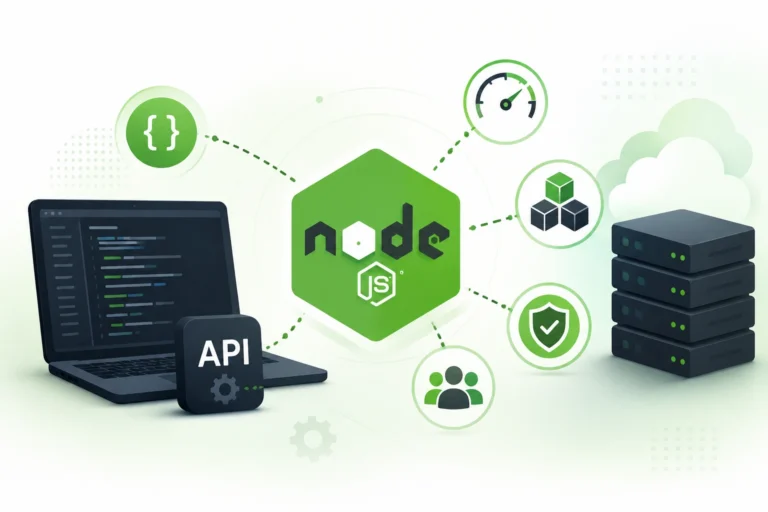
1. Asynchronous and Non-blocking I/O
Multiple connections can be handled with Node.js simultaneously with its event-driven and non-blocking I/O model. For API-heavy applications where performance is important, Node.js provides remarkable speed and efficiency.
2. Single Language Across the Stack
With Node.js developers can write both backend and frontend in JavaScript. This speeds up development cycles and reduces the learning curve. It also enables seamless data exchange, quicker debugging, and improves team collaboration.
3. Built-In Support for JSON and REST APIs
JSON is the standard format for API communication. Node.js supports JSON natively, which makes it easy to build and consume RESTful services. From creating lightweight APIs to authentication management and data exchange, Node.js makes whole process simpler.
4. Scalability with Microservices
Node.js is more suitable for microservices-based architectures. You can split your application into small services that communicate with APIs. This enables easier updates, better fault isolation, and scalable deployment. In fact, using microservices architecture using Node.js has become a better strategy for enterprise web apps.
5. Rich Ecosystem and NPM
Node.js boasts a massive ecosystem, with many packages available through the Node Package Manager (NPM). Whether it’s for API authentication, logging, or middleware support, NPM modules accelerate development. This ecosystem supports rapid Node.js app development by minimizing the need to write another code.
6. Enhancing Node.js with TypeScript
While JavaScript is powerful, adding TypeScript, which is a statically superset of JavaScript strengthens application robustness. Using TypeScript with Node.js helps developers check bugs early and improve maintainability for larger applications. TypeScript is better for use in API-driven applications where data types plays an important role in consistent data exchange.
Node.js Deployment Strategies for APIs
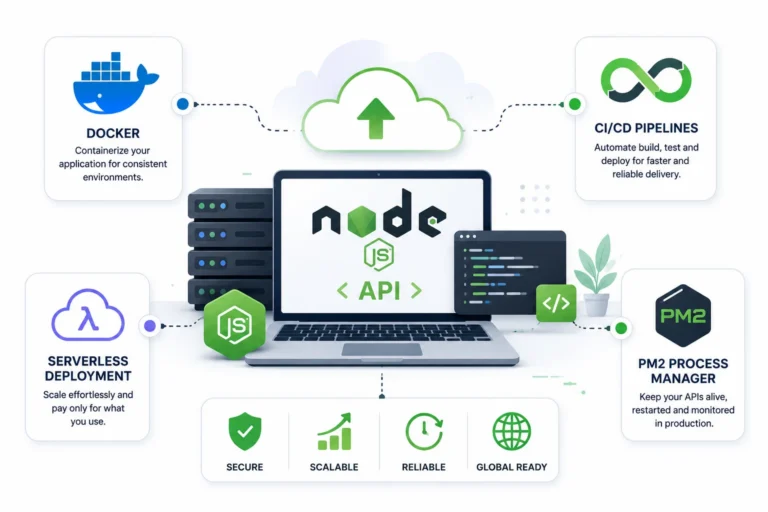
A successful API helps in the development and is very reliable for deployment. There are several effective deployment strategies of Node.js for production environments which are:
- Containerization with Docker: Ideal for deploying microservices.
- CI/CD Pipelines: Automate testing and deployment.
- Serverless Deployment: Cost-effective for low latency.
- Process Managers like PM2: For monitoring and restarting services.
Each strategy ensures that your Node-based APIs remain resilient, and easy to update.
Build Your Next API-driven Web Applications with Node.js
Choosing the proper technology is important when building scalable and efficient API-driven web applications. Node JS web app development offers several advantages, from performance to real-time capabilities and reusability of the code.
If you are starting a small project or scaling a complex system using application development with Node.js, you get advantage needed for modern web solutions. Combined with TypeScript, you can future-proof your application and deliver exceptional performance. If you’re investing in Node.js web app development, you can leverage the full potential for making robust API-centric applications.
Architectural Advantages of Event-Driven Systems
When designing modern API-solutions, it is vital to remember that the backend system should be efficient under thousands of simultaneous client requests. The thread-based request handling model used traditionally by servers limits the number of concurrent HTTP requests due to memory cost of maintaining threads. While Node.js allows you to build scalable API-solutions because of the special event loop design which effectively handles asynchronous requests. The Node.js server uses threads in the background to perform database queries, read or write files or send HTTP requests to webhooks. Therefore, you can use the callback function once the I/O operation is done. In combination with low memory consumption, asynchronous processing ensures reliable API-performance under heavy load.
Modern Applications Favor Real-time Communication
A lot of modern application designs centered around APIs involve heavy real-time data exchange. Such a requirement may appear in collaborative document editing software, financial dashboards, or chat applications. In such cases, the ability to send data updates from the server to the client immediately after processing is beneficial or even critical for the user experience. Node.js gives you a competitive advantage in building such applications because of its built-in WebSocket support. Using the ‘socket’ binding, you can set up a persistent connection and start sending and receiving data streams in both directions with minimal overhead. Therefore, Node.js is a good fit for building applications requiring bidirectional, real-time data exchange channels between the server and the client.
Node.js Facilitates Secure Enterprise API Development
When designing enterprise-level API-solutions, the security of the data processing is a physical and economic priority. That is why it is of uttermost importance to design a secure API, that only accepts authenticated and authorized requests and limits the client-traffic to reasonable levels. With Node.js, you can easily implement these security measures with the help of built-in token-based authentication mechanisms and middleware rate-limiting plugins. Moreover, adding the Helmet.js middleware to your application will help you increase your API-security by automatically protecting your application from well-known XSS and HTTP-header vulnerabilities. It is also recommended to implement payload validation on the server side with the help of Schemas, for example, provided by Zod or Joi packages to prevent malicious data from being processed by the application. Regular NPM audit command execution will help you keep track of security issues in the third-party modules used in your application.
Microservices Compatibility and API Scalability
Nowadays, companies try to move from the traditional application architecture towards the microservices-based one to ensure agility and continuous deployment of API’s. Such projects may benefit from using Node.js as it allows building easily modified and updated apps, which is possible due to its quick server start, reducing server memory consumption, and overall mature ecosystem. First of all, the decomposition of the application into single-service API’s parts may help to design a scalable solution as the traffic may be prioritized depending on each part’s current load.
Furthermore, building APIs on Node.js allows one to achieve faster communication between the application’s components. For instance, it can be used in combination with gRPC, Rabbit MQ, Apache Kafka, or other RPC frameworks to establish a fast exchange of data between sub-services. Such technologies allow one to decouple the system’s elements, which makes it easier to handle and update an application; changing one component will affect only a particular sub-service. On the other hand, the system will be flexible and efficient; the data exchange between services will be well-structured and asynchronous.
Finally, creating single-service API’s parts allows achieving better maintenance and faster deployment. As Node.js code requires fewer resources to launch, an application’s single parts will be more reliable and stable. The utilization of this technology also reduces the size of docker images, making it lighter to deploy them on Kubernetes or AWS Elastic Container Service. It ensures faster scaling and less time between different versions of an application.