

Static and dynamic typing mainly differ in when a programming language checks the type of a value. Static typing catches many mistakes before the application runs, while dynamic typing gives developers more flexibility during execution. Neither approach is automatically better. The right choice depends on the project’s size, team, performance requirements, tooling, and how quickly the software needs to evolve.
- 1 Error Detection and Performance: Strongly-typed languages such as Java and C++ provide early error analysis, and are better optimized because type checking and other operations are performed during compile time making them ideal for large-scale and high-performance applications.
- 2 Flexibility and Rapid Development: Dynamic typing such as Python and JavaScript is used for their flexibility and speed in development to implement changes fast useful for start up companies and web development.
- 3 Project Suitability: Whether to use statically typed languages or dynamically typed languages depends on the need of a project, statically typed languages provide accuracy and safety on the other hand dynamically typed languages are flexible and provide speed to the development process.
- 4 Choose typing based on the project's needs. Static typing can provide stronger safeguards and maintainability for large or complex systems, while dynamic typing can make experimentation and rapid development easier.
One of the most important aspects of any programming language is how it treats types and what types it can, or cannot, handle. This is known as its “typing discipline,” and it influences the way that you both author and maintain the code for the system. Basically, programming languages fall into two main groups based on this typing discipline: various programming languages include statically typed and dynamically typed.
Dynamically typed languages have to deal with this problem as you have to tell the program what type each variable is even before you run the program. And do you know why? Just because before your code begins functioning you have to configure the variables as number, string or something else. In dynamically typed languages, you do not have to do this up front, but it happens while the program is executing. Their type may be inferred by the compiler as the code is executed.
The following information focuses on the issues of statically typed and dynamically typed languages of business, their strengths and limitations. I’ll explain all of this through examples and everyday life situations to help you understand these things better.
Statically Typed Languages
In statically typed languages, you declare variable types at compile-time. The type is known before the program runs, catching any type errors during compilation.
Examples
Languages such as Java, C, C++, Swift, and Rust are statically typed. For instance, in Java, you must declare the type of a variable when you first define it:
int number = 5;
String text = "Hello, World!";
Pros
- Early Error Detection: Errors are caught at compile-time in Statically Typed, reducing runtime bugs.
- Performance: Better optimization since types are known ahead of time.
- Refactoring Support: Easier to refactor code with type information available.
- Documentation: Explicit type declarations improve code readability.
Cons
- Verbose Code: More code to write due to type declarations.
- Reduced Flexibility: Changing variable types requires more code modifications.
Dynamic Typed Languages
In this case since the dynamically typed languages, the type of a variable can only be determined at runtime. You do not have to state the types in the program – the interpreter takes care of this.
Examples
Languages such as Python, JavaScript, Ruby, and PHP are dynamically typed. For example, in Python:
number = 5
text = "Hello, World!"
Pros
- Concise Code: Less code to write without type declarations.
- Flexibility and Speed: Easier to change variable types on the fly, speeding up development.
- Ease of Use: Often simpler for beginners to learn and use.
Cons
- Runtime Errors: Errors are caught only when the code runs, making debugging harder.
- Performance: Slower execution due to runtime type checking.
- Maintainability: Large projects can be harder to manage without strict type constraints.
When to Use Dynamically and Statically Typed
Statically Typed Languages
- Large-Scale Systems: Enhanced clarity and error checking are crucial.
- Performance-Critical Applications: High performance is needed, such as in game engines or real-time systems.
- Safety-Critical Applications: In fields like finance or healthcare, early error detection is vital.
Dynamically Typed Languages
- Rapid Prototyping and Development: Speed of development is prioritized, ideal for startups.
- Web Development: Many frameworks are built on dynamically typed languages.
- Scripting and Automation: Quick scripts benefit from the simplicity and flexibility.
Conclusion
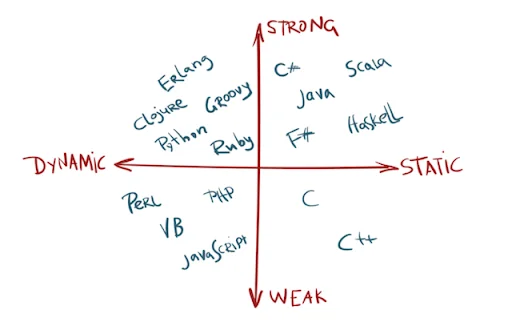
Both of these types of languages have their advantages and disadvantages. It is based on the requirements of a project, the environment used to develop the software, and individual choices or preferences of a developer or a team. Understanding these differences enables you to make a lot of important decisions and use the appropriate tools to construct efficient, sustainable, and resilient software.
This is where statically and dynamically typed languages play their role: statically typed guarantees precision, dynamic – flexibility, however, these tools should not be used blindly or for their own sake but with a practical task in mind.
To learn more about Type system check out their wikipedia page .
For additional insightful articles and information on custom software development services, please reach out to us.
Type Inference: You Don’t Always Have to Write the Type Yourself
When one hears the term statically typed, they may think that a developer has to define the type of each variable. This is not the case since many statically typed languages have type inference that let a compiler determine the type from the value or context.
For example, in Kotlin, you can write:
val number = 10
val message = "Hello"
The developer doesn’t explicitly write Int or String, but the compiler still knows the types. This gives teams the safety benefits of static typing without making every line unnecessarily verbose.
Static Typing Can Become More Valuable as the Team Gets Bigger
A smaller project may thrive with fewer limitations since the person coding knows most of the software. But with ten, twenty, or a hundred programmers working on the same source code, there is more limitation involved.
Having type information helps the programmer and IDEs learn more about the behavior of the function or object. If a programmer modifies a function months after it is written, he can predict what input and output it would give based on the source code.
This does not guarantee that no bugs will happen but lessens a certain type of mistake. For projects which continue to be developed for many years, being maintainable is more crucial than the time used for coding.
Dynamic Typing Isn’t the Same as “No Type Safety”
It is not hard to call dynamically-typed languages unsafe; however, it is a simplification. A dynamically-typed language has its types. The point is in the different moment of the check and the management of the types.
For instance, Python knows whether a variable is an integer, string, list, or some other object. There appears an issue only when the assumption about some variable was incorrect at runtime. Modern technology may provide some additional safety with the help of Python type hints, mypy or Pyright for the project, and TypeScript in case of a necessity to use JavaScript.
Dynamic typing allows for easier experiments and prototyping since a developer does not need to update type declarations in all places of the code while changing some data structure. This possibility is becoming harder to implement as the application becomes larger. Good documentation, testing, validation, and coding standards allow making projects safe and dynamic at the same time.
The Performance Argument Isn’t Quite That Simple
The connection between static typing and better performance has to do with the compiler knowing more about the program at compile time. While this may benefit optimization in some languages, it would be wrong to claim that all statically typed languages perform better than all dynamically typed ones.
Performance at runtime depends not only on the type of typing but also on the compiler or interpreter, runtime environment, memory management, algorithm implementation, database queries, network interaction, and general application architecture. For the majority of business software applications, the typing paradigm itself is unlikely to be a major factor.
You Can Change Typing Strategy as a Project Evolves
Not all typing decisions have to be final and irreversible. A development group could opt for creating a new product with JavaScript since speed is crucial at that stage, then switch to TypeScript as the project matures and as more developers become involved in it.
In addition, an existing Python product could slowly get type hints without having the whole project rewritten from scratch. This method can actually yield more fruit compared to a full-fledged rewrite when typing guarantees are meant to solve a concrete issue.