



- 1 Next. js excels in cross-platform development: Create applications for iPad, iPhone, and Android, which gain popularity among the users without any difficulties.
- 2 Next. js offers extensive customization: Individualize app with the help of customized APIs and options that will help satisfy definite business requirements.
- 3 Next. js revolutionizes industries: In the financial services, healthcare, and more – build safe, elastic, and stable solutions.
In a rapidly evolving digital landscape, businesses must stay ahead of the curve to succeed. The future of app development is here, and it’s powered by Next.js. This groundbreaking one of the many React meta-frameworks introduces revolutionary technology, providing a cross-platform solution that surpasses conventional boundaries, making it the preferred option for contemporary app development.

The Next.js Advantage
Cross-Platform Excellence
Next.js is at the forefront of cross-platform app development. Gone are the days when businesses had to choose between iOS and Android development. With Next.js, you can create applications that seamlessly run on both platforms, reaching a broader audience with ease.
Customization and Flexibility
Tailoring your app to your unique business needs has never been easier. Next.js provides extensive customization options, allowing you to build custom APIs and enterprise software that align perfectly with your objectives. Say goodbye to one-size-fits-all solutions.
Financial Services Transformation
For banking and financial services, Next.js is a game-changer. Say hello to custom financial software development that meets the industry’s stringent requirements. Next.js empowers businesses to create secure, scalable, and compliant solutions for the financial sector.
Healthcare Revolution
In healthcare, precision and reliability are paramount. Discover the world of healthcare custom software development, where you can build solutions that save lives. From electronic health records to telemedicine apps, Next.js has you covered.
The Next.js Ecosystem
Expert Teams, Anywhere
With Next.js, you have access to dedicated offshore developers and overseas development teams. Whether you need to hire software developers for your Android app agency or require a Node.js developer in the USA, Next.js offers a global talent pool at your fingertips.
Streamlined Development
Efficiency is key in app development. Next.js streamlines the process, making it easier to create applications for both iOS and Android. You can even repurpose code, reducing development time and costs.
Robust Testing
Quality assurance is non-negotiable. Next.js supports QA software testing services, ensuring your app is bug-free and performs flawlessly across platforms.
Getting Started with Next.js
Installation
To begin your journey with Next.js, you’ll need Node.js installed on your system. If you haven’t already, download and install Node.js from the official website.
Once Node.js is installed, you can create a new Next.js project using the following steps:
- Initialize a New Project: Open your terminal and navigate to the directory where you want to create your app. Run the command given below to set up a new Next.js project with all the necessary configurations.
npx create-next-app my-nextjs-app
cd my-nextjs-app- Start the Development Server: To start the development server and see your app in action, run:
npm run devYour app will be available at http://localhost:3000. Open your web browser and navigate to this address to see your app running.

Project Structure
Next.js follows a simple and organized project structure. Here’s a brief overview of important directories and files:
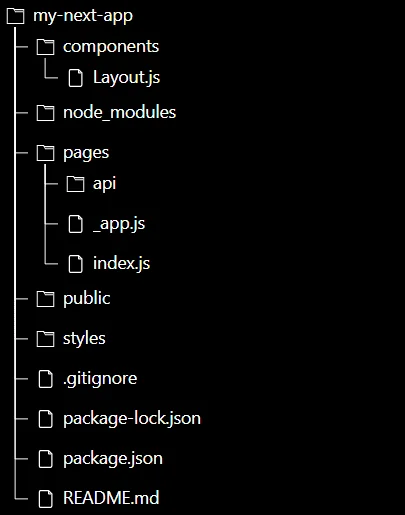
- pages/: This directory contains your application’s routes. Each .js file in this directory becomes a route in your app.
- public/: You can place static assets like images, fonts, and stylesheets in this directory.
- components/: Store your reusable React components here.
- styles/: It uses CSS modules for styling. You can create CSS modules here and import them into your components.
Building Your First Page
Let’s create a simple “Hello World” page to get started. Inside the pages/ directory, create a new file named index.js with the following content:
import React from 'react';
function HomePage() {
  return (
    <div>
      <h1>Hello, Next.js!</h1>
    </div>
  );
}
export default HomePage;
Save the file, and your changes will be reflected immediately in your running app.
Customization and Beyond
Now that you’ve set up your Next.js project and created your first page, you can dive deeper into customization, adding more routes, and integrating libraries and APIs as needed. It offers a wide range of features and possibilities to explore.
Ready to Transform Your App Development?
With Next.js, you’re equipped to build powerful and dynamic web and mobile applications. Whether you’re working on Android app development services, healthcare software, or any other industry, Next.js empowers you to create cutting-edge solutions. Embrace the future of app development with Next.js today!
Embrace the Future Today
The future of app development is about flexibility, customization, and cross-platform excellence. It empowers businesses to thrive in the digital age. Whether you’re in the healthcare sector, financial services, or you run an Android app agency, Next.js is your gateway to success.
Are you ready to embark on a journey of innovation? Join the Next.js revolution and unlock endless possibilities in app development. Embrace the future today.
Choosing the Right Rendering Approach
One of the most significant choices that you will have to make when creating a Next.js app is the way the pages will be served. There are several ways to achieve this and which one is preferable in each particular case depends on a few different things, such as how often your content changes, how important it is to optimize it for search engine indexing, and how fast do you need your visitors to get access to up-to-date information.
Some pages will benefit from being generated in advance, while other ones require fetching fresh data with every new visit. For instance, product pages, documentation, and marketing materials may be generated in advance, while dashboards or account pages will require fresh data to be fetched dynamically.
The correct choice will depend on several factors, including how often the data changes, how important SEO optimization is, and how fast do you need your page to load.
Managing Data and APIs
It should be added that an application requires more than pages and components. They have to interact with databases, external systems, and even with internal APIs. In such a way, the app will be able to read the user data, handle form submissions, and get connected with the systems that provide basic functionalities.
Also, Next.js may co-exist with backend services and offers server-side capabilities that can protect some of the processes from the browser. It is especially valuable in case of performing authentication, querying the database or working with credentials of the third-party APIs. Moreover, it enables the applications to handle requests safely, sending only the necessary information to the client.
The separation of the business logic component on the server side when necessary, reduces the maintenance of the front-end component, controls access to data better and reduces the amount of sensitive information that can be visible to users.
Performance Should Be Designed In
Performance shouldn’t be an issue when one needs to consider after a slow application is developed. Early considerations about performance make the experience more enjoyable for the users and the application easier to scale as well.
Big images, unnecessary JavaScript, inefficient data fetching, and excessive client-side rendering may influence the time of becoming usable for the page. There are many features that allow solving those issues on Next.js; however, they have to be applied responsibly.
For instance, optimization of images, reduction of unnecessary client-side code and appropriate loading of data make the difference. Smaller files of the images, as well as less unnecessary JavaScript may help pages become interactive faster.
Authentication and Security
However, many business application have private client details, private dashboard interfaces or some other account-related features. For this reason, authentication has to be taken into account at the very start, not just tacked on as an afterthought.
Server-based validation is to be applied to actions, which are intended to remain confidential, and sensitive information should never be included in client-side code. The validations, secure sessions and authorizations are essential components of any production system.
However, all of this is pointless if clients can view content or use features that were not intended for them. Authorization policies and security reviews make sure that this does not happen.
Preparing a Next.js Application for Production
Successfully deploying the application on the local server marks just the start of the process. Prior to launching it, one needs to test key user cases, ensure proper error handling, perform the necessary testing in terms of application performance and correctness of setting up of environment variables and configurations for the production environment. It is crucially important to make sure that the application functions properly on different devices, operating systems and screen resolutions.
One might also find it beneficial to monitor the application after its deployment. Problems, related to traffic, external APIs, input data will become apparent to real users and may become visible only during the actual use of the application by users.
Deployment and monitoring as a part of the development process as opposed to a separate phase helps keep the application stable throughout its life cycle.
Performance Should Be Designed In
Performance shouldn’t be an afterthought once the app is already sluggish. Early performance planning allows for better usability and scaling of the application.
Images of large sizes, unnecessary JavaScript, poor data fetching, and too much client-side rendering can influence the responsiveness of the page. Next.js offers several solutions for these problems, but their implementation should be carefully planned by the developer.
Such actions as image optimization, avoiding unnecessary client-side logic, and efficient data fetching can significantly contribute to improving user experience. Small size of image files improves loading time, whereas less JavaScript means faster interaction with the page.
Authentication and Security
Running the application locally is just one step. Prior to release, developers should test the necessary use cases, evaluate error handling, consider the performance of the application, and make sure that all environment variables and production settings are configured correctly. In addition, it is crucial to test the application in terms of different devices, browsers, and screen resolutions.
Authorization procedures need to be executed on the server side for the operations which require access checks, and secret credentials have to stay outside the client-side code. Input validation, sessions management, and authorizations rules are just as essential when developing production-ready applications.
Taking deployment and monitoring as the process which belongs to the development stage makes maintaining the application much more simple. Updates, backups, and performance evaluations may assist in keeping it stable.