

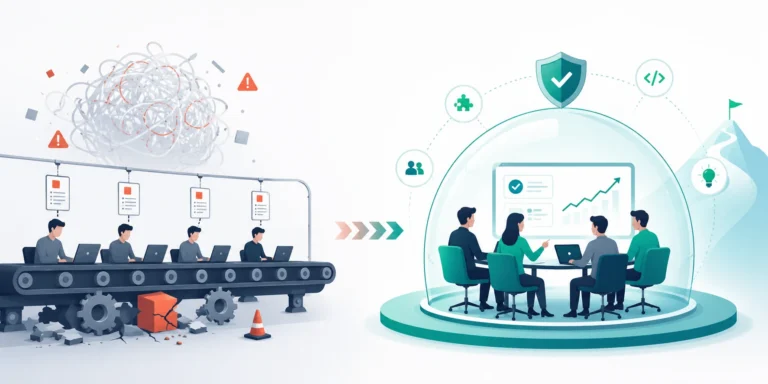
Offshore teams often have trouble taking charge of delivery because their setup rewards finishing tickets of achieving product results. Managed engineering pods fix this by bringing teams, experienced engineers, product understanding and clear delivery responsibility. The end result is a group that doesn’t just build what is asked-it questions ideas points out problems early handles debt and ensures the product actually works.
- 1 A team can finish all tasks on time. Still end up building the wrong feature creating technical debt or missing key product issues.
- 2 A good engineering team does not just follow instructions. It asks about assumptions finds technical limits and suggests better ways before big problems happen.
- 3 Teams that stay the grow a stronger understanding of the product and technology. This knowledge helps engineers see when a new task goes against choices or causes future issues.
- 4 More people don’t always mean better results. A small team with engineers and shared knowledge can often work faster because there is less back and forth and clearer responsibility.
- 5 When choosing an offshore partner ask: "Who is responsible if the product doesn’t work?" The answer shows if you are getting a team that owns delivery or just a group that does tasks.
Plenty of offshore engagements deliver code. Fewer deliver outcomes. The difference usually comes down to one structural choice made long before a single line is written: whether the team is set up to execute tickets or to own the result.
It’s a distinction that rarely shows up in a sales pitch. Every vendor talks about “quality engineering” and “dedicated teams.” But six months into an engagement, founders can usually tell which kind of team they actually hired , one is quietly catching problems before they become expensive, and the other is closing tickets exactly as written, technical debt and all.
At Innostax, this distinction shapes everything about how we work ; AI-native managed engineering pods for SaaS founders , senior-heavy teams that own delivery and are built for quick turnaround. This post breaks down why ownership and ticket execution produce such different outcomes, and what to look for before you sign your next offshore engagement.
The Ticket-Execution Trap
Most offshore relationships start with the best intentions on both sides. A backlog gets written, tickets get assigned, and work gets done.
The trap isn’t laziness or bad engineering. It is what happens when a team’s entire mandate is defined by the ticket in front of them, with little responsibility beyond it.
Doing What’s Asked, Not What’s Needed
Teams structured purely around ticket execution build exactly what’s specified, even when the specification is wrong, outdated, or missing important context.
Raising concerns may not be part of their mandate.
A ticket might describe a feature as it looked three sprints ago, before the product direction shifted. An execution-only team may still build it because questioning the ticket isn’t considered part of the job.
The founder discovers the problem weeks later, after the sprint closes and the feature reaches production.
No One Is Watching the Bigger Picture
When a team’s success metric is “tickets closed” rather than “product working well,” technical debt and product-quality issues can accumulate quietly.
Nobody on a ticket-execution team is necessarily incentivized to step back and ask whether the last twenty tickets are pulling the codebase in a coherent direction.
That is a different responsibility.
Ownership-oriented teams take that broader view by default, while ticket-execution teams are often structured around completing the work assigned to them.
Why This Trap Is Easy to Fall Into
This isn’t usually a story about bad engineers.
Most offshore engineers are capable of exercising judgment. They are simply working inside a structure that may not ask them to do so.
Staff-augmentation models are often priced and measured around throughput. That can quietly train both the client and vendor to treat the ticket as the unit of success.
The result is a team that can appear productive while important product and technical problems remain outside its immediate scope.

What Ownership Actually Looks Like
Ownership is easy to claim and harder to demonstrate.
It shows up less in what a team says during a sales call and more in the decisions it makes when nobody explicitly asks for a judgment call.
Proactive Flagging, Not Passive Execution
An ownership-oriented team raises concerns when a requested feature conflicts with a technical constraint or when a better approach exists.
Instead of building exactly what was requested, the team might stop before the sprint begins and raise the issue:
“This ticket assumes X, but we think Y is a better fit given what we built last month. Want to talk it through?”
That conversation may create a few minutes of friction.
It can also prevent weeks of rework later.
Accountable for the Outcome, Not Just the Output
The team’s incentive is aligned with the product actually succeeding, not simply with completing assigned tasks on schedule.
That means an ownership-oriented team may tell a founder something they don’t want to hear.
The deadline may be unrealistic given the current scope. A shortcut taken last quarter may need to be addressed before new features can safely be added.
A ticket-execution team is less likely to volunteer this feedback when it isn’t measured or rewarded.
Ownership Extends to How Problems Get Communicated
Ownership also includes communication.
A team that owns outcomes tends to surface bad news early and clearly. That could be a slipping timeline or a riskier-than-expected integration.
A ticket-execution team may be more likely to leave a status as “in progress” until the problem becomes impossible to ignore.
Founders who have worked with both models often describe the difference in terms of trust.
They know whether the updates they receive give them an accurate picture of what is happening or simply describe what has already been completed.

Why Managed Pods Structurally Enable This
Ownership isn’t just a mindset. It is supported or undermined by how a team is structured.
Two factors matter particularly: continuity and seniority.
Small, Consistent Teams Build Context
A managed pod that stays consistent over time develops deep product knowledge.
That context is essential for meaningful ownership.
It is difficult to flag that a ticket conflicts with a decision made two months ago if you weren’t on the team two months ago.
Continuity isn’t simply a nice-to-have for ownership. It is a precondition for it.
Senior Composition Changes the Incentive
Senior engineers are more likely to push back constructively and suggest better approaches.
This isn’t about junior engineers being unwilling to speak up. Seniority typically brings pattern recognition that helps engineers spot problems earlier.
It also brings the professional confidence to raise those problems before they become someone else’s emergency.
Team Size Matters More Than Team Count
Counterintuitively, a smaller pod can produce better ownership outcomes than a larger team with more raw capacity.
A five-person team where everyone understands the product can sometimes move faster and catch more issues than a fifteen-person team where knowledge is fragmented across specialists.
More people do not automatically mean better outcomes.
In offshore engineering, increasing team size can also increase coordination overhead between a problem and the person who can solve it.
Ask Who’s Accountable, Not Just Who’s Available
Before signing an offshore engagement, ask directly:
Is this team incentivized around completing tickets, or around the product actually succeeding?
The answer can tell you more about the likely engagement than a list of resumes.
It is a simple question, but many vendors aren’t asked it directly during the sales process.
That means founders may not get a clear answer until several months into the engagement.
Ask for a Real Example
Don’t stop at the vendor’s stated philosophy.
Ask for a specific example of a time when the team pushed back on a client request.
Find out:
- What was the original request?
- Why did the team challenge it?
- What alternative did they suggest?
- How did the client respond?
- What happened as a result?
A concrete example is more useful than a general statement about being “ownership-driven.”
The Cost of Finding This Out Later
Founders don’t always realize they are working with a ticket-execution team until the cost has already compounded.
A feature may be built exactly to specification but based on an outdated assumption.
The cost then extends beyond the original sprint.
The team has to spend time realizing there is a problem, uncovering what caused it, and eventually unwinding and rebuilding the work.
Sometimes the customer has already interacted with the broken feature by the time the problem is discovered.
Why Switching Vendors Isn’t an Obvious Fix
Once a founder realizes that the current team is focused on ticket execution, the obvious response is to find a new vendor.
In practice, switching is not that simple.
A new team needs time to understand the product, architecture, codebase, and decisions made by the previous team.
That transition can temporarily reduce delivery velocity.
The Codebase Creates Its Own Handoff Cost
The bigger challenge can be the code itself.
Months of unquestioned tickets can leave behind patterns that make sense individually but fail to work together coherently.
A new team must then reverse-engineer the design decisions behind the existing codebase.
They are not simply taking over a backlog. They are taking over the consequences of previous decisions.
This is one reason continuity matters so much in an ownership-focused engagement.
A team that understands the product over time can identify inconsistencies while they are still small instead of inheriting them as a much larger problem later.
Observations to Make Within the First 30 Days
You don’t need to wait six months to determine whether you’ve hired the wrong type of team.
The first month can provide several useful signals.
Watch how the team behaves during the first few sprints.
Does it ask clarifying questions before picking up a ticket?
Does it flag ambiguous requirements or simply start building?
Does it identify risks before implementation?
Look at the Status Updates
Pay attention to what appears in project updates.
Are the updates primarily lists of completed tickets?
Or do they explain:
- Current risks
- Technical trade-offs
- Blockers
- Dependencies
- Changes in scope
- Potential impact on delivery
Neither observation is conclusive by itself.
But several of these patterns appearing together can provide a strong indication of how the engagement is structured.
Look for Red Flags Early
Some early warning signs include:
- No questions about unclear requirements
- Features built despite obvious contradictions
- Problems reported only after deadlines are affected
- Status updates focused entirely on completed tickets
- Little discussion of technical trade-offs
- No clear ownership of delivery risks
There is no hard deadline for realizing you’ve hired a ticket-execution team.
But the longer you wait, the more expensive it can become to restructure the engagement.
The first month is often enough to identify patterns before the cost of a mistaken hire becomes too high.
Ready for a Team That Owns the Outcome, Not Just the Tickets?
At Innostax, our managed pods are structured around delivery ownership from day one, rather than ticket-by-ticket execution.
The goal is to give founders a team that understands the product, raises risks early, and takes responsibility for the outcome.
Schedule a Free Delivery Model Consultation →
Let’s talk about what true ownership would mean for your roadmap.