


- 1 Open-Source and Free: AngularJS is backed by Google and has no licensing costs, reducing initial investment.
- 2 Faster Development: Modular structure and reusable components accelerate the development cycle.
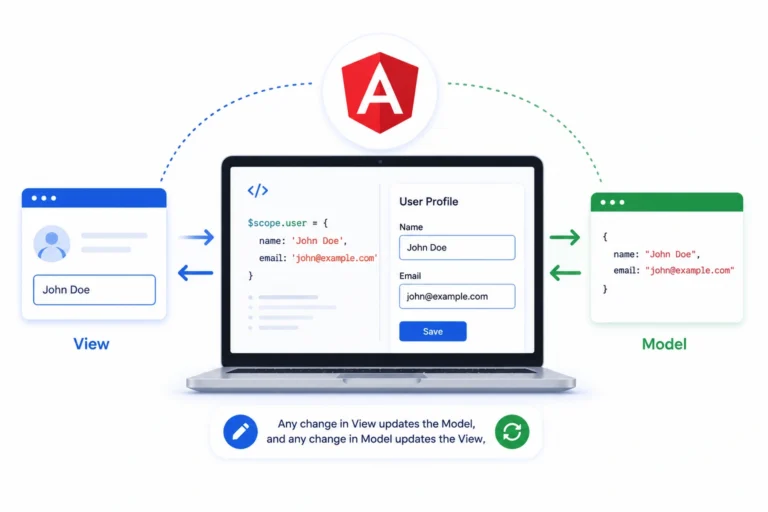
- 3 Real-Time Sync: Two-way data binding minimizes manual coding, reducing workload and costs.
- 4 Community Support: Large community offers plugins, support, and faster troubleshooting.
- 5 Cross-Platform Compatibility: Single codebase works across platforms, cutting development time and costs.
- 6 Robust Testing Tools: Built-in tools like Karma and Protractor ensure early bug detection and lower maintenance costs.
- 7 Customizable Architecture: AngularJS allows tailored app development to meet specific business goals efficiently.
A user-friendly web application is key to a better customer experience and business growth. AngularJS is one of the most important frameworks that makes this possible. It has helped greatly reduce the overall cost of app development.
If you want to develop an app, AngularJS web app development offers an efficient and cost-effective path. Here, we look at the key factors that contribute to its cost-reduction, popularity, and efficiency.
Understanding AngularJS
AngularJS is an open-source JavaScript framework designed for building dynamic, single-page web applications. It delivers better user experiences with its MVC (Model-View-Controller) architecture and two-way data binding.
These features simplify the process of building and managing web applications. AngularJS also has a robust ecosystem that supports everything from form validation to complex UI management.
Why Businesses Choose AngularJS Coding Services for Apps ?
Building a custom app takes real time and money. AngularJS offers a smarter way to manage that investment. Here are the key reasons why custom AngularJS solutions are cost-effective:
1. Open-Source and Backed by Google
AngularJS is completely open-source. This is one of its biggest cost-saving advantages. Businesses can use a wide range of community libraries and resources at zero licensing cost. The framework also gets continuous updates for better performance and security.
2. Faster Development Cycle
AngularJS supports reusable components and a modular approach. This cuts down on repeated coding. It also speeds up the development process. The result is a quicker turnaround and lower overall costs for clients.
3. Two-Way Data Binding
One of AngularJS’s best features is two-way data binding. It keeps data in sync between the model and the view, in real time. This cuts down on development work. In turn, it lowers the cost of building custom apps.
4. Large Community
AngularJS has a large, active developer community. They freely share plugins, insights, and fixes. This is a major advantage for teams using AngularJS. It lets them use pre-built modules, fix problems faster, and cut both development time and cost. This community support also means help is usually just a search away when a team runs into an unfamiliar issue.
5. Cross-Platform Compatibility
AngularJS supports cross-platform development. This removes the need to build a separate app for each platform. One codebase works for both mobile and desktop users. This saves money on both development and long-term upkeep.
6. Enhanced Testing Capabilities
Testing matters for every app. AngularJS was built with testability in mind. Tools like Karma and Protractor make unit and end-to-end testing simple. Catching bugs early means fewer costly fixes later on.
Total Cost of Ownership for Enterprise AngularJS Applications
When you calculate the total cost of an enterprise web app, look past the initial build cost. Ongoing maintenance expenses matter too. As a client-side framework, AngularJS helps cut long-term costs in two areas: infrastructure and professional services. Looking at both of these together gives a much clearer picture of what an app will actually cost over its lifetime..
Client-Side Nature of AngularJS Lowers Infrastructure Costs
AngularJS shifts most of the workload from your servers to the user’s browser. This means companies need less backend infrastructure to scale. It also means lower spending on professional services. Both benefits come from the framework’s declarative style and its wide range of built-in features.
AngularJS’s MVC design also helps here. It lowers the amount of custom code needed to build an app. Less custom code means lower professional service costs. This is because a smaller, more consistent codebase is cheaper to maintain than a mix of custom and third-party code. AngularJS is also opinionated. It gives developers clear, strict guidelines. This lowers the learning curve for new hires and cuts training time.
Maximizing ROI through Custom Directives
Creating custom directives is one of the best ways to get more value from AngularJS. Directives let developers build reusable HTML widgets across an entire app. Each widget holds its own behavior, logic, and styling in one place. This removes duplicate code and lowers maintenance costs.
Directives also help you reach the market faster. You can build complex interfaces by combining directives together. This takes far less effort than building from scratch. When something needs to change, developers update just the one directive. There’s no need to search for scattered code across the whole app. This shortens development time and lowers the risk of bugs.
Minimize Infrastructure Costs with AngularJS’s Built-in Dependency Injection
AngularJS has built-in support for dependency injection. This design pattern keeps different parts of an app decoupled from each other. So a change to one part doesn’t force changes to the rest. Over time, this significantly lowers maintenance costs.
Dependency injection also lets developers swap one part of the app for another. They can do this without changing the part itself. This makes troubleshooting much faster. Developers can isolate a problem to one specific part and fix it there. The rest of the system stays untouched. Less complexity means shorter, cheaper service contracts and lower overall costs.
Client-Side Nature of AngularJS Lowers Infrastructure Costs
Building declarative user interfaces with AngularJS cuts the computational load on servers. This lets a business scale down its infrastructure. Less need for processing power means lower costs for servers, cloud platforms, and other hosting services. That’s because the server no longer needs to handle UI rendering. Instead, it can offload that job to the user’s browser.
This benefit matters most for large-scale web apps. These apps can rely on static HTML files, which minimizes the load on servers. This frees up computing power. That power can then be redirected to the app’s databases, which may need to scale up in turn.
Mitigating Technical Risks and Creating Value through Open Standards
Choosing a proprietary framework or a niche library comes with real risk. It can lead to vendor lock-in and sudden jumps in licensing costs. AngularJS avoids this. It’s built on standard code and language specifications. This protects a business from steep, unexpected costs and from being tied to one specific ecosystem.
This approach also makes staffing easier. AngularJS uses standard coding principles and common web development elements, like DOM and MVC design patterns. Because of this, any solid JavaScript developer can understand the code. They can start contributing to the project without extra training or onboarding.
Open standards also give AngularJS more flexibility for the future. Since it relies on common web development conventions, it can work alongside modern tools and practices. This is possible without rewriting the framework’s core setup. For example, a modern app built with RESTful services or GraphQL can still connect to an AngularJS front end. In a migration, that app can use data from a new backend API without extra changes to the existing AngularJS code.
Custom AngularJS Solutions: Tailored for Business Needs
Every business has its own needs. Custom AngularJS solutions let developers build an app that matches those needs exactly. AngularJS is flexible enough to handle most requirements without a lot of extra rework or added cost.
AngularJS coding services help developers create customized components and reusable directives. These align with your specific business goals. They also improve performance and help ensure a scalable, easy-to-maintain structure. This approach also makes it easier to add new features later, since developers can build on existing components instead of starting from scratch each time.
Are You Ready To Make a Cost-Effective App with AngularJS?
When it comes to balancing performance and cost, AngularJS web app development is a smart choice for businesses of all sizes. It reduces development time through reusable components. It improves front-end design and testing. AngularJS keeps costs low without compromising quality.
Choosing the right development partner unlocks all these benefits. If you are ready to transform your idea into a high-performance web application, explore Custom AngularJS web app solutions. AngularJS is very economical for building a robust web app for your business.