


AngularJS remains a strong choice for building dynamic, data-driven web applications, particularly for enterprise dashboards, e-commerce platforms, and real-time tools, thanks to two-way data binding, dependency injection, and a complete built-in framework. Compared to React, Vue, and Ember, AngularJS tends to win out for businesses that want a structured, opinionated framework rather than assembling separate libraries, though the right choice ultimately depends on project scope, team size, and how much flexibility versus built-in structure a business actually needs. Working with an experienced AngularJS development company helps ensure the right technology decisions are made early and supported through to deployment and beyond.
- 1 AngularJS is a robust framework suited for dynamic, single-page applications (SPAs) with built-in features like two-way data binding and dependency injection.
- 2 Compared to React, Vue.js, and Ember, AngularJS offers a complete solution without the need for additional libraries, making it ideal for enterprise-level applications.
- 3 Best suited for e-commerce platforms, dashboards, CMS, and real-time apps where scalability and structure matter.
- 4 Businesses benefit from AngularJS through its vast ecosystem, community support, testing capabilities, and modular architecture.
- 5 Choosing an AngularJS development company ensures expert guidance, scalable solutions, and ongoing support for business-critical applications.
- 6 Ideal for companies seeking structured, long-term web app solutions with flexibility and comprehensive tooling.
If you want to build a robust business application, then choosing the right technology stack is crucial. There are different frameworks available. However, AngularJS continues to be a strong contender for making a data-driven web application. Would you like to look at how Angular.js stands against other popular frameworks for app development? Here, we will dive into the comparison and explore which framework might be the right fit for your business.
Why AngularJS?
AngularJS is a powerful open-source framework designed for building dynamic single-page applications (SPAs). It offers dependency injection, two-way data binding, and a modular architecture. Its features simplify the complex development processes and speed up project timelines.
Businesses that opt for AngularJS development benefit from:
- A detailed documentation
- A well-established ecosystem
- A large community of developers
- Support for testing and enterprise-level features
Comparing AngularJS With Some of the Other Commonly Used Frameworks
Following are some app development frameworks which you can consider instead of Angular for app development.
1. AngularJS vs. React

React library is developed for building user interfaces. Unlike AngularJS, it focuses solely on the view layer and requires other libraries for routing and state management.
Pros of React:
- Component-based architecture
- High performance with virtual DOM
- Large developer community
Pros of AngularJS:
- Two-way data binding is easy
- Complete framework with a nice built-in routing and services
- Ideal for full-scale enterprise applications
If your business needs a complete, opinionated framework, then AngularJS development services may be more suitable than the modular approach required with React.
2. AngularJS vs. Vue.js
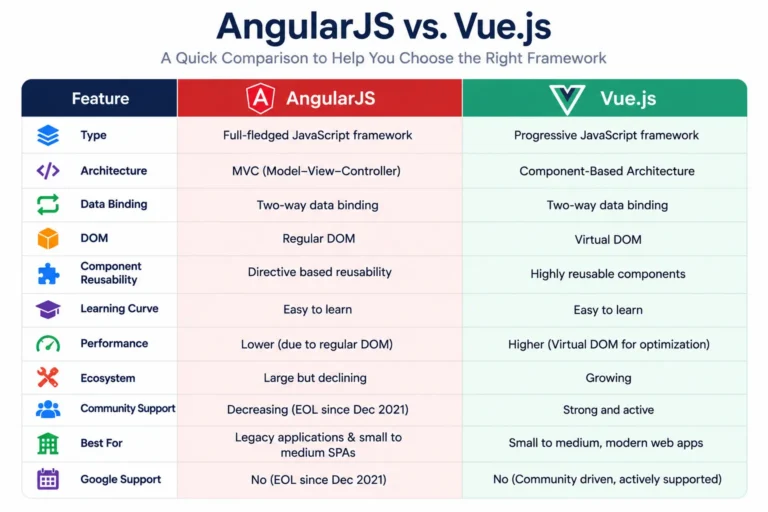
Vue.js is a progressive framework and it is easier to learn than AngularJS. This makes it ideal for smaller teams.
Pros of Vue.js:
- Ease of integration
- Lightweight
- Reactive components
Pros of AngularJS:
- Vast and supportive ecosystem
- Enterprise-level development is simpler
- Built-in tools for HTTP services, form validation, etc.
While Vue is great for fast prototyping, AngularJS app development agencies often recommend AngularJS for projects that require structure and scalability.
3. AngularJS vs. Ember
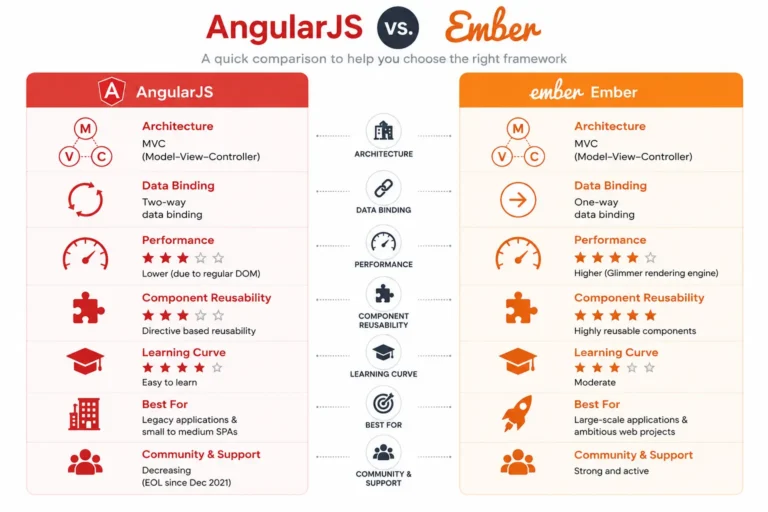
Ember is a full-featured framework that is very similar to AngularJS, designed for different types of web applications.
Pros of Ember:
- Convention over configuration
- URL-driven application state
Pros of AngularJS:
- The structure is more flexible
- Easier learning curve
- Strong community support
Both of the frameworks are capable, however, if you are looking for a JavaScript framework with a more flexible architecture, then an Angular.js web development company could provide a better path forward.
Business Use Cases Where AngularJS Excels
AngularJS is especially strong in use cases where you need:
- E-commerce platforms
- Enterprise-level dashboard applications
- Content management systems (CMS)
- Real-time applications like collaborative tools or chat apps.
With features like two-way data binding and dependency injection, AngularJS development services make it easier to manage dynamic content. It will also ensure faster development cycles.
Here’s what to look for when finding an Angular js development service:
- Experience in handling complex projects
- Proven portfolio of AngularJS app development
- Knowledge of the industry with best practices and security standards
- Scalable team for ongoing support and maintenance
An established AngularJS development company can help you make the most of AngularJS, from design to deployment.
Is AngularJS Right for Your Business App?
If you are looking to build a scalable, dynamic, and feature-rich web application, AngularJS development remains a solid option. Its comprehensive framework, supported by a vast developer community offers long-term flexibility and reliability.
Consulting with an experienced AngularJS development company can provide clarity and direction. They will provide the right guidance which will ensure you invest in the right technology from the start. They can guide you every step of the way from planning to post-launch support.
Start building smarter web application with the power of AngularJS.
Migrating from AngularJS to Angular: What Businesses Need to Know
Many businesses have the task of migration from AngularJS to modern Angular. It is a relevant issue since the historical framework is no longer supported by the core team. Thus, if your app is intended to be worked for decades and contain highly-sensitive data, it might be worth migrating to the new version of Angular.
Migration from legacy AngularJS to Angular does not require rewriting all the code at once. The frameworks are compatible, and apps can include both versions of the framework and migrate feature by feature. Such an approach is usually more expensive and time-consuming but allows businesses to continue developing the app, instead of stopping for several months or even years. For a business, it is critical to understand that code rewrite is a risky and costly endeavor that requires the specialization of the team in hybrid migrations.
Total Cost of Ownership: AngularJS vs React vs Vue Over 3-5 Years
The initial cost of development is not the only criterion that must be taken into account when choosing a framework; from an economical perspective, it is important to assess the total cost of ownership for the selected technology during its lifetime. Ongoing costs linked to the maintenance and management of these technologies may differ considerably for AngularJS, React, and Vue due to the variance in their update policies, community support, and additional tools.
The comprehensiveness of AngularJS decreases the costs related to the use of complementary libraries, which is especially relevant when compared to React. The latter’s ecosystem is fragmented, with individual components (routing, state management, HTTP client) developed separately. This leads to additional maintenance and update costs for these components, which can be significant for a large project.
Hiring cost is another essential parameter that should be taken into account when comparing the three solutions. The big amount of React developers allows filling vacancies quicker, and the competition for these specialists might reduce the hiring budget. At the same time, AngularJS has a smaller talent pool, but these experts are usually more experienced with enterprise-level apps and have a better understanding of enterprise-class structured development. Vue.js has an intermediate position, with an acceptable number of specialists who can be hired at a medium price.
Security Considerations Specific to AngularJS Applications
The security of an AngularJS application depends on the built-in security features of the framework and the extent to which they are used by their developers. For example, the framework possesses automatic HTML sanitization, which would prevent common XSS (cross-site scripting) attacks that generally require a manual sanitization of all user-supplied inputs. While this certainly enhances the software’s overall security, it should not replace the necessary input validation by the developers.
The framework’s built-in security tools also encourage secure coding practices among developers. For example, the use of AngularJS’s dependency injection system makes applications more testable, which, in turn, boosts the likelihood of security vulnerabilities being discovered and remediated during the testing phase. In other words, the harder an application is to test, the more potential issues will there be present until the product is launched and much harder to fix.
When choosing a development partner, asking them these types of specific questions is fundamental, as general assurances are often little but empty marketing platitudes. In this regard, the kinds of questions that could be asked include the recommended approach to authentication and sessions management and if there are any steps taken to perform a security audit or penetration testing before launch. It is also important to ask how the development team keeps track of the latest security advisories for the framework, since it is no longer supported by Google, and any vulnerabilities found must be manually addressed. Ultimately, a development company that is thorough and specific with their answers to security-related questions is more likely to be trustworthy, than one that is evasive or uses vague language.