

- 1 Technology Matters: The choice of web framework impacts performance, security, and scalability.
- 2 React Native: Ideal for cross-platform mobile-friendly ecommerce apps.
- 3 Node.js: Ensures high performance, scalability, and real-time data handling.
- 4 Django: Provides security, SEO benefits, and rapid development.
- 5 Spring Boot: Offers robust security, scalability, and microservices compatibility.
- 6 Laravel: Delivers customizable, high-performance, and secure ecommerce solutions.
- 7 Expert Guidance: Partnering with an ecommerce web development agency helps select the best technology for long-term growth.
Are you willing to expand your business through e-commerce? If yes, then you need to get scalable ecommerce web development solutions to stay competent in the market.
An e-commerce website is instrumental in increasing their sales and growing their business. So, when working with an e-commerce website development company, it is important to know the technology being used to build your app. It will directly impact the performance, security, and scalability of your platform.
Why the Underlying Framework Matters More Than It Seems
While it’s easy to think about the choice between framework-built or template-based e-commerce sites as a purely cosmetic distinction, in practice it has downstream implications for later in a store’s lifespan.
Template-based options take many decisions off the table by default, which makes them a good option for a launch that doesn’t need to incorporate a lot of bespoke functionality that a plugin or API integration wouldn’t normally support. The cost of those decisions are baked in as well, however, with businesses that outgrow a platform’s native capabilities often finding themselves incurring significantly higher costs to migrate their data and processes elsewhere.
A framework-based build, while requiring many more upfront decisions and carrying a longer tail of development work, does not have those limitations. The ability to build in-house checkout logic, recommendation algorithms, inventory synchronisation with a warehouse system, loyalty programs or complex pricing rules for b2b partners without relying on a third party plugin or stretching the capabilities of an existing one can often prove much more valuable to a growing business over the long term than any early benefit gained from a simpler, cheaper launch.
Questions to Ask Before Choosing a Framework
In addition to comparing the features of each framework, there are certain questions that need to be answered before selecting one. The first of these questions is about the expected traffic. The framework should be able to handle the amount of traffic that a store expects to get in the first year and the third year. While such a factor as the traffic of the business in years one and three appears to be significant, most often, the truth is that nothing will be able to withstand the surge of the first year. Therefore, the main challenge in this case is to choose a tool that is not difficult to maintain for the existing team of developers.
The next question is about the skills of the existing team. Most often, if the team already has skills in a particular programming language, they will be able to use them more efficiently and quickly, rather than code in a language they may not have mastered at all. While individual skills may outweigh the differences between one framework and another, the overall impact of this choice will still be greater on the team’s skills. Thus, selecting a framework that the team does not know about, only to improve some minor metric, may result in significantly more time spent on development.
Finally, the third question is about the complexity of payments, taxes, and inventory. On the one hand, it seems that for a small store selling a couple of digital products, none of this should be a problem. However, when the business grows and ties up inventory in several warehouses, the complexity of the program increases to include different tax systems and accounting methods. Consequently, the complexity of the framework is also very relevant for selection based on specific features.
Which Web Frameworks are Best for Developing Ecommerce Apps?
While platforms like WordPress and Shopify are widely used for developing e-commerce websites, they work with ready-made templates and built-in plugins for adding functionalities. However, when working with a web framework, the UI/UX design can be unique for your app. Even functionalities can be added as per your requirement.
Following are some of the best web development frameworks for building ecommerce websites:
1. React Native

Building an e-commerce website using React Native involves creating a cross-platform mobile-friendly application that can give a better user experience. You need to set-up for a React Native environment, using React Native CLI. Choose a backend like Firebase, Node.js, or Django for data management.
When you are working ecommerce website development, implement navigation using React Navigation, integrate payment gateways like PayPal or Stripe. Make sure that proper optimization of performance is made.
Benefits of using React Native:
- Compatibility across different platforms
- Faster Development & better Reloading
- Reusable Components
2. Node.js
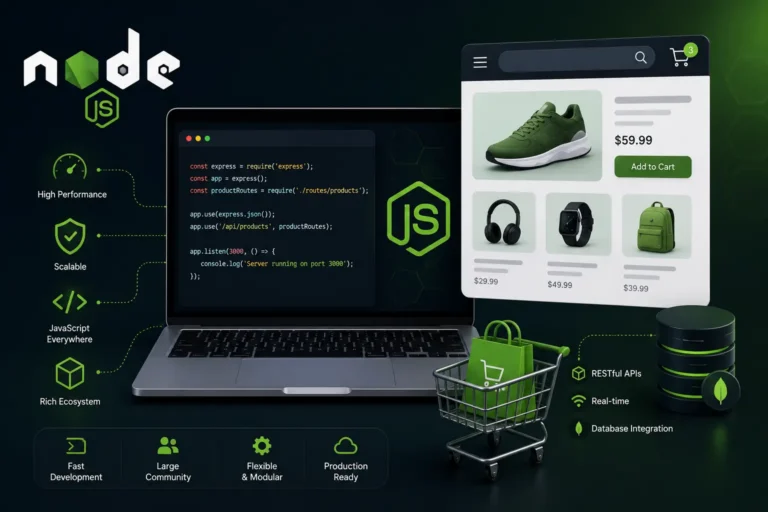
When you design an e-commerce website using Node.js Technology involves setting up a backend with Express.js, managing a database PostgreSQL or MongoDB. Key steps include handling payments with Stripe or PayPal, setting up authentication, and implementing features of product management.
Benefits of Using Node.js:
- High Performance: Handles multiple requests efficiently.
- Scalability: Ideal for growing e-commerce businesses.
- Real-time Data: Useful for live updates (e.g., inventory management).
- Cross-platform Compatibility: Works seamlessly with mobile applications.
3. Django (Python)
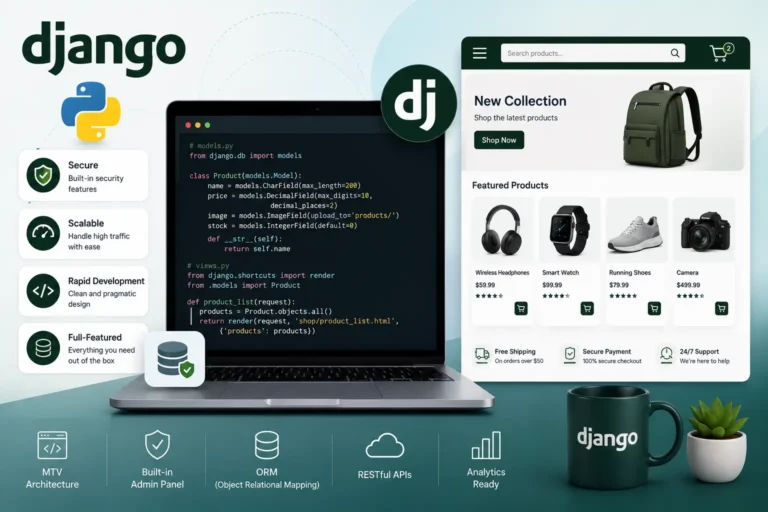
Building an e-commerce website using Django involves setting up a Django project, and defining models for users, products, and orders. You can create desired templates for displaying products and integrating payment gateways. Django’s built-in authentication system ensures secure user management and Django ORM makes database operations simple. You can use Django REST Framework to build APIs for a smooth shopping experience.
Benefits of using Django (Python):
- Scalability – Handles high traffic efficiently.
- Security – Protects against common vulnerabilities.
- Rapid Development – Reusable components speed up coding.
- SEO-friendly – Clean URLs enhance search visibility.
- Customization: Full control over design and functionality.
4. Spring Boot (Java)
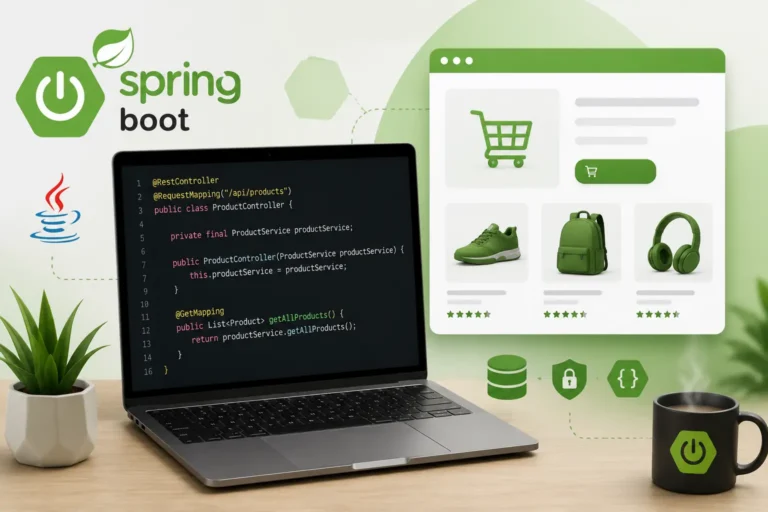
When you are doing e-commerce website development using Spring Boot (Java) involves simple steps. First, set up a Spring Boot project with dependencies like Spring Data JPA, Spring Web, and Thymeleaf. Configuration of database (e.g., MySQL) and use JPA/Hibernate for data persistence. Develop REST APIs for products, orders, and users. Integrate payment gateways and ensure security with JWT.
Benefits of using Spring Boot (Java):
- Security – Built-in security features.
- Scalability – Handles high traffic efficiently.
- Rapid Development – Reduces boilerplate code.
- Compatibility for Microservices – Supports modular architecture.
5. Laravel (Custom PHP Solutions)

Laravel is a powerful PHP framework widely used for building custom ecommerce applications. Many professional ecommerce services providing agencies prefer this to build a robust ecommerce website.
Benefits of using Laravel:
- Customizability: Fully customizable functionalities and features.
- High Performance: Optimized for speed and efficiency.
- Robust Security: Built-in security features for preventing cyberattacks.
For businesses looking for ecommerce web application development, Laravel offers unmatched flexibility over the entire system.
Comparing the Five Frameworks Side by Side
| Framework | Primary strength | Best fit | Backend language |
| React Native | Cross-platform mobile UX | Mobile-first ecommerce brands | JavaScript |
| Node.js | Real-time performance, scalability | High-traffic, real-time inventory needs | JavaScript |
| Django | Security, rapid development, SEO | Content-heavy or fast-to-launch stores | Python |
| Spring Boot | Enterprise scalability, microservices | Large, complex, multi-service platforms | Java |
| Laravel | Customization, PHP ecosystem | Fully bespoke ecommerce builds | PHP |
A pattern that emerges from some of the options is that three of the five technologies suggested have the same language as their foundation. A team that is comfortable working in JavaScript can leverage it in both their front-end (React Native) and their back-end (Node.js), sharing not only the language but also some patterns and tools in their day-to-day work. While React Native relies on JavaScript, the other two technologies mentioned (especially the backend) are built with it as well, so this is a significant advantage. This way, the development team would not need to switch between multiple programming languages while working with both ends of the application.
What Happens after Launch: Maintenance
The choice of the framework does not end when the product is released. It affects future maintenance and, therefore, the costs associated with it.
The frequency of security updates depends significantly on the ecosystem in which the framework functions. Django and Spring Boot, in particular, are known for their high degree of organization and security, which is explained by the fact that they are used in enterprises where the cost of possible failures is very high. The Node.js ecosystem is large and thriving, but individual dependencies require more careful maintenance since one of the most common ways of stealing information from web apps is to find vulnerabilities in their third-party components.
Third, potential problems with finding specialists should be discussed. If the framework requires highly specialized knowledge, the loss of such an employee will be more difficult to replace than, say, in Django or Node.js. This factor is more relevant for projects that intend to exist for a long time and, therefore, require a stable development team.
Cost-related considerations outside of development
The cost of developing an application based on a particular framework is only part of the equation: businesses that base their decision solely on the first figure often get unpleasant surprises when calculating the bottom-line cost of ownership a year or two later.
The hosting cost for applications built with different frameworks may also prove to be significantly different, and not necessarily in one’s favour. While Node.js and its ability to handle heavy lifting through event loops are frequently praised on developer forums, the actual demand for such capabilities is often lower than one might expect: a chat feature and inventory tracking in real-time may be useful for some projects, but for many a simple Django or Laravel deployment will be more cost-effective in the long run. Spring Boot, for its part, has a reputation for being particularly demanding in terms of server resources and accordingly expensive to host.
The difference may also be found in the salaries offered to people who can maintain a particular framework: Laravel and NodeJS, being relatively common, have less competitive rates than one would find for Spring Boot or Django developers in many recruitment markets. It must be stressed that in and of itself this is not a disadvantage: budgeting more money for a Django developer may be the most sensible decision for a particular business, depending on one’s particular needs. However, the trend does exist, and it is useful to keep in mind when comparing the costs of development in different programming languages.
Finally, a word must be said about the potential additional costs of third-party software integration. At the most basic level, any serious e-commerce project will require a number of external services: shippers, tax calculators, accounting tools, CRM systems and more. For some frameworks, supplementing one’s own code with such tools may prove to be comparatively expensive: Laravel and Django, for example, tend to have more third-party services and tools available for them, often in official repositories, while others may require custom coding for each particular piece of software. In the long run, this reduces both the initial development costs and the ongoing maintenance costs due to the reduced technical complexity of such integrations and the availability of technical support.
Scaling Trends: Understanding How Each Framework Scales
Discussing abstract scalability is not particularly useful for the business, since most of the time companies are looking to understand what particular growth patterns will look like in terms of engineering resources. Node.js applications are usually scaled horizontally, which is relatively straightforward in terms of technical complexity and aligns with the general tendencies of cloud hosting platforms. This makes the runtime a good fit for stores which expect to see traffic growth in unpredictable bursts, which is common for many flash-sale or seasonal stores.
Django, on the other hand, typically scaled by optimizing the database and caching layer, and moving its heavier features to dedicated services behind a load balancer. Django apps which began as prototypes tend to see decent traffic growth before requiring significant architectural improvements. This makes the framework better suited for ventures which expect to see stable traffic increases rather than unpredictable traffic bursts.
Finally, Spring Boot is rarely used in monolithic applications, as the framework is best utilized in a microservices architecture. The same quality which makes it more difficult to work with in theory, makes it a good choice for businesses which need to scale their operations to extremely high levels. A large-scale ecommerce application would likely make use of Spring Boot for its services, APIs and dedicated components due to the inherent flexibility of the microservices approach.
Which One Will You Choose for your Ecommerce App?
Choosing the right technology for your ecommerce app is essential for long-term success. If you still feel unsure which technology best suits your business, partnering with a reputable ecommerce website design agency can help you make the right decision. Are you ready to take the next step to boosting your online business?