



SQLAlchemy offers both an ORM and a lower-level SQL Expression Language, mixable in one project. Real projects also need migrations, handled by Alembic. Watch for common mistakes: forgetting to commit, touching closed-session relationships, and holding sessions too long.
- 1 SQLAlchemy combines an ORM and SQL toolkit, allowing developers to work with both Python objects and raw SQL.
- 2 Key components include the Engine for database connections, Session for transactions, and Declarative Base for defining models.
- 3 SQLAlchemy’s flexibility and support for multiple databases make it ideal for scalable applications, offering full control over query performance.

Introduction to SQLAlchemy
Whenever one needs to interact with the databases in Python, more often than not, SQLAlchemy is what is used. This is a more flexible framework which is also popular particularly for wrapping the relational databases into Python objects. Not only is SQLAlchemy an ORM tool, but it’s also a powerful SQL tool that provides full control to the developer regarding how he/she wants to interact with databases.
This guide will introduce you to SQLAlchemy especially if you are a total beginner in the tool and will also cover some of their most frequent applications.
What is SQLAlchemy?
The Object-Relational Mapping (ORM) module and Python SQL toolkit SQLAlchemy enable developers to avoid usage of plain SQL queries and rather work with python objects for databases. SQLAlchemy offers two essential parts: SQLAlchemy offers two essential parts:
SQL Expression Language: A nicely designed SQL toolkit complemented with the ability to provide direct SQL manipulation in a Pythonic way.
For example the Object-Relational Mapper, or ORM as it stands for, is an edited Pythons tool which allows you to work with the database using only Python objects and Python classes mapped to database tables.
Why Choose SQLAlchemy?
Out of the numerous Python database packages, SQLAlchemy has some benefits which have made it to feature among the best.
Flexibility: It can work at the level of concrete queries in SQL and work at the abstract level of ORM. You can write both ‘low-level’ raw SQL as well as ‘higher-level’ ORM offered by your framework.
Database Agnostic: Some of the supported databases are PostgreSQL, MySQL, SQLite, Oracle, and more more databases are supported by SQLAlchemy. This allows for movement between databases as required, and could be adapted to work in a like manner for document management systems as well.
Declarative Syntax: One of the major strength of SQLAlchemy’s ORM is the declarative syntax that helps in defining models and relationship.
Performance: SQLAlchemy exposes a lot of technical credit over the query performance, unlike certain other ORMs, so the developer can perform the optimizations by their own.
Installing SQLAlchemy
To get started with SQLAlchemy, you can install it via pip:
pip install sqlalchemyIf you also need a database driver (e.g., psycopg2 for PostgreSQL or pymysql for MySQL), you can install it alongside SQLAlchemy.
Core Concepts of SQLAlchemy
Before getting into the code, there are some important basic concepts of SQLAlchemy that needs to be understood.
Engine: This is the starting point of every application that is built on SQLAlchemy. The engine is a connector between your application and the database while having the connection pool in its disposal.
Session: The session facilitates the communication that results in managing the database. With it you may control the transactions and add, modify or delete things from the database.
Declarative Base: Your whole ORM models are based on this class. It provides the way to relate Python classes with the Relational Database.
Model: The term used to refer to a Python class, which represents a database table is known as Model. To correlate the rows in the table to the concept above, it should be noted that each instance of the class corresponds to a row in the table.
Getting Started with SQLAlchemy ORM
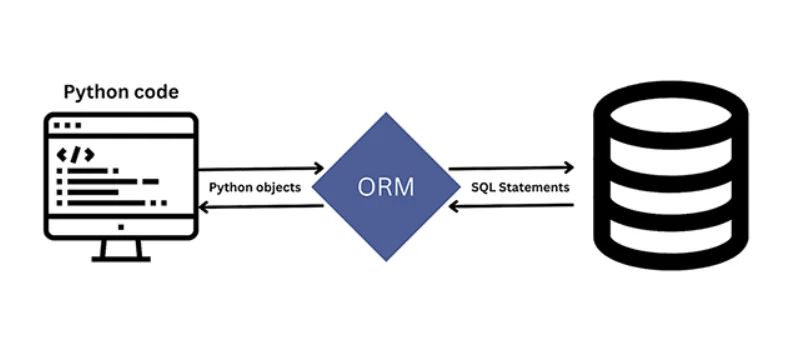
Let’s now go over a simple example that shows you how to utilize the ORM features of SQLAlchemy.
from sqlalchemy import create_engine
# Replace the connection string with your database URL
engine = create_engine('sqlite:///example.db')
Defining Models
By building Python classes that derive from the declarative_base() class, you define your database tables.
from sqlalchemy.ext.declarative import declarative_base
from sqlalchemy import Column, Integer, String
Base = declarative_base()
class User(Base):
   __tablename__ = 'users'
id = Column(Integer, primary_key=True)
name = Column(String)   age = Column(Integer)
In this instance, a table named users and a User model are defined in tandem. A class property is used to represent each column in the table.
Creating the Tables
After defining your models, you can make the relevant database tables:
Base.metadata.create_all(engine)This will produce the SQL required to establish the user’s table.
Working with Sessions
Using the Session object, database interactions are possible. You can add, query, and update records in the following ways:
from sqlalchemy.orm import sessionmaker
Session = sessionmaker(bind=engine)
session = Session()
# Adding a new user
new_user = User(name="John Doe", age=30)
session.add(new_user)
session.commit()
# Querying users
users = session.query(User).all()
for user in users:
   print(user.name, user.age)
# Updating a user
user_to_update = session.query(User).filter_by(name="John Doe").first()
user_to_update.age = 31
session.commit()
Handling Relationships
Define relationships between models with SQLAlchemy, one of its great features. A one-to-many relationship between a User and a Post model, for instance, can be defined as follows:
from sqlalchemy import ForeignKey
from sqlalchemy.orm import relationship
class Post(Base):
   __tablename__ = 'posts'
   id = Column(Integer, primary_key=True)
   title = Column(String)
   content = Column(String)
   user_id = Column(Integer, ForeignKey('users.id'))
   user = relationship("User", back_populates="posts")
User.posts = relationship("Post", order_by=Post.id, back_populates="user")
By doing this, a relationship is established between the user and the post, enabling easy access to the user’s postings and vice versa.
SQLAlchemy vs. Other ORMs
SQLite can also be compared to other ORM like SQLAlchemy, Django, ORM and Peewee. Here’s how it stacks up:Here’s how it stacks up:
Flexibility: SQLAlchemy is more versatile when compared to Django’s ORM because it allows you to write your own SQL query as opposed to limiting you to only pre-defined queries.
Learning Curve: That is why SQLAlchemy is considered to be less easy to learn although it is more powerful than other solutions; it is flexible and is based on both ORM and SQL Expression Language.
Community: It should also be noted that the SQLALchemy has both a large and active community and the project has existed for many years so it is very stable and well documented.
When to Use the ORM Layer and When to Drop Down to Raw SQL
SQLAlchemy is different from other ORM tools because of its avoidance of obfuscating SQL. Developers can work with Python objects that represent common database operations and revert to SQL when needed.
The ORM can be utilized to implement creation, update, retrieval and association navigation operations. Additionally, it can manage sessions, identity maps and lazy loading. The session object also allows for implementing the unit-of-work pattern, thus allowing for grouping of changes and committing them in a single transaction.
ORMs can become hard to read when dealing with bulk updates and selects, window functions, common table expressions, and subqueries. For these situations, it is better to use SQLAlchemy’s Expression Language that provides similar features through select(), join(), and where() syntax and other functions.
Expression Language is also helpful when working with SQL queries that need to have more control over what columns are being selected or joined than what ORM objects are available. This is due to the ability to avoid loading entire objects and instead return specific columns needed for results. This is also beneficial for reporting and analytics use cases where extra processing has to be done.
Using text() it is possible to add raw SQL to parts of a query while still maintaining connection management and parameterization provided by SQLAlchemy. When using parameters, they must be provided externally, preferably in a manner that prevents SQL injection attacks, and not as Python format strings for safety and convenience.
Conclusion
Starting from simple operations with the ORM layer up to complex database work-flow SQLAlchemy is a sophisticated and flexible toolset. Because of the ability to use it as an ORM and SQL tool, it is a favorite among developers who need full control of their database and wishing to work in the object-oriented paradigm of Python.
SQLAlchemy can scale up if you’re using PostgreSQL for a huge application, or you’re using SQLite for a miniature application. If you learn about the fundamental concepts and how they can be harnessed and expanded to take advantage of Python’s more advanced features, it may be possible to write more structured, mangesible and effective database code in Python.
To learn more about SQLAlchemy and its capabilities, check out SQLAlchemy’s official website.
For additional insightful articles and information, please reach out to us.