

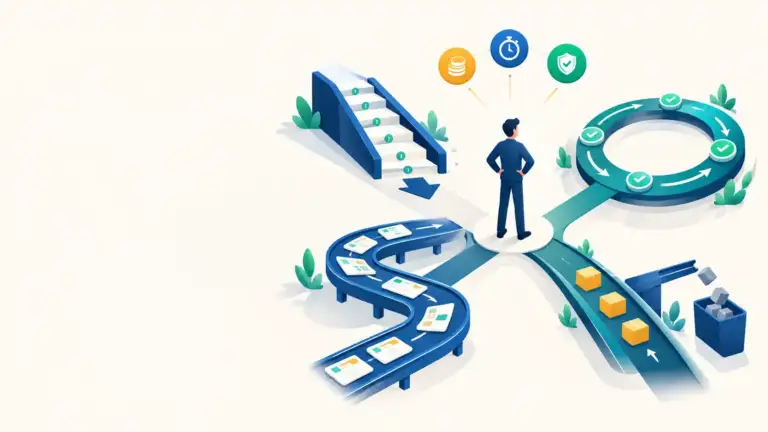
There is no single best methodology. Waterfall gives predictability for fixed, regulated work. Agile, run as Scrum or Kanban, gives speed and adaptability for evolving products. Lean cuts waste to control cost, and hybrids blend the two for regulated products that still need to iterate. The cost, speed, and risk you get depend on matching the method to the project, not on picking the trendiest one. Get the match wrong and the bill shows up around month three as a mid-project restructuring.
- 1 There is no single best methodology; match it to the project's shape.
- 2 Waterfall suits fixed, regulated work; Agile, as Scrum or Kanban, suits evolving products.
- 3 Lean cuts waste to control cost, and pairing it with Agile improves cost efficiency further.
- 4 Hybrids like Water-Scrum-Fall fit regulated products that still need to iterate.
The methodology you choose affects your project’s cost, delivery time, and risk. Many teams use Agile by default, but it is not always the right choice. Regulated projects may need Waterfall, cost-conscious teams may prefer Lean, and long-running products can work well with Kanban instead of Scrum. The idea is to choose a method that fits the project, and not simply following what another team used.
Why software development process methodologies shape your ROI
Your choice of process sets the pace, the cost curve, and the risk profile of a project. Software development process methodologies chosen without matching them to the project type fail in predictable ways. Fixed-scope Waterfall on evolving requirements produces change-request wars. Agile on regulated projects produces audit findings. Kanban on stakeholder-heavy projects produces expectation gaps. The cost of the wrong choice usually shows up in month three, when the mismatch forces a mid-project restructuring. Picking the right one at kickoff avoids that whole class of problem.
The Waterfall methodology: predictable but rigid
Waterfall breaks a project into sequential phases, requirements, design, build, test, and maintain, each finishing before the next starts. That sequence is what gives the Waterfall methodology its predictability, and its rigidity.
- Strength: predictability. After requirements, everyone knows what will be built, what it costs, and when it ships.
- Weakness: rigidity. Changes found mid-build cost 10 to 100 times more than they would have in the requirements phase.
- Fits: stable-requirement work like regulatory reporting, contractual government work, and safety-critical embedded systems.
- Fits poorly: consumer products where user feedback drives the roadmap.
The Agile software development methodology: built for speed
Agile structures work in short iterations with continuous stakeholder feedback, so requirements evolve as evidence accumulates and working software ships every two to four weeks. The Agile software development methodology wins on speed and adaptability, at the cost of upfront predictability.
- Plans for change instead of pretending change will not happen.
- Surfaces problems early through short iterations and frequent review.
- Fits products where users, market, or requirements are still evolving.
- Often misread as no plan needed, though strong Agile teams plan carefully.
Scrum methodology vs. Kanban software development
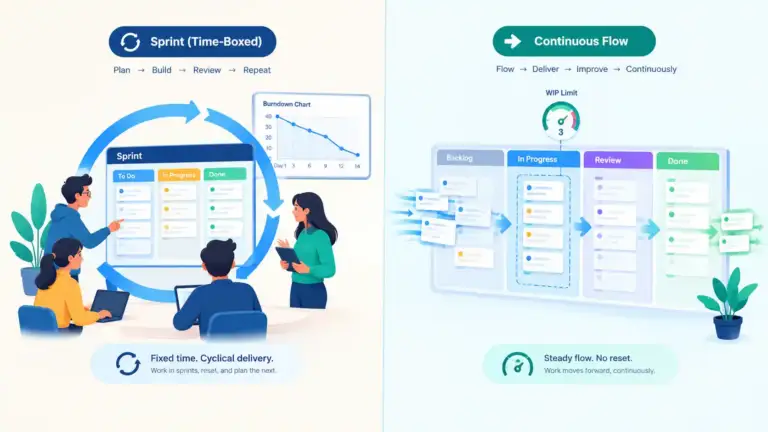
Under the Agile umbrella, Scrum methodology and Kanban software development are two ways to run agile methodologies, and they structure the work differently.
| Dimension | Scrum | Kanban |
|---|---|---|
| Work structure | Fixed-length sprints (2 to 4 weeks) | Continuous flow |
| Roles | Product owner, Scrum Master, dev team | No defined roles |
| Meetings | Standup, planning, review, retro | Standup, others on demand |
| Change during cycle | Discouraged mid-sprint | Always welcome |
| Metrics | Velocity, burndown | Cycle time, throughput, WIP |
| Fits | Product teams shipping features | Ops, support, mixed work |
Lean software development: cutting waste to control cost
Borrowed from the Toyota Production System, Lean software development applies a handful of ideas to software, eliminate waste, amplify learning, decide as late as reasonable, deliver fast, empower the team, build integrity in, and see the whole. The main software development cost driver it targets is waste:
- Features users do not need.
- Documentation nobody uses.
- Meetings that do not produce decisions.
- Duplicate work or unnecessary handoffs.
Cutting that waste lowers cost while improving flow. Lean is usually layered onto Agile rather than run alone, and the combination tends to improve cost efficiency, by rough practitioner estimates on the order of 15 to 30 percent, though the figure varies widely and is not from a controlled study.
Project management methodologies compared: cost, speed, and risk
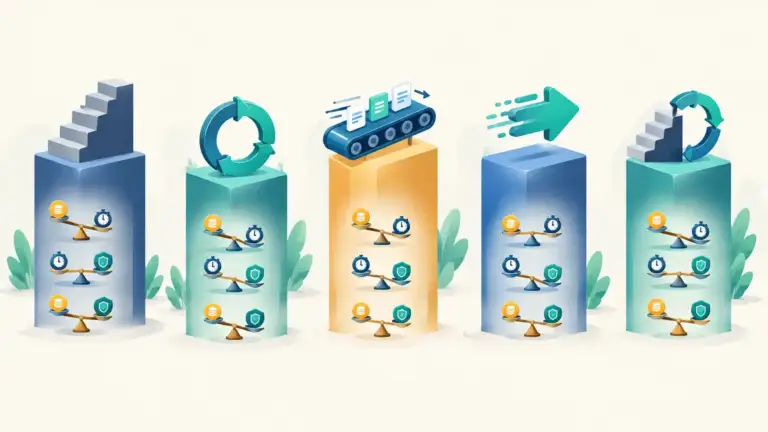
It becomes easier to compare project management methodologies when the question shifts from “which one is best?” to “what does this project need most?”
| Methodology | Upfront cost | Time to first ship | Mid-project change cost | Risk profile |
|---|---|---|---|---|
| Waterfall | High | Long | Very high | Rigid |
| Agile (Scrum) | Low | Short | Low | Adaptive |
| Kanban | Very low | Continuous | Very low | Flow-based |
| Lean | Low | Short | Low | Waste-averse |
| Hybrid (Water-Scrum-Fall) | Medium | Medium | Medium | Balanced |
Software development risk management: match the method to complexity
Software development risk management starts with matching software development methods to project complexity:
- Low complexity with stable requirements: Waterfall or tightly scoped Agile.
- Moderate complexity with evolving requirements: Scrum.
- Continuous or operational work: Kanban.
- High uncertainty with pressure on cost and flow: Lean-Agile.
- Regulated work with changing product needs: Hybrid delivery.
The stronger methodology is the one that gives the team enough structure without forcing the project into assumptions that are unlikely to survive contact with reality. Innostax runs delivery across Agile, Waterfall, Lean, and hybrid models, with the approach chosen around the project rather than applied as a fixed template.
Hybrid software development methods: the best of both
Pure methodologies may look good on paper, but real projects are often more flexible.
Hybrid software development methods combine different approaches at different stages of a project. One example is Water-Scrum-Fall, where teams use a structured approach for requirements and governance, work in iterations during development, and follow defined controls for release or compliance.
This approach can work well for businesses that need both proper documentation and room to adapt. Many modern development methodologies use a similar mix, especially when some parts of a project require strict controls while others need faster development.
Software development methodologies: which one fits your goals?
The right methodology matches the shape of the project, not the team’s preference. Whether the answer is Waterfall, Agile run as Scrum or Kanban, Lean, or a hybrid, Innostax runs client projects across all major software development methodologies and helps teams pick the right one at kickoff. Our tech leads bring the discipline that makes any methodology work, clear rituals, honest metrics, and adjustments when the framework and reality diverge. Talk to us before the next steering committee if the current method is not fitting.
Ready to run your next build on the right methodology? Book a free delivery review with the Innostax managed engineering team.