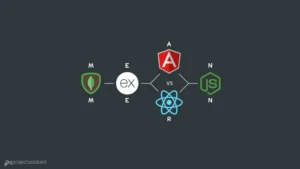


- 1 MEAN and MERN stacks both use JavaScript for full-stack development but differ in their frontend frameworks: Angular (MEAN) vs React (MERN).
- 2 MEAN stack is ideal for enterprise-grade applications needing a structured and secure framework using Angular and TypeScript.
- 3 MERN stack offers faster development, is easier to learn, and is better suited for dynamic single-page applications with React.
- 4 Both stacks support RESTful API development with Express.js and share MongoDB and Node.js as backend technologies.
- 5 MEAN is backed by Google, offering stability, while MERN has a vast community and extensive third-party library support.
- 6 Choose based on your team’s expertise, the complexity of your project, and whether you prioritize performance or structure.
- 7 MEAN fits complex enterprise projects, while MERN is great for startups and modern, interactive UIs.
- 8 Both stacks enable scalable, open-source web development, helping businesses grow efficiently.
Choosing the right technology stack is very important for the success of an application of any business. MEAN stack and MERN stack stand out preferable, due to their robust performance and community support. Both stacks leverage JavaScript for client and server-side development, their main differences can significantly impact your application. Here, we shall explore more about MERN stack vs MEAN stack. It will help you make a proper decision as per your business goals.
What is the MEAN Stack?
It is a collection of open-source web technologies used to build dynamic web applications. The acronym stands for:
- MongoDB: A NoSQL database
- Express.js: A backend web application framework
- Angular: A TypeScript-based frontend framework developed by Google
- Nodejs: A JavaScript runtime environment
It’s widely used for MEAN-based web application development, including enterprise applications, content management systems, and RESTful APIs.
Cost Considerations Beyond the Initial Build
Stack comparisons tend to focus heavily on development speed and technical fit, but cost is often the deciding factor for growing businesses, and it plays out differently than most people expect.
The upfront cost difference between MEAN and MERN development is usually small — both use the same database and server-side runtime, so a lot of the cost overlap comes down to hourly rates and team size rather than the stack itself. Where the cost picture actually diverges is in long-term maintenance. MEAN’s structured, opinionated nature tends to mean lower onboarding costs when new developers join a project later, since Angular enforces conventions that make an unfamiliar codebase easier to navigate. MERN’s flexibility can reduce initial development costs but sometimes shifts that cost downstream, since a loosely structured React codebase built without consistent conventions can take longer for a new developer to understand.
Neither pattern is a rule — a disciplined team can keep a MERN codebase just as maintainable as a MEAN one. But it’s worth budgeting for that difference in structure rather than assuming maintenance costs will track identically across both stacks.
What is the MERN Stack?
The MERN stack is similar to the MEAN in terms of core components, except for the frontend technology.
The acronym here stands for:
- MongoDB
- Express.js
- React – a frontend JavaScript library developed by Facebook
- Node.js
The component-based architecture of React makes MERN a favorite for developers focused on high-performance and interactive UIs.
Security Considerations in Both Stacks
Security is rarely the headline factor in a stack decision, but it’s worth understanding since the two stacks approach it somewhat differently by default.
Angular, used in MEAN, includes built-in protection against common vulnerabilities like cross-site scripting (XSS), largely because it automatically sanitizes values bound to the DOM unless a developer explicitly opts out. This “secure by default” posture reduces the chance of an oversight introducing a vulnerability, particularly on teams with less security-specialized experience.
React, used in MERN, also escapes content by default before rendering it, which mitigates a lot of the same XSS risk. However, because React is a library rather than a full framework, security-related decisions — like how authentication state is managed, or how third-party components handle user input — are left more to the individual libraries a team chooses to bring in. This isn’t a weakness of React itself, but it does mean security consistency depends more on the team’s choices than on the framework enforcing a pattern.
In both stacks, the database and server layer (MongoDB, Express, Node.js) carry identical security responsibilities — proper input validation, authentication handling, and query sanitization to prevent injection attacks matter equally regardless of which front-end framework sits on top.
MEAN Stack vs MERN Stack: Core Differences
Here are the key areas where these two popular stacks diverge and how they fit different business requirements:
1. Frontend Framework: Angular vs React

Angular (MEAN) is a full-fledged MVC framework. It offers several built-in features like HTTP client, form validation, and routing, which complete development.
React (MERN) is a focused solely on library for building user interfaces. It is lightweight and flexible, it also needs other tools like Redux or React Router for complete development.
Choosing MEAN for enterprise-grade apps can be better as it has a well-structured framework. MERN is better for applications that need flexibility and high performance in UI development.
2. Learning Curve and Development Speed
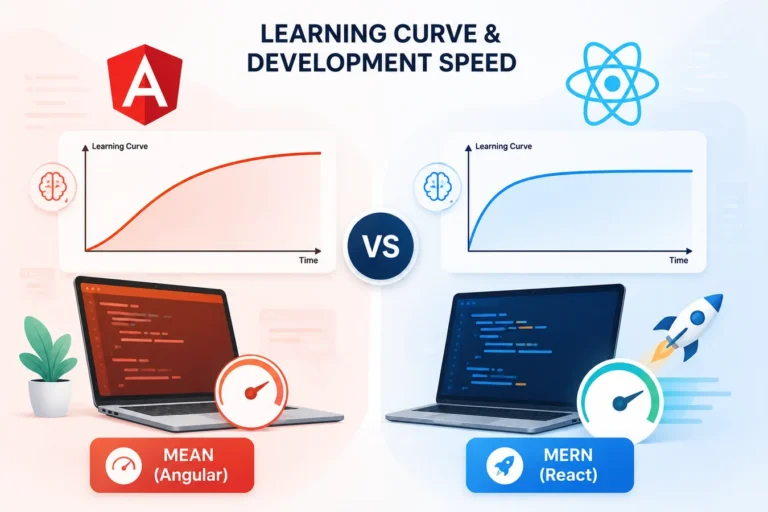
MEAN development stack will need familiarity with Angular’s learning point, which can initially slow down development, and is good for large-scale applications.
MERN is beginner-friendly as it is easy and due to the simplicity and vast developer resources it has.
If application delivery is important and your team is less experienced with Angular, MERN may be a better option.
3. RESTful API Development
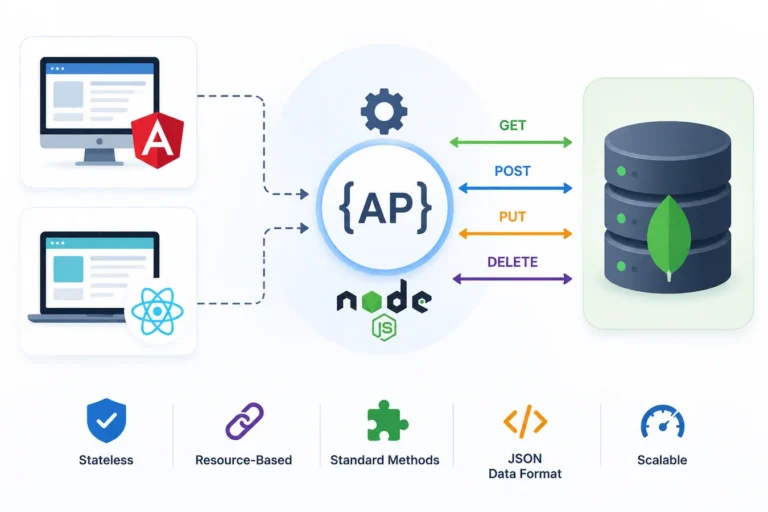
Both MEAN and MERN stacks are better with RESTful API development using Express.js. Express offers a flexible approach to routing and middleware management in both stacks.
No significant difference here, as both stacks are equally good for building efficient APIs.
4. Community Support
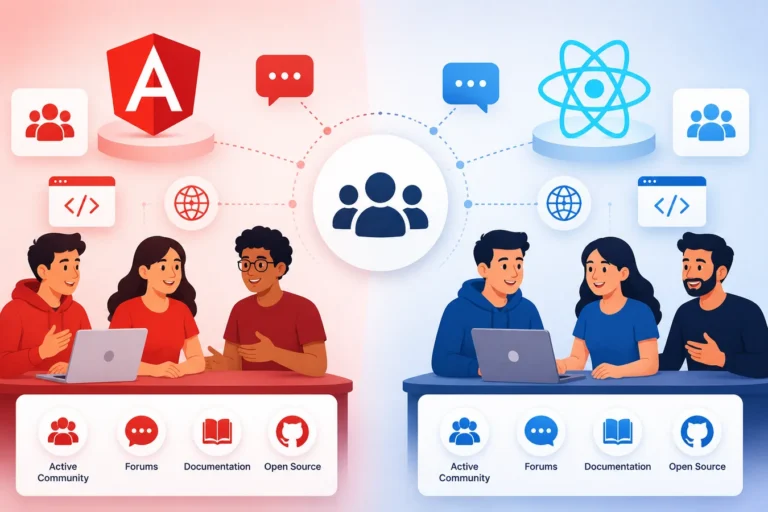
Angular (MEAN) is backed by Google, which can ensure long-term support and frequent updates.
React (MERN) has a larger community and several third-party libraries, which can be used across startups and tech giants properly.
MERN may provide more pre-built components and better support, while MEAN offers stability and reliability at the enterprise-level.
Scalability: How Each Stack Handles Growth
It may seem that scalability is a purely database-related concept, but also the choice of the front-end framework influences how easily an application can be scaled. This factor is of particular importance for those projects that require a significant amount of features.
The scalability of the Angular framework is determined by the fact that it is built on discrete self-contained units (modules). The bigger the application is, the more modules there are, and the easier it is to scale it by adding new modules by established patterns. The same pattern is used to all parts of the code, which allows for maintaining consistency and avoiding confusion when interacting with a large team of developers.
The scalability of React, on the other hand, depends greatly on the conventions used to build the code of the application, since the framework does not offer a standard way of developing projects. Thus, if a MEAN project following specific conventions can scale well, a MERN project with inconsistent code conventions may be tough to scale.
Differences in scalability, largely due to front-end technologies, are not reflected in the back-end since both use Node.js. The ability to scale applications based on these technologies would depend primarily on the database, which for both technologies is MongoDB. For this system, there are options for horizontal scaling such as sharding.
Which Stack Should You Choose for Your Business?
The decision between MERN stack vs MEAN stack should be based on your team’s expertise, the complexity of the project, and the business goals.
Choose MEAN Stack When:
- You want a complete, integrated framework.
- You are developing a complex and enterprise-level application.
- Your team is comfortable with TypeScript and Angular’s structure.
Businesses looking for MEAN-based web solution development can get an advantage from Angular’s security features and testability.
Choose MERN Stack When:
- You need better development speed and flexibility.
- You are building a highly interactive and single-page application (SPA).
- Your team prefers JavaScript over TypeScript.
MERN is excellent for startups and fast-paced projects where modern UIs are a priority.
Questions Worth Asking Before Committing to Either Stack
Beyond the general guidance above, a few specific questions tend to clarify the decision faster than a feature-by-feature comparison:
How long is this application expected to live? A short-lived MVP built to validate an idea doesn’t need the same structural investment as a platform expected to run for years with an expanding team. Longer-lived, larger applications tend to benefit more from Angular’s enforced structure.
How much of the team already knows TypeScript? Angular is built around TypeScript, and while it’s learnable, a team without prior TypeScript experience will spend real time climbing that curve before becoming fully productive. Teams already comfortable with plain JavaScript tend to feel MERN’s learning curve is gentler.
Does the roadmap include a mobile app? If mobile is a near-term goal rather than a distant one, MERN’s overlap with React Native is worth weighing seriously, since it allows some component logic and team knowledge to carry over to a mobile build.
Who will maintain this after the initial team moves on? If long-term maintenance will fall to a different team, or to whoever can be hired locally, it’s worth checking which framework has a deeper talent pool in your hiring region — this varies significantly by location and can affect maintenance costs more than the technical merits of either stack.
What’s Best for Your Business?
When evaluating the MEAN application development stack against the MERN alternative, it’s not about which stack is better, which is better for your business requirement. Both stacks are powered by modern open-source web technologies, which enable faster and a scalable development. Ultimately, understanding the requirements and aligning them with your strategic goals will help you choose the right stack for your success.