

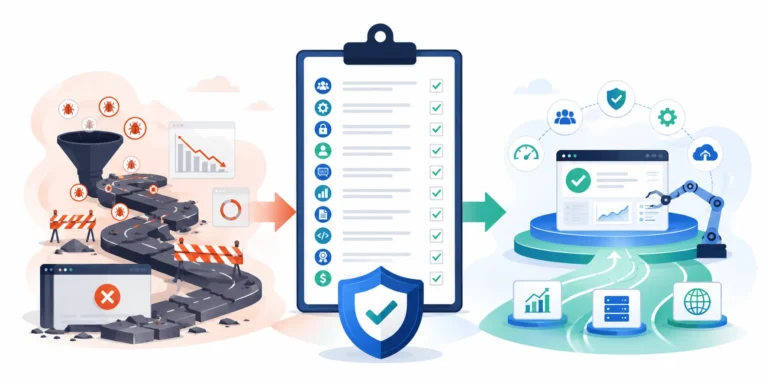
Choosing a software QA testing partner requires more than comparing prices. Evaluate vendors across domain expertise, modern tools, security, scalability, reporting, IP ownership, Agile integration, and proven results. Use the 10-point checklist to score each QA outsourcing provider consistently, validate their claims with client references, and choose the partner that can support your quality goals as your product grows.
- 1 Choose a QA partner based on delivery outcomes, not just hourly rates or tester headcount.
- 2 Evaluate domain expertise, modern testing tools, security practices, scalability, and communication before signing a contract.
- 3 Confirm ownership of test scripts, frameworks, documentation, and other QA assets to avoid vendor lock-in.
- 4 Assess how well the vendor integrates with your Agile, DevOps, sprint, and engineering workflows.
- 5 Use measurable QA metrics such as defect escape rate, coverage trends, and cost per defect to evaluate performance.
- 6 Score every vendor against the same checklist and validate claims through recent, relevant client references.
Choosing the wrong software testing company delays releases and wastes budget. Choosing the right one gives you a partner that catches bugs your team would have missed. The decision carries significant risk when cost is prioritised over capability. This 10-point vendor checklist gives you a repeatable way to evaluate QA outsourcing services against the criteria that actually predict quality outcomes. Use it for RFPs, reference calls and internal debriefs after each vendor meeting.
Why Your Choice of Software Testing Company Defines Your 2026 ROI

Choosing the right quality assurance software testing company can strengthen release quality across the engagement. Vendors with weak domain knowledge miss context-specific bugs. Vendors with outdated tooling slow every sprint. Vendors with poor communication burn engineering hours in status meetings that could have been async updates. Get the choice right and QA becomes a delivery accelerator. Get it wrong and QA becomes the reason releases slip. The evaluation deserves the same rigor as picking a development partner.
Specialized Domain Expertise vs. Generalist Testing
Can the vendor apply testing practices that fit your industry? Healthcare, fintech and e-commerce each have specific regulatory and edge-case profiles. A generalist tester covers basics; a specialist finds domain bugs.
Mastery of the Modern Tech Stack and AI Tools
Ask about the actual tool stack. Playwright or Cypress for browser tests, Appium for mobile, K6 for load. AI-assisted test generation for regression coverage. Vendors that have not moved beyond manual testing are missing a core part of modern QA.
Intellectual Property and Data Security Protocols
What controls does the QA testing company have on your code and test data? SOC 2 Type II report, data residency options, background checks on engineers with production access. Request the full report rather than a high-level sales version.
Scalability and the “Bench” Capacity
Can they add testers when you need to double coverage for a launch? Vendors offering QA testing services with real bench capacity ramp in a week. Vendors without it fill the gap by pulling engineers off other accounts, and quality drops.Communication Transparency and Time Zone Overlap
How many overlap hours does the delivery team have with yours? Under four hours daily creates a lag on every question. Vendors that work well asynchronously make decisions easy to track. Those that do not often slow the team down.
Look Beyond Activity in Weekly QA Reports
What does their weekly report look like? Defect density, escape rate, coverage trend and cost per defect caught are all useful. Reports that list activity without outcomes are a warning sign.
Keep Ownership of Every QA Asset
Who owns the test framework, scripts and data? If the vendor keeps them, switching vendors later means rebuilding from scratch. Contract explicitly for ownership of every artifact produced during the engagement.
Agile Integration and DevOps Maturity
Look at how the vendor fits into your existing sprint process. Do they participate in stand-ups, own tickets in your tracker and follow your PR review flow? Or do they operate as a walled-off team? Integrated is faster.
Proven Track Record and Client References
Ask for two clients in your industry, at your size, active in the last 12 months. Speak to the references yourself and focus on what happened when things did not go to plan. Vendors with real track records answer these questions comfortably.
Why Cost-Per-Hour Is the Wrong Primary Metric
Comparing QA vendors on an hourly basis is one of the most common vendor selection mistakes, and a very expensive one at that
A lower hourly rate combined with a lower accuracy of defect detection typically translates into higher overall costs due to the higher number of production issues, delays, and project rework. The value of the vendor’s work output, and not the rate, should be the deciding factor in choosing between QA vendors.
The cost per detected defect is a much more informative metric than the cost per hour, as it considers both factors (productivity and price) and highlights the combination that delivers the most value. A higher hourly rate with a significantly higher number of defects found before reaching production might be much more beneficial in the long run.
Understanding of Vendor’s Pricing Models
QA vendors typically offer the same pricing models that most companies apply, and it is crucial to understand the differences between them beforehand to avoid any misunderstanding during the negotiations.
Time and materials pricing means that the client pays for the actually spent time on their project. The main advantage of this option is its flexibility, while the significant disadvantage is a possible overpayment for the services.
Fixed-scope pricing develops around a detailed outline provided by the client and implies a specific sum that the customer should pay for the delivered products or services. The primary benefit is a clear understanding of the prices, whereas the disadvantage is that not all projects may suit this type of cooperation.
Finally, value- or outcome-based pricing structures are linked to specific measurements, such as the percentage of defects or coverage found by the vendors during the trial period. Vendors’ remuneration is based on particular goals, which can benefit the client since they get motivated for the quality outcome that determines their pay.
The Software Testing Checklist for CTOs
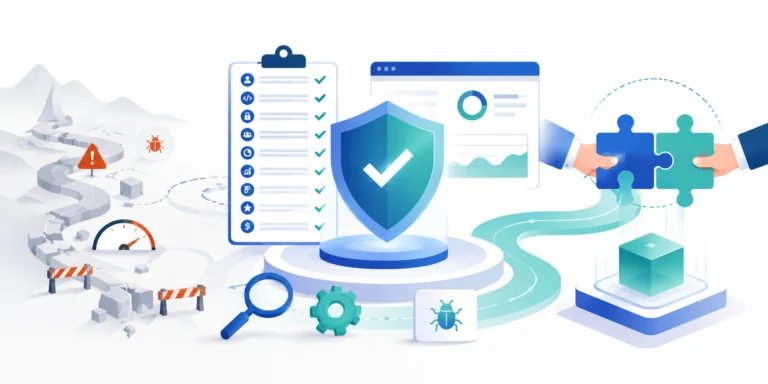
This condensed software testing checklist maps the 10 points into a scoring rubric you can bring into every vendor conversation.
| Criterion | What to ask for | Weight |
| Domain expertise | Case studies in your industry | High |
| Modern tool stack | List of test frameworks used | High |
| Security posture | SOC 2 Type II report | High |
| Bench capacity | Ramp timeline for extra testers | Medium |
| Time zone overlap | Hours of daily overlap | Medium |
| Reporting maturity | Sample weekly report | High |
| IP ownership | Contract clause language | High |
| Agile fit | Sprint integration pattern | Medium |
| References | Two active clients in your space | High |
| Pricing model | Value-based options available | Medium |
Why Innostax Is a Software Testing Services Company Worth Evaluating
Innostax is a software testing services company that scores well on every point above. Domain expertise across healthcare, fintech and travel. SOC 2 aligned processes. A modern tool stack with AI-assisted test generation. Weekly reports tied to escape rate and coverage, not activity. Full IP ownership handed to the client. Real bench capacity and time zone overlap for US teams. If your last testing engagement disappointed, use this checklist on us. We answer every question openly.
Building a Quality-First Partnership
The software testing company you choose becomes an extension of your engineering team. Run the 10-point checklist rigorously. Weight the criteria against your actual risks. Talk to references. Choose the QA outsourcing partner that will still be a fit two years from now, not just the cheapest one available today. Quality outcomes compound, and the right partner compounds with you.
Run the Checklist on Innostax – We’ll Show You the Score
Most vendors ask you to take their word for it. Send us your 10-point checklist and we’ll answer every line item directly, with references, sample reports and our test coverage approach included, no sales pitch first.
Send us your checklist and get a scored response within 2 business days.
The Strategic Shift: Moving from Quality Control to Quality Engineering
Evaluating a modern QA partner requires looking beyond basic manual execution. Leading software testing vendors operate through Quality Engineering (QE), embedding quality checks into every stage of the Software Development Life Cycle (SDLC):
- Shift-Left Integration: QA engineers review product requirements and acceptance criteria before developers write code, catching logic flaws and edge cases early when they are cheapest to fix.
- Continuous Testing Pipelines: Automated test suites run natively within your CI/CD setup, triggering regression and API checks on every pull request to enforce strict quality gates.
- Defect Root Cause Analysis: Rather than simply logging bug tickets, QA partners analyze recurring failure patterns to help development teams improve code architecture and prevent similar bugs in future sprints.
Red Flags to Watch for During QA Vendor Selection
When vetting potential software testing providers, watch for these common operational warning signs during initial discussions and technical interviews:
- Sales-Led Demos Without Engineering Access: Vendors that refuse to let you interview the actual QA lead or automation engineers who will be assigned to your account.
- Activity-Only Reporting: Weekly status reports that highlight hours logged or manual test cases executed rather than business outcomes like defect escape rate, API coverage trends, and release stability.
- High Staff Turnover: Vendors unable to guarantee core team retention throughout the project lifecycle, leading to continuous re-onboarding and lost domain context.
- Opaque Security Practices: Failure to provide formal SOC 2 Type II reports, ISO certifications, or clear data masking protocols for staging and testing environments.
Questions to Ask During the Vendor Interview Stage
In addition to the criteria that a vendor should comply to, some additional questions can be useful to ask during the interview process.
One example is asking how they would respond to a scenario in which the engagement did not go according to the plan, and what lessons learned were implemented in their current process. Exploring the details of a negative situation that a vendor faced in the past gives a better insight into their general approach to the testing process.
Another question that could provide helpful information is asking how coverage decisions are made within an engagement, who is responsible for approving such decisions, and how the client’s needs and the time constraints are balanced during the project.
The Value of a Short Trial Engagement Before a Long-Term Contract
Even outside a formal Proof of Concept, a shorter initial trial engagement — a few weeks rather than a multi-month commitment — can reveal a lot about how a vendor actually operates day to day.
A trial period surfaces communication patterns, responsiveness, and actual technical competence in ways that sales conversations and reference calls, however thorough, sometimes miss. Vendors confident in their capabilities are typically comfortable proposing this kind of trial themselves.
Structuring a trial with a clear, mutually agreed endpoint — rather than an open-ended “let’s see how it goes” — keeps expectations clear on both sides and makes the eventual decision to continue or part ways considerably less awkward than it would be mid-way through a long-term contract.
Structuring a High-Impact QA Proof of Concept (PoC)
Running a structured Proof of Concept gives engineering leadership empirical data on a vendor’s technical capabilities before signing a long-term contract:
- Define Clear Gate Criteria: Establish measurable success metrics upfront, such as test execution speed, defect detection accuracy, and pipeline stability.
- Provide a Real-World Technical Challenge: Assign the vendor a complex user flow featuring dynamic UI elements, multi-step API workflows, or strict data validation rules.
- Evaluate Communication Overhead: Measure how independently the vendor operates, noting whether their engineers raise proactive questions early or require constant hand-holding.
Engagement Models: Choosing Between Dedicated Teams and Augmented Staffing
Selecting the right delivery model depends directly on your internal QA maturity and roadmap predictability:
Hybrid Delivery Model: Combines an internal QA architect for strategic governance with an outsourced vendor team handling day-to-day test execution and regression suite maintenance.
Dedicated QA Managed Service: Best for organizations needing an end-to-end testing function. The vendor provides QA leadership, designs the automation framework, executes tests, and manages daily deliverables independently.
Staff Augmentation: Ideal for engineering teams with established QA leads who simply need extra automation or manual testing bandwidth to cover temporary launch spikes or roadmap acceleration.