


- 1 Single Codebase Advantage: Flutter enables developers to create applications for Android, iOS, web, and desktop using one codebase, reducing development time and cost.
- 2 Faster Time-to-Market: The framework allows for quicker prototyping and app launches, thanks to its efficient development tools and streamlined workflow.
- 3 Cost Efficiency: Businesses save on hiring separate teams for each platform, making Flutter a cost-effective solution.
- 4 Superior UI & UX: Flutter’s customizable widgets allow for a consistent, polished user interface across platforms, enhancing brand identity.
- 5 High Performance: Apps built with Flutter are responsive and perform at near-native speed, comparable to apps developed in native languages.
- 6 Web App Expansion: Flutter is not limited to mobile—it supports web and desktop platforms, ideal for omnichannel engagement.
- 7 Visual Development with FlutterFlow: A low-code platform for visual app design, ideal for MVPs and rapid prototyping.
- 8 Ecosystem & Plugins: A wide range of open-source plugins extends functionality, including payments, geolocation, notifications, and storage.
- 9 Custom Features Supported: Flutter allows full customization beyond built-in widgets and plugins.
- 10 Choosing the Right Development Partner: Prioritize companies with cross-platform experience, UI/UX expertise, and post-launch support.
A high-performance application is one of the important aspects for most online-based businesses. However, the applications developed must run across different platforms in order to ensure their smooth running across large users. One technology that has gained significant traction for cross-platform development is Flutter.
While considering building a mobile app or a web platform, understanding the basics of Flutter web app development is important to make informed decisions for your business. We will explore here more about Flutter in simple terms for non-technical decision-makers. It will help in understanding its capabilities and benefits.
What is Flutter?
Flutter is an open-source UI development SDK from Google that lets developers build natively compiled applications for desktop, web, and mobile from a single codebase. Unlike hybrid development, which typically involves writing applications in HTML/CSS/JavaScript that is wrapped in a native shell, Flutter lets you build native apps with native widgets.
Because Flutter utilizes Dart as its programming language, you can build applications that compile to native ARM code. This enables you to achieve performance levels that are similar to apps that are built with Kotlin, Java, or Objective-C, which are the native programming languages for Android and iOS, respectively. Furthermore, with a single codebase to maintain, you can scale your development team horizontally or vertically to meet the demands of your project without worrying about duplicating logic across separate repositories. All of these advantages combine to make Flutter one of the most compelling cross-platform development options on the market.
Why Flutter App Development is a Great Choice
When it comes to choosing the technology for your application, you must consider the business implications of your choice. Technical debt, team structure, and maintenance overhead are all affected by the framework you select. Below, you will find the primary reasons that Flutter is well-suited for modern business applications.
1. Faster Development
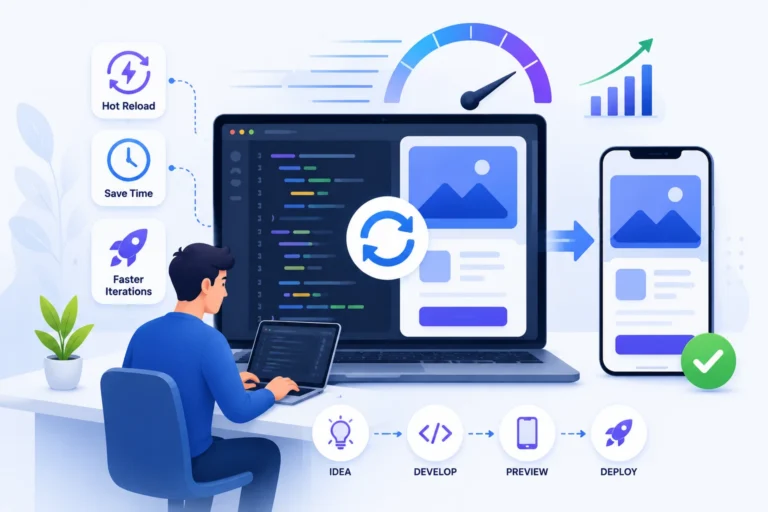
Flutter’s unified codebase dramatically reduces the amount of code that you have to write when developing cross-platform apps. Instead of coordinating two separate engineering teams to release a single feature, your developers work in tandem on one repository. Additionally, the framework provides a powerful “hot reload” that lets you see your code changes in real-time. This eliminates the traditional minutes-long waiting periods required to compile code after a minor UI tweak. All of these factors contribute to a dramatically shortened development cycle. Furthermore, Flutter’s powerful tools help you prototype your minimum viable product (MVP) faster. This is crucial for you to secure investment, test market viability, or get your product in front of users before your competitors do.
2. Lower Costs
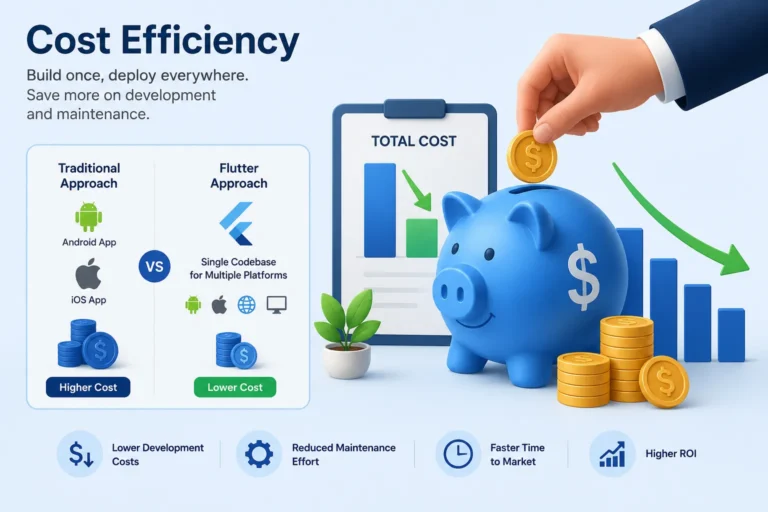
Faster development translates into lower costs because you will be able to utilize your resources more efficiently. Beyond the initial build phase, long-term operational costs drop significantly because bug fixes and feature updates only need to be programmed once.
When building native applications, you often have to hire different specialists for iOS and Android development, effectively doubling your payroll for mobile engineering. With Flutter, you can hire a single team of developers to build your app for all of your target platforms. You can also choose to work with a specialized Flutter application development company that provides cross-platform services. Either way, you will significantly reduce your overhead as compared to native application development.
3. Better UI/UX for Users
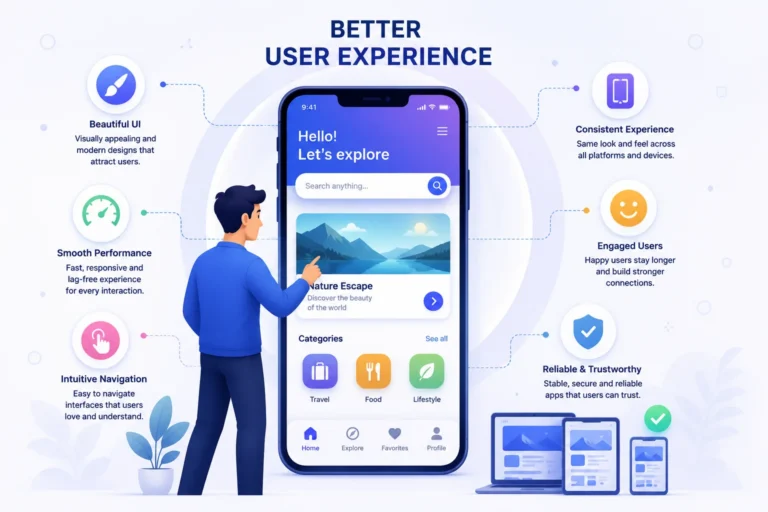
User interface is one of the most important aspects of your application. After all, it is what your users will see and interact with. Fortunately, Flutter makes it possible to design stunning applications for different platforms with minimal effort. This is possible because Flutter provides developers with a rich set of customizable widgets that mirror standard design languages like Material Design and Cupertino. Additionally, Flutter renders its own widgets instead of relying on the underlying OEM platform components. This enables you to create a UI that looks the exact same across all of your target platforms, ensuring your brand identity remains consistent regardless of the device the customer uses.
4. High Performance
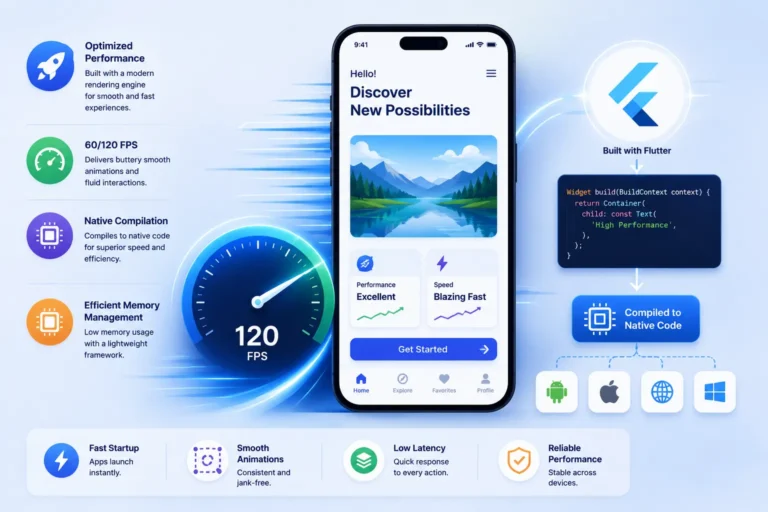
Perhaps the biggest advantage of Flutter is that it can let you build high-performance apps for different platforms without sacrificing user experience. Unlike other cross-platform frameworks such as React Native, Flutter does not rely on JavaScript bridges to access platform-specific APIs. Instead, it compiles directly to native ARM code, which grants you access to all platform-specific features without a communication bottleneck. Flutter can give better app performance, which can be compared to native applications built with Java, Kotlin or Objective-C. This direct compilation results in smooth scrolling, immediate touch responses, and fluid animations that keep users engaged.
Flutter Development: Going Beyond Mobile Apps
Many applications benefit from having a presence on the web in addition to mobile apps. Fortunately, Flutter can help you build compelling web apps with the same codebase that you use for your mobile applications. This can be crucial for you to engage with your customers on their preferred channel. Additionally, if you are targeting desktop platforms such as Windows or macOS, Flutter can help you deliver a great user experience without having to build a separate codebase for each of your target platforms. This approach is highly effective for internal business tools and enterprise dashboards.
Leverage FlutterFlow for Rapid Prototyping
If you need to develop an MVP for your application, you will find that FlutterFlow is a powerful rapid prototyping tool. Essentially, FlutterFlow is a no-code tool that lets you build applications with Flutter framework visually. This drastically reduces the time-to-market for your product. Additionally, using a visual tool can help you communicate your ideas to your development team more clearly. It can also help your UI/UX designers mock up application screens faster, establishing a clear visual contract before heavy engineering work begins.
Flutter Plugins: Powerful Add-ons
When developing applications, you need to rely on third-party tools to help you add specific functionality to your apps. Fortunately, Flutter has a thriving open-source ecosystem that provides you with ready-to-use plugins that you can leverage in your applications. Using plugins can significantly reduce the amount of code that you need to write from scratch.
Below are some of the most popular plugins that can enhance your Flutter application:
- Stripe, PayPal, etc.
- image_picker
- Geolocation API
- shared_preferences
- Push notifications
Hiring the Right Flutter Application Development Company
If you have decided to outsource your Flutter application development, you need to find the right partner. When choosing a company, you should consider the following factors:
1. Portfolio of Cross-Platform Apps
You should look for companies with proven track records of delivering cross-platform apps. Ideally, you want to hire companies that have delivered successful web and mobile applications using Flutter. Ask to see examples of complex native device integrations, such as camera or microphone access, to verify their technical depth.
2. UI/UX Design Expertise
Because Flutter grants you fine-grained control over your application’s UI, it is possible to build stunning applications using this framework. However, this potential advantage is only realized when you have a competent UI/UX design team that understands visual hierarchy and interaction design.
3. Performance Optimization Experience
Your application must perform well on a variety of devices. This is especially true for mobile applications since users will access them on devices with a broad range of specifications and memory constraints. When choosing a Flutter app development company, you should choose a partner that has experience with performance optimization and memory profiling tools.
4. Post-Launch Maintenance and Support
After launching your application, you need to ensure that it continues to function properly as operating systems update and third-party libraries change. You should ask your Flutter app development company about post-launch support options, including SLA terms and monitoring strategies.
Does Flutter Framework Limit You?
Often, executives ask whether using a cross-platform framework such as Flutter limits their ability to deliver features that require accessing platform-specific features such as the camera or sensors. The short answer is that Flutter does not limit you. While Flutter provides you with rich platform-specific widgets, you can also leverage platform-specific code to gain greater control over your application’s behavior. Developers can use Platform Channels to write native Swift or Kotlin code that communicates directly back to the Flutter interface whenever specialized functionality is required.
Are You Ready to Use Flutter?
Flutter is an incredible framework that can help you build powerful apps for multiple platforms. Understanding the value of Flutter web development is key to making the right choice when it comes to building your application. By investing in this cross-platform framework, you can reduce your costs, accelerate your time-to-market, and deliver a great experience to your customers. Additionally, partnering with a skilled Flutter development company can help you achieve your goals faster and with less effort. Ultimately, Flutter can be the catalyst that propels your business to the next level.