

AI coding tools like Cursor and Claude Code genuinely speed up development — but they pass code through a standard pull request review that was built for human failure modes (logic errors, style issues, missing null checks), not AI-specific ones. Five failure patterns slip through untouched: hallucinated API contracts, silent serialization errors, ambient authentication drift, threading assumption failures, and observability blind spots. None of these show up in a demo or in tests — they show up in production, under real load, at 2am. The fix isn’t slower AI adoption — it’s four specific human-judgment checkpoints: architecture before generation, a production-readiness review after generation, load testing at 3–5× expected traffic, and security review every 30 days.
- 1 Standard code review was built for human failure modes (logic errors, style, missing null checks) — not AI-specific ones like hallucinated API contracts or threading assumptions.
- 2 Adoption and trust are diverging: 84% of developers use or plan to use AI tools, but only 29% trust the output — down from 40% the year before.
- 3 AI tools excel at boilerplate, scaffolding, first-draft functions, and unit tests for well-defined inputs — but can't reason about live data volume, existing auth patterns, or real API contracts.
- 4 Five named failure patterns recur in AI-assisted codebases: hallucinated API contracts, silent serialization errors, ambient authentication drift, threading assumption failures, and observability blind spots.
- 5 AI-generated code carries 2.74× higher vulnerability density than human-written equivalents, and 45% of samples introduce OWASP Top 10 vulnerabilities — mainly because security constraints aren't in the prompt.
- 6 Senior judgment belongs at four points: architecture before generation, production-readiness review after generation, load testing at 3–5× expected traffic, and security review every 30 days.
- 7 A 30-minute architecture conversation before generation starts is the highest-leverage intervention — it prevents days of rework after the fact.
- 8 The production-readiness review is different from a standard PR review — it checks concurrency assumptions, auth consistency with existing patterns, and whether failures are observable, not just whether the logic is correct.
AI tools like Cursor and Claude Code are genuinely fast — teams that use them well ship prototypes in hours that would have taken days. The speed is real. The problem is what happens next: that same code passes a standard pull request review, someone merges it, and it then behaves unpredictably under real load, real users, and real-world conditions that nobody thought to prompt for.
Teams designed standard code review around human failure modes: logic errors, style inconsistencies, missing null checks, obvious bugs. Nobody built it to catch hallucinated API contracts, inconsistent authentication patterns, silent serialisation errors, or threading assumptions that an AI model bakes in at generation time. Some of these problems are new, and others show up far more often since AI-generated code became common. Yet most teams haven’t updated their review processes to account for them. The 2025 Stack Overflow Developer Survey found that 84% of developers now use or plan to use AI tools in their workflow — but only 29% trust the output, down from 40% the year before. The gap between adoption and trust is exactly the oversight gap this post addresses.
What this article covers:
What AI code generation tools are actually good at — and where they consistently fall short
The judgment layer that exists before and after generation, which disappears when you remove senior engineers from the loop
Five named failure patterns that appear specifically in AI-assisted codebases, named after what they cause rather than the underlying code concept
Four decision points where human judgment belongs in an AI-assisted workflow
A production readiness checklist built specifically for AI-generated output
What AI Code Generation Tools Are Actually Good At
Before getting into what breaks, it is worth being clear about what works. AI coding tools earn their place in a serious engineering workflow. The issue is not the tools — it is which parts of the job they are good at, and which parts they are not. GitHub’s Octoverse 2024 report documented a 55% productivity increase among AI-assisted developers, and over 1.1 million public repositories now integrate an LLM SDK — signals that generation speed is a real and durable gain.
Where they reliably add value:
Generating boilerplate, scaffolding, and repetitive CRUD logic faster than any engineer can type it
Translating a well-specified requirement into a working first draft of a function or module
Catching common syntax errors and suggesting idiomatic patterns for the language you’re using
Writing unit tests for code that already has well-defined inputs and expected outputs
Accelerating code search and refactoring across large, well-documented codebases
Where they consistently fall short:
Understanding how the code they generate will interact with live data volumes, connection pools, or real concurrency patterns
Knowing the authentication model, session handling logic, or permission structure that already exists in the codebase
Recognising that an API endpoint they’re writing code to call has a different contract in production than in the documentation from their training data
Preserving architectural consistency across modules that different people wrote at different times
Making the right tradeoff between correctness and performance when both matter and they conflict
No single one of these gaps is catastrophic on its own. The problem is that they compound, and they all pass standard review because standard review was not looking for them.
The Judgment Layer AI Tools Bypass
There is a version of AI-assisted development that works well. In that version, a senior engineer is involved before the prompt is written and after the output is generated. What AI tools produce is the middle part — and they do it fast. The before and after, though, requires judgment that the tools do not have.
What Senior Engineers Do Before Writing Code
Before anyone writes a line of code, AI-assisted or not, an experienced engineer makes a set of decisions that rarely appear in a prompt:
What are the realistic concurrency assumptions? Not “how many users do we have today” but “what happens when ten times that number hit this endpoint in the same second.”
Does this new module need to share state with anything that already exists, and if so, what is the contract? This requires knowing the existing codebase, not just the ticket.
Which failure modes need to be handled gracefully versus allowed to propagate? AI tools default to the optimistic path. Production doesn’t.
Do security standards or compliance rules, such as OWASP, SOC 2, or HIPAA, limit what this code can do? Prompts rarely mention them, and AI tools rarely account for them unless someone explicitly asks. The Veracode 2025 GenAI Security Report found that 45% of AI-generated code samples introduced OWASP Top 10 vulnerabilities — not because the models are careless, but because security constraints are not in the prompt.
What does the logging and observability layer look like, and how will this code need to integrate with it? If the answer isn’t in the prompt, the generated code won’t include it.
None of these decisions are things you can prompt your way around. They require someone who knows the system, the load assumptions, and the constraints — and who is asking the right questions before the generation starts.
What Senior Engineers Do After Writing Code
After generation, the review that matters for AI output is not the same as a standard pull request review. A senior engineer reviewing AI-generated code is not primarily looking for logic errors — the code is usually logically correct. They are looking for production readiness:
Does the generated code make assumptions about data shape or volume that will break under real traffic?
Are there race conditions that only surface when multiple requests execute concurrently?
Does the authentication handling match the pattern used everywhere else in the codebase, or did the AI generate its own interpretation?
Does the code handle errors in a way that exposes internal state, or suppress them in a way that makes debugging impossible?
Is there anything here that a security audit would flag — and that would be embarrassing to explain to a customer?
The review step is where most teams fall short. They run the same PR review they always did — look at the diff, check the logic, merge. That process finds human mistakes. It was not designed to find what AI gets wrong. The 2025 Stack Overflow survey found that 45% of developers lose significant time debugging AI-generated code — and 35% visit Stack Overflow specifically after AI-generated code fails. That is not a sign that the tools are bad. It is a sign that the review process is not catching what the tools miss.
When the senior engineer is removed from both the before and after, the codebase looks fine. It compiles. The tests pass. The demo works. The failure mode shows up at 2am on a Wednesday when a database connection pool hits its limit, or when a user triggers an edge case that was never part of the prompt.
Failure Patterns in AI-Assisted Codebases
These are not theoretical risks. They are the patterns that show up in production, consistently, across teams using AI code generation without the right oversight layer. CodeRabbit’s analysis of thousands of production pull requests found AI-generated code carries a 2.74× higher vulnerability density than human-written equivalents — not from exotic attack vectors, but from the everyday failure modes named below.
Pattern 1: Hallucinated API Contracts
What it is: The AI generates code that calls an external API — or an internal one — with a request shape, parameter name, or authentication header that does not match the real contract. The code looks correct. The endpoint exists. The method name is right. But the payload structure is subtly wrong.
When it appears: Not in development, where mocks or limited test data might not surface the mismatch. In production, on the first request that hits a real API response with a field the AI did not know existed — or a field the AI assumed existed that does not.
Why AI generation specifically misses it: the model learned from documentation, Stack Overflow answers, and public repositories, not from the actual live API contract of the service your code calls. If that contract has changed since the training data cutoff, the code comes out wrong in a way that static analysis can’t catch, because static analysis never sees the live service. The OWASP LLM Top 10 identifies training data cutoff mismatch as one of the core sources of LLM unreliability in production environments.
Pattern 2: Silent Serialisation Errors
What it is: the code writes data to a database, cache, or message queue in a format that looks correct in isolation but deserialises incorrectly on the other end. The write succeeds. Nothing throws an exception. The data is quietly wrong.
When it appears: Usually under two conditions: when data crosses a boundary between services written in different languages, or when a type system mismatch exists between the write path and the read path that only surfaces with real data values — not the clean, round-number test data used in development.
Why AI generation specifically misses it: The AI generates code that satisfies the immediate prompt — write this object to this store. It does not have visibility into what reads that data on the other end, or what assumptions the downstream consumer is making about the format.
Pattern 3: Ambient Authentication Drift
What it is: The AI generates authentication and session handling that works — but uses a slightly different pattern than the rest of the codebase. Token extraction happens in a different place. Session expiry is handled differently. The generated code passes review because the logic is correct in isolation; the drift from the existing pattern is only visible if you are looking at the whole codebase at once.
When it appears: During a security audit, or when an edge case in the authentication flow — a token that expires mid-request, a user with unusual permission combinations — exercises the inconsistency between the two implementations.
Why AI generation specifically misses it: The AI does not read the existing authentication code before generating new authentication code. It generates a pattern that is idiomatic for the language and framework. Whether that pattern matches what already exists in the system is not something it can check.
Pattern 4: Threading Assumption Failure
What it is: The AI generates code that assumes single-threaded execution or stateless requests — which is fine for a prototype and wrong for a production service handling concurrent requests. Shared state gets modified without locks. Functions that assume sequential execution are called from parallel goroutines or async handlers.
When it appears: Under load. A development environment running one or two requests at a time will never surface this. A production environment handling 200 concurrent requests will surface it immediately, in the form of race conditions, inconsistent state, or intermittent errors that are nearly impossible to reproduce.
Why AI generation specifically misses it: The prompt almost never specifies concurrency requirements. “Write a function that does X” does not include “and 200 concurrent goroutines will call this function.” The AI generates the simplest correct implementation, which assumes only one caller at a time unless you say otherwise.
Pattern 5: Observability Blind Spots
What it is: The generated code has no logging, no metrics emission, and no tracing instrumentation — or has logging that captures the wrong things at the wrong verbosity level. When something breaks in production, there is no signal to debug from.
When it appears: The moment something actually goes wrong in production and the on-call engineer opens the logs to find either silence, or a wall of INFO-level messages that contain nothing useful.
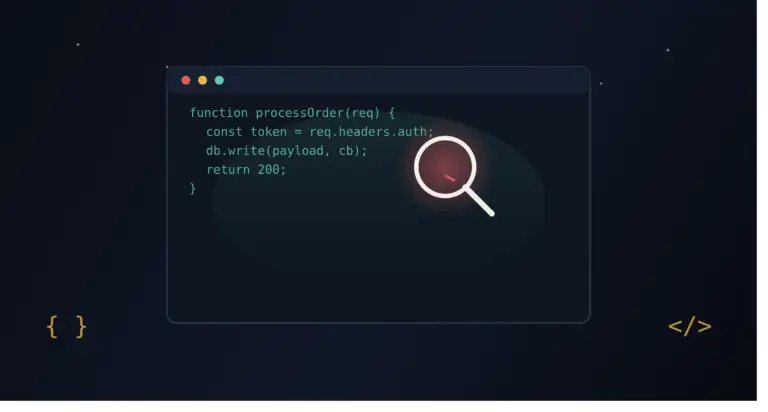
Why AI generation specifically misses it: Observability is never the primary purpose of a prompt. “Write a function that processes orders” doesn’t produce logging unless you explicitly ask for it. Even when you do, the AI doesn’t know which fields, IDs, or state transitions matter for the specific system you’re building. The Cloud Security Alliance’s 2026 analysis found that AI-assisted developers commit code at three to four times the rate of peers — but introduce security findings at the same multiplier. More code, faster, with fewer observable signals when it breaks.
What Senior Oversight Actually Means in an AI-Assisted Workflow
Oversight is not a vague concept. It has four specific insertion points. Skip any one of them and the risks above become real risks rather than theoretical ones.
Decision Point 1: Architecture Before Generation
Before your team builds any significant AI-assisted feature, a senior engineer needs to make explicit decisions about module boundaries, shared state, and error propagation strategy. They also need to decide how the new code will integrate with existing authentication, logging, and data layers.
This is the highest-leverage intervention in the entire workflow. A 30-minute architecture conversation before generation starts prevents days of rework afterward. The AI will generate code that fits whatever shape it is given — the shape has to be right before generation begins. GitHub’s Octoverse analysis makes the same observation directly: “As developers become more productive, senior engineering time becomes more valuable, not less. Someone must ensure the system remains coherent as more code lands faster.”
Decision Point 2: Review After Generation, Before Merge
This is not a standard PR review. A production-readiness review for AI-generated code has a different focus. The reviewer is looking for the five patterns above — not for logic errors, which the AI usually gets right. Specifically:
Does the generated code match the existing codebase patterns for authentication, error handling, and logging — or did it generate its own interpretation?
Are there assumptions about data shape, concurrency, or API contracts that need to be validated against the real system?
Are there failure modes that only surface under load or with real data that are not covered by the generated tests?
(A standard PR review will not surface any of these. They require someone who knows the system — not just the diff.)
Decision Point 3: Load Testing Before Launch
Before any AI-generated feature goes to production, run it at 3–5× the expected traffic volume. Not in development, where there is no connection pool pressure, no real data variance, and no concurrent requests — in a staging environment that is as close to production as possible.
Load testing specifically catches threading assumption failures and anything that relies on state that is clean at low volume but contested at high volume. This is the check that finds what code review misses.
Decision Point 4: Security Review at Milestone Intervals
In an AI-assisted development cycle, run a targeted security review every 30 days — not at the end of the project. AI-generated code accumulates authentication drift, hardcoded assumptions, and dependency vulnerabilities faster than hand-written code because generation volume is higher. Catching it monthly is manageable. Catching it at launch is not. The OWASP GenAI Security Project documents exactly how AI tools replicate vulnerable patterns from training data — SQL injection via string concatenation, insecure deserialization, missing authorization checks — because those patterns were common in the public repositories the models learned from. A 30-day interval is short enough to catch accumulation before it compounds.
Role Comparison Table:
| Phase | AI Role | Senior Engineer Role |
| Architecture | None — AI has no context about the existing system | Defines module boundaries, state ownership, integration points, and constraints before generation begins |
| Generation | Produces code rapidly from a well-formed prompt | Writes the prompt with the right context, constraints, and failure modes specified |
| Review | Can flag surface-level syntax and common patterns | Reviews for production readiness: concurrency assumptions, auth consistency, observability, and API contract accuracy |
| Testing | Generates unit tests for specified inputs and outputs | Designs load tests and integration tests that exercise real-world conditions the AI did not consider |
| Observability | Adds logging only if explicitly prompted — and logs whatever seems relevant | Specifies what to log, at what verbosity, and ensures it integrates with the existing monitoring layer |
| Launch | N/A | Owns the go/no-go decision, the rollback plan, and the post-launch monitoring window |
Production Readiness Checklist for AI-Assisted Codebases
Run this before any AI-generated feature goes to production. “Review” is not a verification method — each row specifies the action that actually confirms the item.
| Area | What to Verify | How to Verify |
| Concurrency | No shared mutable state accessed without synchronisation; no functions called concurrently that assume sequential execution | Run a concurrent load test at 5× expected volume; use a race detector (Go’s -race flag, ThreadSanitizer for C++) and review for lock contention |
| Authentication | Generated auth code matches the existing codebase pattern exactly — token extraction location, session expiry handling, permission check placement | Diff the generated auth logic against the established auth module line by line; flag any deviations for explicit sign-off |
| Data consistency | Serialisation format is correct across every read and write path; no type mismatches between services | Write an integration test that writes generated output and reads it with the downstream consumer; use real-shaped data, not clean test values |
| Error handling | Errors are handled consistently — not suppressed silently, not exposing internal state, not swallowing exceptions | Inject failures at every external call point (database, API, cache); confirm the response at each failure mode matches the expected behaviour |
| Observability | Structured logs capture request ID, user context, and relevant state transitions; metrics are emitted at the right granularity | Trigger a representative request in staging and confirm the logging output contains enough context to debug a failure without access to the code |
| Dependency security | No high or critical CVEs in generated dependency additions; no pinned versions that are known to be vulnerable | Run npm audit, pip-audit, trivy, or equivalent against the full dependency tree after any AI-generated dependency additions |
| Architectural consistency | Generated code follows existing patterns for module structure, naming conventions, and integration points — not the AI’s default interpretation | Have the senior engineer or architect who defined the system review the generated code structure against the existing codebase, not just the diff |
| Handoff readiness | Any engineer unfamiliar with the AI-generated code can understand what it does and why within 20 minutes of reading it | Have a developer who was not involved in generation read it cold and describe what it does — if they cannot, add documentation or simplify before merge |
Shipping Fast and Shipping Safely Are Not in Conflict
Innostax uses Cursor and Claude Code across every engineering engagement. The generation speed is real and we build it into our delivery timelines. Every line that comes out of those tools goes through peer review, tech lead review, and architect sign-off before it ships — not because the AI output is unreliable, but because the judgment layer it bypasses is exactly what catches the failure patterns above.
The three-layer review is what makes the speed usable in a production context. Without it, fast generation becomes fast debt accumulation. Stack Overflow’s 2025 survey found that 46% of developers actively distrust AI output accuracy — and experienced engineers show the highest distrust rate. That is not a cynical reading of the tools. It is a calibrated one, from people who have seen what happens when the oversight layer is skipped.
If you want to understand what AI-assisted development looks like when the oversight layer is actually built in — not bolted on after problems appear — the details are at innostax.com.
Curious what that looks like for your specific stack and team structure? innostax.com