



- 1 Object-Oriented Power: Java’s OOP principles enhance code organization and reusability in API development.
- 2 Strong Framework Ecosystem: Frameworks like Spring Boot, Micronaut, and Jakarta EE offer robust support for RESTful APIs and microservices.
- 3 Platform Independence: Java’s JVM enables seamless deployment across environments.
- 4 Scalability: Java frameworks handle high data loads with asynchronous processing and built-in scalability.
- 5 Enterprise-Grade Security: Integrated security modules like Spring Security support modern protection standards.
- 6 Vast Community Support: Java’s large developer base offers resources, libraries, and troubleshooting help.
- 7 Java vs. Kotlin: While Kotlin is concise, Java offers stronger enterprise compatibility and framework support.
When it comes to making API, Java continues to stand tall as a reliable choice. It helps for building scalable, robust, and secure applications. Many businesses have successfully used Java-based web solutions.
One of the prominent uses of Java in recent years is in API development, where its frameworks provide developers with powerful tools. They have the ability to create efficient and maintainable back-end systems. This guide will explore the reasons why Java is a top choice among developers and organizations for API development.
Why Java Frameworks Are Preferred For API Development?
Following are some main reasons that Java framework is preferred largely for API development:
1. Object-Oriented Programming (OOP)
Java is inherently an OOP language. This promotes modularity, reusability, and organization of code which are important when building APIs. With OOP principles like inheritance, encapsulation, and polymorphism, Java frameworks help developers design APIs that are easy to understand and maintain.
2. Rich Ecosystem of Frameworks
Java has a vast ecosystem, particularly when it comes to frameworks tailored for API development. The best Java frameworks for web apps such as Jakarta EE, Spring Boot, , Micronaut, and Dropwizard are engineered to support RESTful and different other microservice architectures.
Java Frameworks for App Development
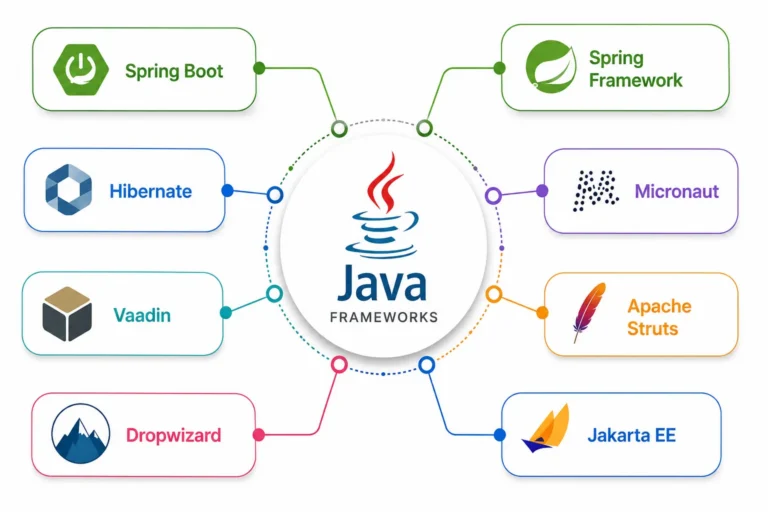
Spring Boot: It is one of the most used Java framework for development. Its ease of setup, configuration, and embedded server support, which allows developers to launch APIs quickly.
Micronaut: Being lightweight and having a fast startup time makes it good for microservices and serverless APIs. It offers compile-time dependency injection and low memory consumption.
Jakarta EE: This framework provides a better performance for enterprise-scale applications. It can offer built-in support for security, persistence, web services, etc. It is a trusted solution for companies that require high performance and reliability.
3. Platform Independence
Java has the ability to run anywhere using the Java Virtual Machine (JVM). This is useful in API development, where consistency across multiple environments is critical. APIs built with Java frameworks tend to be stable and predictable across various hardware and operating systems.
4. Scalability and Performance
Java frameworks are designed to handle large volumes of data traffic. Tools like Spring Boot and Vert.x offer asynchronous processing capabilities and built-in scalability features. It helps in meeting performance demands without compromising reliability.
5. Security Features
Security is paramount in Java API development. Java frameworks come with many security features such as authorization, authentication, CSRF protection, and integration with different security protocols. Spring Security, provides a comprehensive security module that integrates seamlessly with other Spring components.
6. Extensive Community
Java’s long-standing presence in development means there is a large community of developers and countless tutorials. If you are building a simple REST API or a complex system with multiple microservices, the support ecosystem around Java is invaluable. Access to community forums, GitHub repositories, and third-party libraries speeds up troubleshooting.
7. Comparing Java and Kotlin for API Development
When we talk about Java and Kotlin for development, Kotlin often is conciseness and modern syntax. However, Java is the preferred choice in API development due to its widespread usage and extensive support from enterprise environments. Kotlin is a little expressive, still, Java frameworks tend to offer better backward compatibility.
8. Choosing the Right Java Framework for Your API
There is no universal Java framework that would be optimal for all API projects. It is necessary to analyze several factors when choosing the best programming tool. First, one has to assess the scale and traffic of the intended project. Second, the technical qualifications of the development team should be considered. Finally, the API’s level of enterprise requirement must determine the choice between existing frameworks.
Spring Boot is a reasonable choice if an increase in the scale and traffic of the API is expected. The main advantage of this Java framework is its wide range of possibilities and convenient tools. Those tools allow one to integrate the API with databases, security systems, messaging platforms, and other services. That is why Spring Boot could be a viable option for the development team when maintenance and new services are required.
Micronaut is worth considering because of the unique ability to launch applications quickly and minimize the use of memory. Those two characteristics could be critical for microservices that run continuously and should not take up too many resources.
Finally, Jakarta EE is the preferred solution for enterprise-level projects. It is essential to note that those frameworks are designed for business applications and tend to provide extended sets of functions. From that perspective, Jakarta EE would be a better choice when the API is a small part of a more significant system.
In general, it is critical to determine the requirements for the API and match them against the existing Java frameworks. By doing that, the development team would avoid the unnecessary complexity of newer technologies and stick to the optimal and well-established solutions.
9. Designing APIs That Are Easy to Maintain
Besides the described requirements for an API in the future, it is also essential to understand that this code should be clear to another developer who will make changes to it in six months. The more complex the application is, the more challenging it becomes to update and enhance it accordingly because of the increased number of endpoints, the amount of business logic, and the number of systems interacting with the application.
Thanks to Java’s Object-Oriented nature, the program code can be divided into self-contained units and organized in a way that isolates concerns and thereby improves its readability and overall testability. It can be achieved by splitting the code into controllers, services, repositories, and other classes and objects.
The significance of having properly defined names for classes, methods, variables, URL endpoints, response bodies, and error codes in an API cannot be underestimated. The code should be consistent and well-organized so that another developer can quickly grasp the general idea of what this or that class or method does. In this regard, the code maintainability and readability will be increased.
10. Java for Microservices and Distributed APIs
Normally, the applications of modern companies use the distributed architecture which allows them to be consisted of many services. With the using Java’s framework, you can design your application so that the different teams can work on the same project but develop and maintain the different services.
For instance, you can identify several services in the e-commerce application, such as the customer service, the product service, the payment service, the order service. They can be developed and maintained separately within the same project. In addition, each of them has the application programming interface (API) which is used to communicate with other software.
Nevertheless, you should keep in mind that such approach usually took more effort and time because of the following reasons. First, you have to spend a lot of time describing and testing each service in detail.
11. Testing and Monitoring Java APIs
Creating an API does not imply that its development ends once the requested endpoints respond as expected; testing is essential in order to assure stability with the addition of new functionalities. Testing can be carried out on segments of the application logic, as well as the interactions between the components considering the behavior that the API endpoints would exhibit under different circumstances. These include the valid and invalid requests, authentication issues, unexpected data input and other factors that the software would experience during normal operation. Particularly, performance testing, can unearth problems that would be otherwise difficult to uncover.
With the deployment of the software, monitoring becomes a critical task; the operational quality of the application can be significantly impacted by errors, poor response times, traffic fluctuations and other factors. Without it, the root cause of an issue in production can be challenging to pinpoint.
A Java API, therefore, should not be limited only to a stable framework implementation; testing and monitoring should be a continuous procedure.
Ready To Use Java Frameworks are Used for API Development?
Java used for API remains a preferred choice due to its object-oriented nature. Apart from that it has powerful frameworks, platform independence, and proven performance. It gives emphasis on modular design, scalability, and security, Java empowers developers to build reliable APIs that meet modern business demands. If you are planning to build or upgrade an API, considering Java web solution development services backed by the right framework can set your project for long-term success. As technology evolves, Java continues to adapt, making it a trusted ally in the world of API development.