


- 1 Fast & Efficient: Node.js runs on the Google Chrome V8 engine, converting JavaScript into machine code for faster execution.
- 2 Scalability & Performance: Ideal for building real-time applications, APIs, microservices, IoT solutions, and serverless apps.
- 3 Cross-Platform & Lightweight: Supports multiple programming languages (JavaScript, C, C++) and runs efficiently across platforms.
- 4 Event-Driven Architecture: Handles multiple requests asynchronously, making it ideal for high-traffic applications.
- 5 Node.js uses Chrome's V8 engine and a non-blocking, event-driven architecture to handle simultaneous requests, making it ideal for APIs, microservices, and real-time apps.
Are you willing to develop a high-quality app for your company? One of the best platforms to develop your app is Node.js.
On 27th May 2009, Ryan Dahl launched an open-source cross-platform environment that could run outside a web browser. This platform was Node.js. It accepts JavaScript, C, and C++ and runs on Google Chrome’s V8 JavaScript engine.
How Does Node.js Work?
Node.js runs on the Google Chrome V8 JavaScript engine. It converts the JavaScript code into machine code, ensuring faster execution of the code.
It has a huge collection of libraries and modules that support in the development of high-functioning apps with efficiency. These include the Single-Threaded Event Loop for processing requests simultaneously and the Libuv library for managing time-consuming operations.
Let’s understand how this works step by step:
Step 1: Client makes an HTTP request.
Step 2: The request goes to the Event Queue.
Step 3: The Event Loop receives the request.
Step 4: It executes the request directly if it doesn’t involve I/O. Else, the Libuv Thread Pool manages it asynchronously.
Step 5: After completing the I/O task, the callback goes to the Event Queue.
Step 6: The Event Loop executes it and sends a response to the client.
Which Services Can You Avail from Node.js?
Node.js powers 6.3 million websites on the internet. Around 40.8% developers prefer using Node.js for developing high-functioning web applications.
Following are some of the web application development services you can avail from Node.js:
API Development
API or application programming interface involves building a set of protocols to enable different software to communicate with each other. They help in seamless exchange of data.
Since Node.js is capable of handling multiple API requests simultaneously, it is a popular choice for API development. Additionally, its cross-platform development, rich ecosystem of libraries and tools, real-time data exchange capabilities, and built-in JSON support enables it to provide you with highly scalable and flexible APIs.

Following are some APIs of popular apps made using Node.js:
- Slack
- GitHub
- Netflix
- PayPal
- Mozilla
- GoDaddy
- Uber
Microservices Architecture
Microservices architecture comprises of a collection of small, independent services. They can communicate with each other via APIs. Each of them focus on specific functions, which makes the system modular, flexible, and easy to maintain.
Node.js is a lightweight platform that is known for developing fast-functioning apps. Its cross-platform support and huge collection of libraries and frameworks allows it to scale microservices independently. Deploying of these microservices becomes much simpler due to its compatibility with Docker, a platform that helps developers build, ship, and run applications in portable containers.
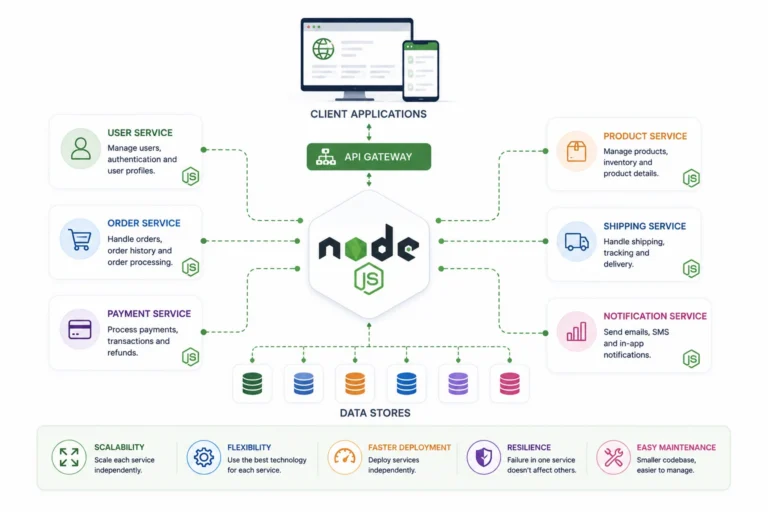
Following are some microservices built using Node.js:
- Amazon AWS Lamba
- Yahoo
- Spotify
- eBay
- Airbnb
- Walmart
- Intuit
Real-Time Applications
The event-driven architecture of Node.js makes it suitable for developing real-time applications, as it can process requests in real time without blocking I/O. The Google Chrome V8 JavaScript engine is fast at making these executions and is capable of handling increasing traffic. Most importantly, its built-in support for WebSockets allows client-server communication at real-time, without the client needing to send continuous requests. Thus, Node.js is a popular choice for chatting and gaming app development.
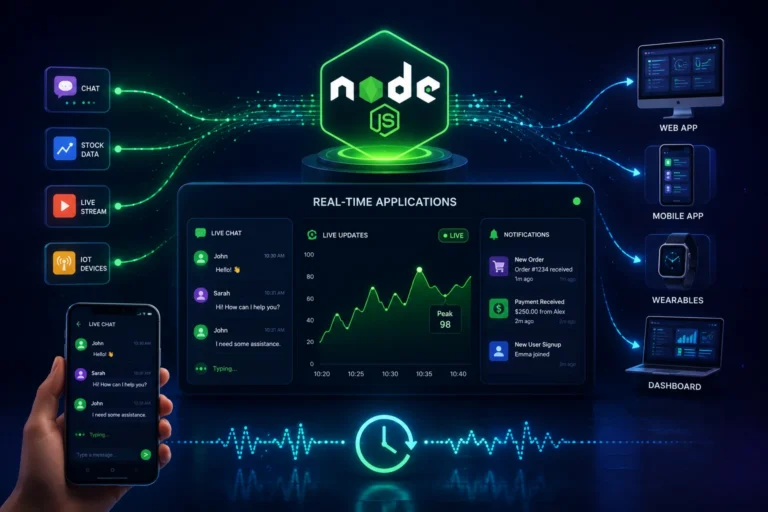
Some popular real-time applications made with Node.js include the following:
- WhatsApp Web
- Rocket League
- New Relic
- Words with Friends (Multi-player game)
- Twitch Chat
- Guild Wars 2
- Slither.io
- Fortnite
Serverless Computing
Serverless computing involves developing applications that don’t require an underlying server for management. The infrastructure, scaling, and resource allocation is allotted by the cloud provider. Hence, the developer only needs to work on responding to HTTP requests, file uploads, and database exchanges.
Node.js has many frameworks that support the development of serverless computing. These include AWS Lamba, Serverless Framework, Azure Functions, and Google Cloud Functions.
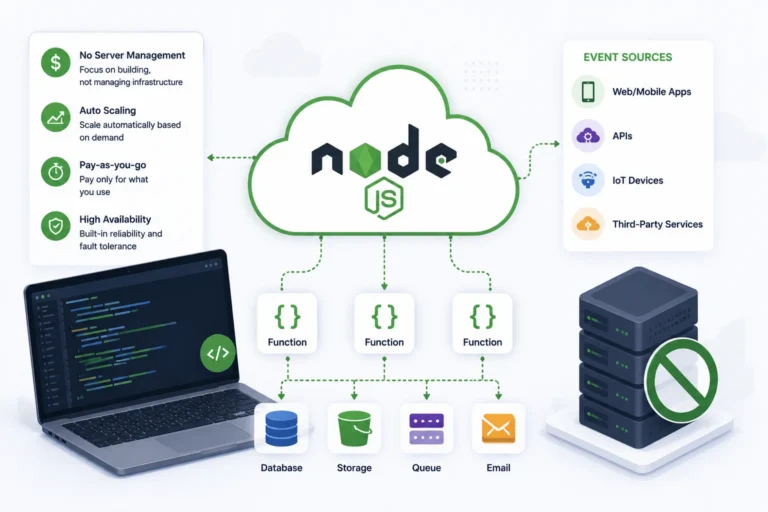
Following are some serverless apps built on Node.js:
- Coca-Cola
- Capital One
- iFood
- Snapchat
- Zynga
- The New York Times
- Adobe
- Autodesk
IoT Applications
Apps that enable real-time communication between multiple devices such as smart phones, sensors, smart watches, smart appliances, and vehicles, are IoT or Internet of Things.
Frameworks such as Johnny-Five and Cylon.js, and MQTT libraries enable developers to build IoT apps on Node.js. additionally, its real-time functioning capabilities and event-driven architecture further supports in building these apps.

Following are some IoT apps made on the platform:
- Samsung SmartThings
- AgriTech
- FitBit
- Siemens
- Traffic Monitoring Systems
- Geotab
- Tesla
Why Choose Node.js for Web Development?
Node.js is a strong choice for businesses that need fast, scalable, and responsive web applications. Because it uses JavaScript on the server side, development teams can work with a consistent technology stack across the frontend and backend.
Its non-blocking architecture allows Node.js applications to handle many concurrent requests efficiently. This makes it particularly useful for applications where users expect quick responses, frequent data updates, and reliable performance as traffic grows.
Node.js also has a large ecosystem of open-source packages through npm. Developers can use these packages to add authentication, database connectivity, API integrations, testing, security, and other capabilities without building every feature from scratch.
When Should You Use Node.js?
Node.js is well suited for applications that handle frequent network requests or require real-time communication. It can be a good option for startups building an MVP as well as established businesses modernizing existing applications.
Common use cases include:
- Real-time chat and collaboration platforms
- REST and GraphQL APIs
- E-commerce and marketplace applications
- Streaming and content platforms
- Microservices and backend systems
- IoT and connected-device applications
- Serverless and cloud-based applications
- Data-intensive dashboards and web portals
However, Node.js is not automatically the right choice for every application. Applications dominated by heavy CPU-intensive processing may require additional technologies or a different backend architecture. The right choice depends on your workload, scalability requirements, existing technology stack, and long-term product goals.
Node.js Development for Scalable Applications
As an application grows, its backend needs to handle more users, API requests, database operations, and third-party integrations. Node.js can support this growth through horizontal scaling, caching, load balancing, and modular architectures such as microservices.
A well-designed Node.js application can also separate business logic, APIs, background jobs, and external integrations into manageable services. This makes it easier for development teams to maintain the application and introduce new features without affecting the entire system.
For businesses expecting rapid growth or unpredictable traffic, Node.js can provide a flexible foundation for building applications that can scale with changing demand.
Node.js API and Backend Development
APIs are a major part of modern web applications, connecting frontend interfaces with databases, third-party platforms, payment systems, and other services. Node.js provides a flexible environment for developing REST APIs, GraphQL APIs, and backend services.
Its asynchronous request handling makes it useful when an application needs to manage many concurrent connections. Developers can also integrate Node.js with databases such as PostgreSQL, MySQL, and MongoDB, depending on the application’s data requirements.
Node.js Application Maintenance and Modernization
Node.js can also be used to improve existing applications rather than building a completely new system. Older backend services can be gradually modernized by introducing Node.js APIs, replacing specific services, or moving selected workloads to a more scalable architecture.
This incremental approach allows businesses to improve performance and maintainability while reducing the risks associated with a complete rewrite.
How to Choose the Right Node.js Development Approach?
The right Node.js approach depends on the application’s requirements, expected traffic, data architecture, integrations, and future growth. A simple API may only require a lightweight backend, while a large enterprise platform may benefit from microservices, caching, queues, containerization, and cloud infrastructure.
Before development begins, it is important to evaluate the existing architecture and identify the areas that will have the greatest impact on performance, scalability, security, and maintainability. This helps ensure that Node.js is being used where it provides a genuine technical advantage rather than simply because it is a popular technology.
Which Web Development Service Do You Need with Node.js?
Every web application needs different functionalities as per the service they provide and how they wish to connect to their audience. Using Node.js to develop your apps can allow better real-time communication with your customers, adding higher-end functionalities, more scalability, and enhanced performance.