

- 1 Faster Development: AngularJS speeds up development through features like two-way data binding and dependency injection, helping businesses launch apps quicker.
- 2 Cost-Effectiveness: Reusable components and built-in testing tools reduce development and maintenance costs, lowering long-term operational expenses.
- 3 Enhanced User Experience: AngularJS provides dynamic views and a robust MVC structure, enabling responsive and user-friendly apps that boost customer satisfaction.
- 4 Scalability for Growth: Its modular architecture makes AngularJS ideal for scaling apps as your business grows—without needing a full rebuild.
- 5 Cross-Platform Support: AngularJS supports both web and mobile platforms, helping businesses reuse code and reduce development time while reaching more users.
- 6 Strong Community & Ecosystem: A large developer community and extensive third-party tools ensure long-term support and ongoing innovation.
- 7 Built-in SEO Optimization: With Angular Universal, your app becomes crawlable by search engines, improving visibility and attracting organic traffic.
While there are a lot of technologies out there, AngularJS is one of the popular choices for businesses aiming to build an App. AngularJS web development agency can create scalable, efficient, and user-friendly solutions. Beyond its technical prowess, AngularJS has several hidden business advantages that can make a real difference to your business. When you are launching a new product or revamping an existing one, using AngularJS can give you a major competitive edge.
Hidden Business Advantages of AngularJS App Development
Let’s explore why availing AngularJS for web application development services could be the smartest move for your business:
1. Faster Development
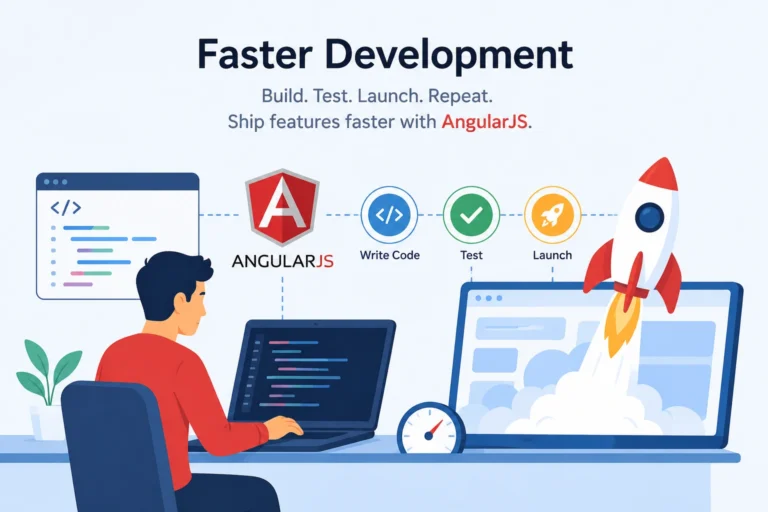
AngularJS comes with different features like dependency injection, two-way data binding, and modular architecture. This helps to speed up the development process. It reduces coding time and the need for debugging, helping businesses launch their products faster. Faster launches not only help you beat competitors to markets but also allow quicker customer feedback, leading to faster iterations and improvements.
2. Cost-Effective
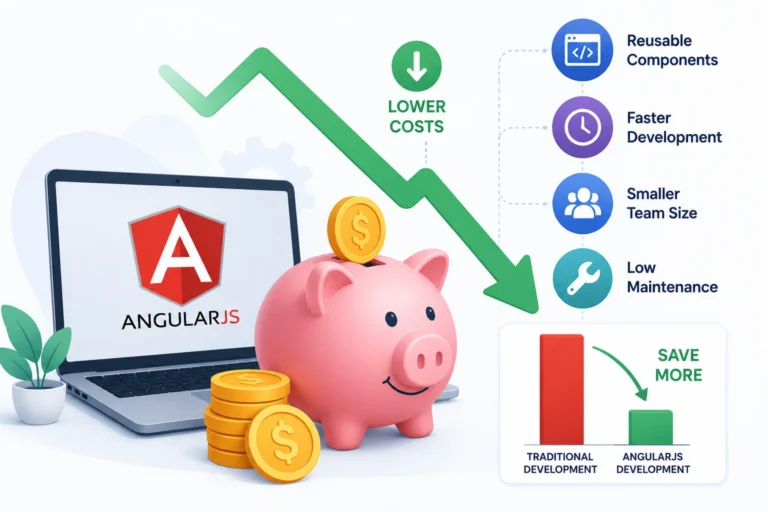
One major hidden benefit of AngularJS is its cost-effectiveness. There are number of reusable components, built-in testing tools, and a powerful MVC framework in Angular JS. It reduces the overall effort required for development and maintenance.
Choosing a proficient AngularJS mobile app development company can ensure that you benefit from best practices. Lesser bugs and streamlined updates can help to lower operational costs.
3. Better User Experience

User experience is very important for customer retention and satisfaction. AngularJS offers seamless dynamic views and a better Model-View-Controller (MVC) structure, allowing for highly responsive and engaging applications. By investing in AngularJS application development, you can deliver an app that feels fast, intuitive, and modern.
4. Scalability for Business Growth
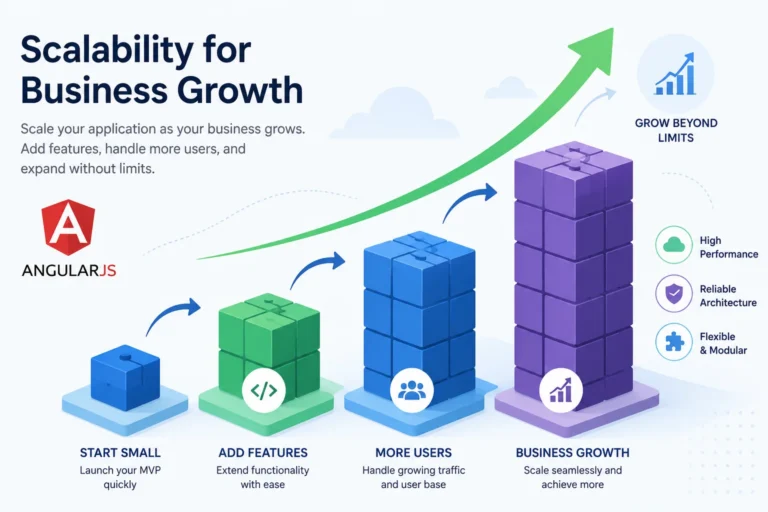
AngularJS has a very nice scalability quality. Its modular nature allows apps to grow seamlessly without needing to start from scratch. A leading AngularJS mobile application development service provider can help to easily accommodate new features and higher loads. This means you can scale up as your business expands without a huge investment.
5. Cross-Platform Versatility
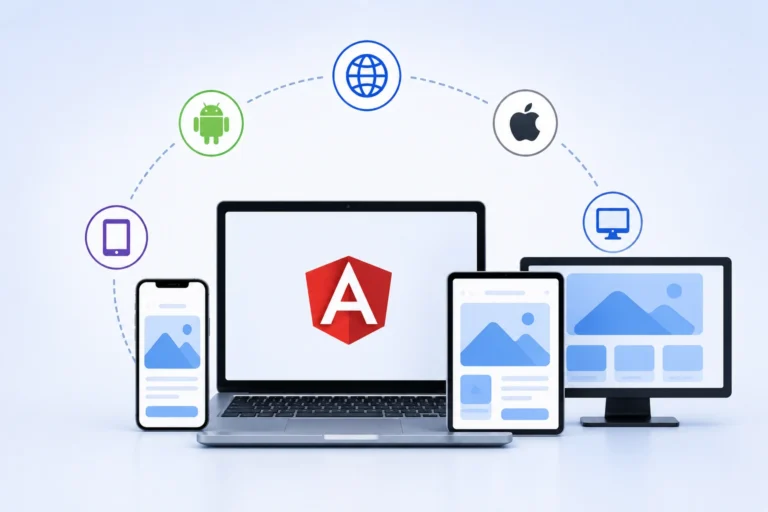
AngularJS supports both web and mobile development, which helps to reuse code and reduce development time. Working with experts ensures you can create high-performing, cross-platform applications with a consistent look. This saves money and also widens your app’s reach.
6. Strong Community and Long-Term Support
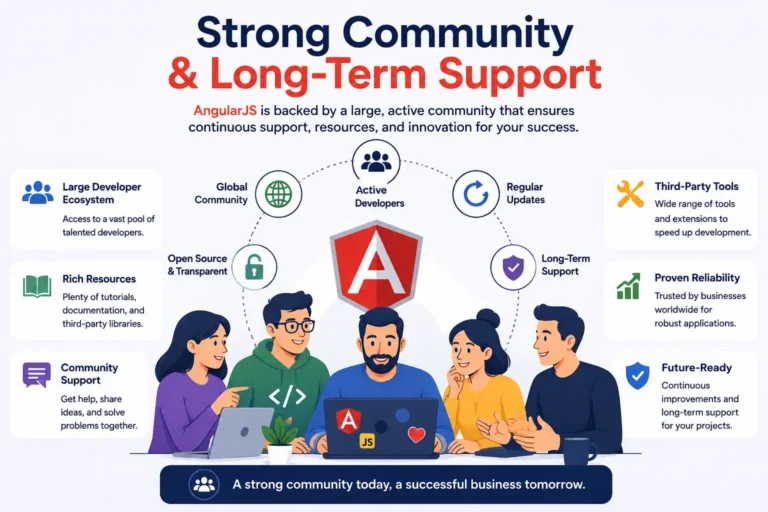
One hidden advantage of AngularJS is the strength of its community. Working with the AngularJS proficient and reputed web development company, can help you build complex apps. AngularJS has a large, active community of developers and contributors.
Thus, it has plenty of resources and a rich ecosystem of third-party tools. Long-term community support reduces the risk of your technology stack becoming outdated which is important for any business.
7. Built-in SEO Optimization
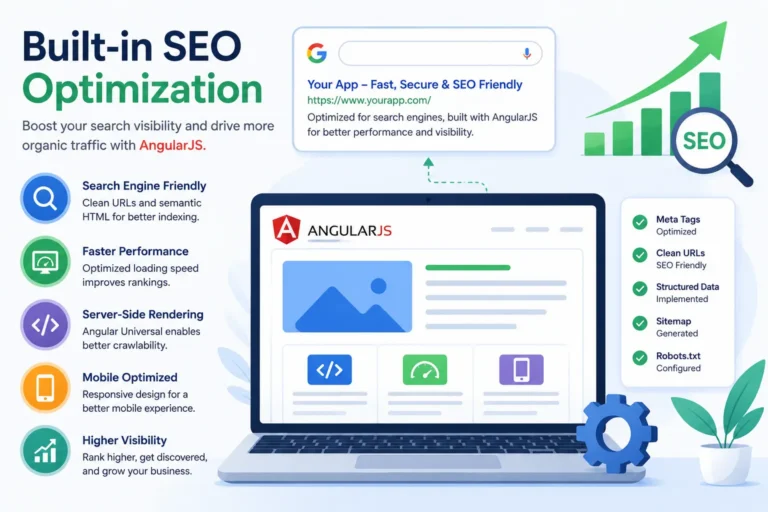
AngularJS comes with tools that enable server-side rendering (using Angular Universal). This helps makes your app easily crawlable by search engines.
Experts in AngularJS can ensure your app’s content is properly indexed, giving your business better visibility and higher rankings in search engines. This is very essential for attracting organic traffic and new customers that ultimately grow the business.
How AngularJS Supports Business Operations
AngularJS doesn’t just speed up development — it also improves how the finished product works day to day.
The right application can simplify everyday business processes. Think dashboards, or manager interfaces for editing information that then displays on a website or app. AngularJS makes it possible to build a dynamic interface that exchanges data without needing a full page reload.
That’s a win on both sides. Users get a smoother experience, and administrators spend fewer steps updating information. Over time, that reduces transaction costs for the business.
One caveat worth noting: how much value you actually get depends on the app’s design, its functionality, and how well it’s integrated with the rest of your company’s systems.
AngularJS for Data-Driven Applications
Many business applications live and die by frequent data exchange — sales dashboards, CRM tools, inventory systems, reports, and other operational data that needs to update in real time.
AngularJS handles this well. It lets you build apps where users view and interact with live data without reloading the page every time something changes.
Here’s a concrete example: an employee sorting and editing data, then returning to a directory to print reports. A responsive interface makes tasks like this fast and painless, day after day.
AngularJS also supports building APIs that pull information from the server on request and display it instantly on screen. Decoupling the front end from the back end this way makes the whole application easier to update as your business needs grow.
AngularJS and Application Security
Security matters in every application that touches customer data or business operations — and AngularJS is no exception.
AngularJS gives developers useful built-in security features. But the real strength of an app’s security depends just as much on what’s happening in the back end: the API, authentication, the database, and the server.
A few essentials worth getting right:
- Strong authentication and authorization, so only verified users reach sensitive data
- Input validation on every form and field
- Encrypted API communication
- Safe, secure session storage
- Regularly updated dependencies, to avoid known vulnerabilities
These aren’t optional extras — they’re foundational. Building them into your application’s architecture from the start takes real attention, but it’s what keeps your data protected as the app evolves.
AngularJS for Long-Term Application Growth
A business application is never really “done.” It scales to meet new customers, gains new features and integrations, and adapts as the company grows.
An app built with solid AngularJS practices can absorb that complexity without buckling. Reusable components let developers build similar elements faster, and update them as user needs or business goals shift.
Because the app can be split into modules, individual parts can be updated on their own — without breaking everything else. That drastically cuts the risk of errors as the app grows more complex over time.
It’s still worth periodically revisiting the code structure to spot weak points that might need extra stability or reorganizing.
Better Collaboration Between Development Teams
Large applications are usually built by many hands — frontend developers, backend developers, testers, and specialists on individual features. A shared convention makes that collaboration faster, and saves everyone the hassle of decoding someone else’s idiosyncratic style.
AngularJS’s common patterns and best practices help define clear, logical units inside your app. That makes it far easier for one developer to understand — and contribute to — someone else’s work without a long ramp-up.
This pays off especially well if you ever need to bring in outside contractors, or if multiple people are actively working on the same app at once.
When Is AngularJS a Good Fit for Your Business?
AngularJS tends to work best for business apps with dynamic functionality — interactive interfaces, reusable components, and tight integration with backend services. Think dashboards, portals, data-heavy apps, and tools with a lot of user interaction.
That said, market popularity alone shouldn’t drive your technology decision. Your current tech stack, in-house expertise, actual app requirements, maintenance plans, and roadmap all deserve equal weight.
If you already have an AngularJS application that needs updating, modernization is often the right move. A good developer can review the code, update dependencies, optimize performance, and help you decide whether migrating to a different stack is actually worth it — or not.
AngularJS in 2026: What You Need to Know Before You Commit
One thing it is important to understand is that Google has officially ceased supporting AngularJS as of December 31, 2021. This means that the company will no longer release any updates, including security updates, for the framework in the future. However, it is also important to note that not all AngularJS applications are “broken” after the end of support. Some of them are still functional and perform their tasks effectively. Nevertheless, the characteristics of the framework make it more relevant in specific scenarios.
Speaking of relevance, the status of AngularJS being no longer supported by Google is less relevant to applications that already use it. In other words, this announcement does not pose any significant risks to existing applications right away. At the same time, organizations that want to continue using AngularJS should be informed that extended support for the framework is available from vendors such as HeroDevs and OpenLogic. The fact that Google stopped supporting the framework does not mean that companies cannot use it anymore. The choice to use AngularJS should be based on a cost-benefit analysis of migrating to another framework, considering such factors as the amount of time spent maintaining the existing codebase and the possibility of using long-term supported software.
When it comes to building new applications, it is safer to use a newly developed framework rather than a legacy product. As mentioned above, companies should consider migrating to another solution when developing new applications. However, it is important to remember that advice is tailored to specific scenarios, such as the need for modernization. Otherwise, the framework is suitable for use in 2026 because of its benefits and the possibility of extended support. A number of advantages listed above allow AngularJS applications to exist and function effectively even after years of development. This is yet another confirmation of the framework’s effectiveness and demand in the modern software development market. However, the key point is that AngularJS development in 2026 should be viewed as a process of migrating to another solution while maintaining existing applications.
Ready to Take Advantage of AngularJS for Your App?
The technology you choose can make or break your app’s success. Our team builds with the latest AngularJS tools to make sure your application has both technical excellence and future-ready architecture.
The business case is strong: faster time-to-market, lower development costs, a better user experience, room to scale, cross-platform reach, strong community support, and built-in SEO advantages.
If you’re aiming for an app that’s powerful, scalable, and strategically built for growth, AngularJS is worth serious consideration.