


ReactJS is a modular, high-performance JavaScript library designed for constructing interactive user interfaces and cross-platform mobile apps via React Native. By utilizing a Virtual DOM, component reusability, and declarative state management, ReactJS minimizes rendering overhead, lowers development costs, and boosts user engagement. Partnering with expert ReactJS development services enables organizations to accelerate time-to-market, improve conversion rates, and build scalable web applications.
- 1 Enhanced User Experience: ReactJS enables smooth, fast, and interactive user interfaces using its virtual DOM and real-time updates.
- 2 Faster Time-to-Market: Modular structure and reusable components speed up development and product launch.
- 3 Cost-Effective Development: ReactJS reduces long-term costs with easy maintenance, scalable architecture, and plugin support.
- 4 Higher Conversion Rates: Intuitive UI and real-time interactivity lead to better customer engagement and increased conversions.
- 5 Cross-Platform Compatibility: React Native allows businesses to target both iOS and Android platforms with a single codebase.
- 6 Proven Expertise: Partnering with top ReactJS development companies ensures customized, high-quality application solutions.
Every business wants to give a better experience to clients using their applications. Apps that do not work smoothly quickly lose customer interest. This heavily discourages them from exploring further. Businesses constantly look for technologies that improve usability and drive rapid growth.
One technology that consistently stands out is ReactJS. From large companies to innovative startups, many invest in the ReactJS development framework. They use it to build high-performance apps that elevate the user experience. These companies see tremendous business growth with ReactJS applications.
Why ReactJS?
ReactJS offers a powerful JavaScript library. It is highly popular for efficiently building dynamic and interactive user interfaces. It features a virtual DOM, component-based architecture, and many reusable elements. These allow developers to create fast, scalable, and highly responsive applications.
By choosing ReactJS for application development, businesses immediately benefit from better speed, flexibility, and user satisfaction. These exact factors directly translate into improved engagement and much higher conversion rates.
Enhancing User Experience with ReactJS
Following are some of the key features of ReactJS that have made it popular for app development:
1. Lightning-Fast Rendering with Virtual DOM

One of ReactJS’s greatest strengths lies in its virtual DOM. It does not blindly update the entire page whenever a change occurs. Instead, ReactJS smartly updates only the specific component that changed. Users experience faster page loading, smooth transitions, and zero lag.
2. Component Reusability
When you opt for ReactJS app development services, developers build smart reusable components. This promotes consistency across the entire application and massively saves development time. A highly consistent interface helps users trust your app, quickly improving customer satisfaction.
3. Real-Time Updates and Interactivity

Real-time data updates are incredibly easy with ReactJS. Whether it is chat applications, live sports scores, or e-commerce carts, ReactJS ensures the UI stays perfectly in sync. This real-time responsiveness heavily enhances overall user engagement.
4. Mobile Experience with React Native
React’s vast ecosystem also includes React Native. This is a powerful framework for building native mobile applications. With react native development services, businesses effortlessly provide users with a clean mobile experience.
ReactJS vs. Other Frontend Frameworks
ReactJS is not the only choice for building interactive UIs. However, it is essential to understand its strong advantages compared to other frontend frameworks on the market.
VueJS is an excellent choice for those wanting a smaller learning curve. It is easier to learn and has many built-in features. However, React has a massive community and high job market demand. This makes React a much more reliable choice for long-term growth.
Angular requires more significant developer involvement. It is a full-scale framework that strictly prescribes rules about application architecture. The choice between Angular and React simply depends on the exact needs of your team and project.
Accessibility Considerations in React Applications Essay
Developing rich web apps means building interfaces that load quickly and respond instantly. However, this process should never sacrifice accessibility. Accessibility requires very specific attention inside React applications.
Firstly, using components is slightly different than standard HTML programming. Developers cannot simply ignore semantic HTML and just use generic div elements. Creating clickable items using basic div tags easily breaks accessibility for users with screen readers.
Secondly, the component-based approach strongly helps implement accessibility features. Developers can easily design generic accessibility components that work everywhere. Adding this component once makes all its inner elements accessible by default.
Boosting Your Bottom Line
Due to the robust architecture provided by ReactJS, you can receive the following benefits for developing apps on this platform:
1. Faster Process
The highly modular nature of ReactJS drastically speeds up the development process. This makes it incredibly easy for businesses to launch products faster. Leveraging ReactJS application development services allows for rapid iterations, helping companies easily gain a competitive edge.
2. Lower Development and Maintenance Costs
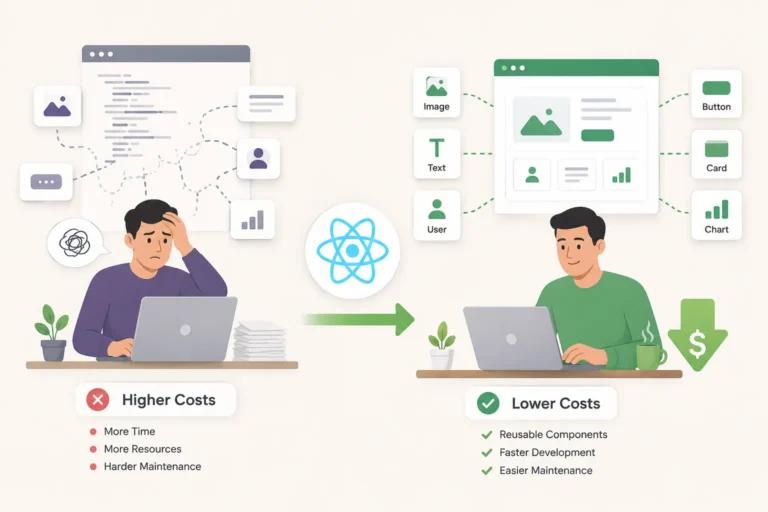
ReactJS provides reusable components and strongly supports many plugins. This makes ReactJS highly cost-effective. It is simply much easier to maintain, scale, and deeply debug code. This heavily saves valuable time and company resources.
3. Better Conversion Rates
An improved UI directly leads to higher overall conversion rates. Users are far more likely to convert if their app experience is smooth. ReactJS application development companies perfectly help businesses create these excellent interfaces.
4. Cross-Platform Reach
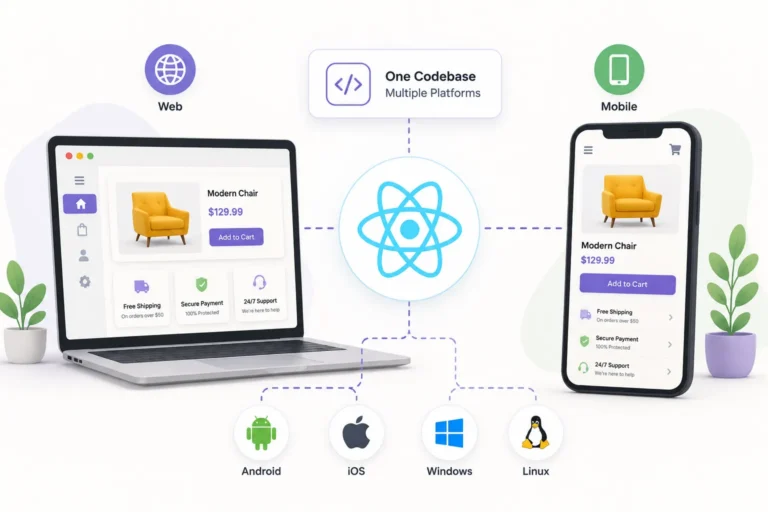
Using React native application development services, businesses rapidly reach both iOS and Android users. They do this completely using a single shared codebase. This heavily reduces development effort and drastically improves market reach.
SEO Considerations for React Applications Essay
Using React can create initial issues with search engine optimization (SEO). Standard React heavily relies on a client-side rendering process. Because of this, handling SEO in React requires very special technical attention.
This problem is easily resolved by implementing server-side rendering using Next.js. Dynamic content generation happens securely on the server instead of the browser. SEO-friendly mechanisms must still be actively used for a React application, just like any standard website.
Choosing Between React and React Native for a New Project
Businesses wanting both a website and a mobile app are often confused by technical choices. Understanding the strong connection between React and React Native is vital. It allows companies to form highly realistic expectations about their overall development process.
The two technologies are very similar in their smart component-based approach. They share logic that can be effectively used in both. However, React Native code must sometimes be adapted for different mobile platforms. While you can easily share core business logic, the final user interface still needs specific mobile adjustments.
Therefore, using React Native does not instantly build a perfect app by magic. Businesses still need to properly design and implement their custom user interface. However, React Native significantly reduces the massive effort and costs compared to building completely separate iOS and Android apps.
Why Work with Experts?
If you want to leverage ReactJS and React Native, always partner with experienced ReactJS application development services. These agencies have dedicated professionals who strictly offer proven processes, deep expertise, and modern best practices.
Top ReactJS development companies provide highly customized solutions tailored to your needs. This heavily ensures your application performs flawlessly under all traffic conditions. Additionally, React Native services actively help achieve a much better overall ROI.
By investing in trusted ReactJS companies, businesses easily create highly engaging applications. They instantly improve their bottom line through increased conversion rates and heavily reduced time-to-market.
If you are ready to elevate your entire digital presence, hire a proficient React team today. With ReactJS, your business can rapidly improve user experience and greatly boost its bottom line.
Key Performance Indicators (KPIs) to Track ReactJS ROI
To accurately quantify the business impact of migrating to a ReactJS application architecture, leads should closely monitor four core metrics post-deployment:
- First Contentful Paint (FCP): FCP is the time taken to paint the first content. Virtual DOM optimizations quickly bring this metric safely below 1.2 seconds.
- Time to Interactive (TTI): This computes the exact time taken for an app to become interactive. A great TTI metric drastically lowers the bounce rate of your pages.
- Sprint Component Velocity: This computes the raw speed of development in a sprint. High component reuse directly translates to 30% less time spent delivering features.
- Cart Abandonment & Conversion Rate: This strictly measures your app’s ability to retain users. It is heavily improved by smooth state updates that avoid full page refreshes.
Technical Architectures: State Management & Component Modularization
Enterprise-grade React applications easily achieve long-term maintainability. They do this by cleanly separating user interface components from complex business logic:
- Context API vs. Redux Toolkit: Simple apps utilize React’s built-in Context API to easily share data. However, large enterprise dashboards smartly opt for Redux Toolkit or Zustand to handle heavy global data flows.
- Custom Hooks for Business Logic: Custom React Hooks cleanly decouple core business logic from visual components. This incredibly allows the entire codebase to be tested and maintained much faster.
- Micro-Frontend Microservices: Massive enterprise projects break large apps into small frontend microservices. Webpack Module Federation enables distributed teams to safely deploy parts without breaking the main app.
ReactJS Architecture Strategies for Long-Term Enterprise Scalability
Building a high-performing application absolutely requires thoughtful architectural decisions. These smart choices directly prevent ugly technical debt as your platform scales:
- Modular Component Organization: Grouping files purely by feature keeps entire codebases clean. Teams safely update UI modules without risking dangerous breaking changes elsewhere.
- State Management Isolation: Smartly using local component state instead of messy global state is key. It massively reduces bad re-renders and keeps the application lightning-fast.
- Progressive Web App (PWA): ReactJS fully supports fast service workers. They provide vital offline support, push notifications, and background sync for a native desktop feel.
Mitigating Common Performance Bottlenecks in React Apps
Even with the fast Virtual DOM, poorly optimized React code easily slows down users. Top engineering teams actively prevent performance drops using these exact key practices:
- Code-Splitting with React.lazy: You can safely split your app into smaller bundles. These are lazy-loaded instantly on demand instead of forcing users to download massive JS files.
- Memoization via useMemo: This actively prevents your components from re-rendering incorrectly. It perfectly keeps your 60fps animations and heavy scrolling silky smooth.
- Virtualizing Long Lists: The React-window tool helps render only the visible items. It intelligently skips building giant arrays of useless DOM nodes.