

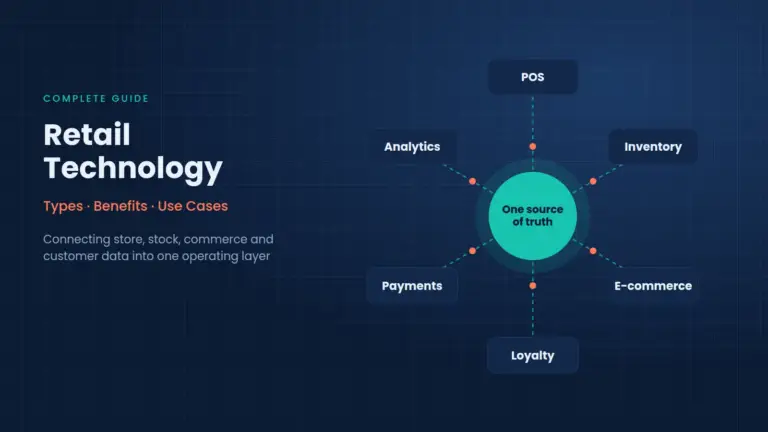
Retail technology is the connected layer of POS, inventory, e-commerce, loyalty, payments, and analytics systems that keeps the business working from one source of truth. The value is not in adding more tools. It is in getting those tools to exchange data fast enough to improve stock accuracy, customer experience, and margin decisions. Off-the-shelf platforms work well for standard operations. However, Custom systems start making more sense once scale, workflows, or integration complexity push packaged software beyond its limits.
- 1 Retail technology creates the most value when POS, inventory, e-commerce, loyalty, and analytics work from connected data.
- 2 Better stock accuracy, faster operations, and stronger personalization come from integration, not isolated tools.
- 3 Off-the-shelf software works well for standard operations, while custom systems become more useful as workflows and integrations become more specialized.
- 4 Successful implementation depends as much on data quality, rollout planning, and store adoption as on the software itself.
Retail runs on small margins and fast decisions. “For example, a stock mismatch, delayed price update, or disconnected loyalty system can quickly turn into lost sales. That is why technology in retail matters less as a collection of tools and more as the operating layer behind the business.
The strongest retailers connect store systems, inventory, e-commerce, fulfillment, and customer data so each channel sees the same information. In other words, the advantage comes from that connection, not from having the flashiest app.
What this article covers:
- What retail technology includes and how it differs from older, siloed IT setups
- Where technology has the biggest commercial impact in retail
- How retail technology evolved from cash registers to AI
- The key types of retail technology across in-store, back-office, and e-commerce
- Real-world use cases, core benefits, and common implementation challenges
- When custom retail systems make more sense than off-the-shelf software
What Is the Retail Technology Definition?
At its broadest, the retail technology definition covers the software and hardware retailers use to sell, fulfill, manage inventory, understand customers, and run operations. That includes POS, warehouse systems, ERP, CRM, e-commerce, analytics, and payments.
Older IT in retail industry setups often kept these systems separate. For instance, store inventory might not match the website. Promotions could update in one channel before another. Modern retail technology is designed to close those gaps by moving data across the business in near real time.
The Role of Technology in the Retail Industry
Wherever speed, accuracy, or customer context affects a commercial outcome, the role of technology in retail becomes visible.
The biggest gains usually show up in four areas:
- Inventory accuracy: Better stock visibility reduces both stock-outs and excess inventory.
- Checkout speed: Modern POS systems help stores handle demand without turning queues into lost sales.
- Personalization: Connected customer data makes offers and recommendations more relevant.
- Margin protection: Pricing and promotion systems help teams react faster to demand and inventory movement.
Technology in the retail industry has moved well beyond back-office support. It now directly shapes how efficiently retailers sell and how quickly they respond when conditions change.
Evolution of Technology in Retailing: From Cash Registers to AI
Over decades, technology in retailing has evolved in layers. Cash registers recorded transactions. Barcode systems added item-level visibility. ERP and e-commerce connected more of the operation. AI now adds another layer through demand forecasting, recommendation engines, computer vision, and dynamic pricing.
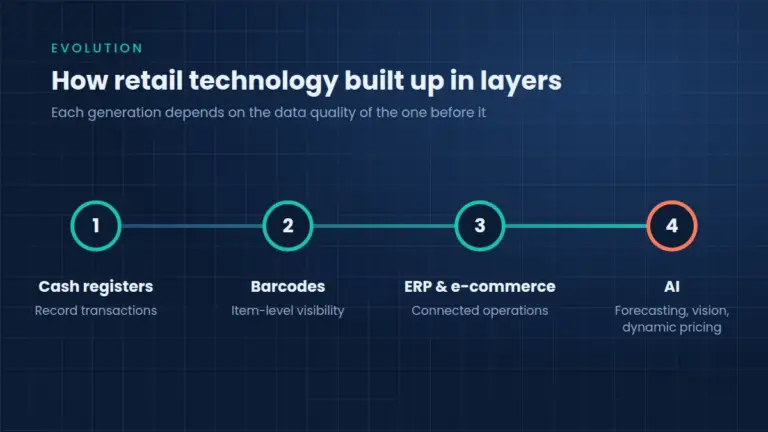
The important point is that these generations build on one another. AI cannot fix unreliable stock data, and personalization cannot work well when customer identities remain fragmented across channels. Retail technology gets more valuable as the underlying systems become better connected.
Key Types of Retail Technologies: In-Store, Back-Office, and E-Commerce
Modern retail technologies work across several layers, each solving a different part of the operating problem.
| Category | Core Systems | Integration Priority |
|---|---|---|
| In-store | POS, self-checkout, RFID, digital signage | Real-time inventory sync |
| Back-office | ERP, warehouse management, workforce | Finance and stock feeds |
| E-commerce | Storefront, CMS, order management, PIM | Price and product parity with stores |
| Data and analytics | Data warehouse, BI, ML platform | Ingest from all layers |
| Customer | CRM, loyalty, marketing automation | Identity across channels |
Application of IT in Retail Industry: Real-World Use Cases
From the warehouse to the aisle, the application of IT in the retail industry covers a lot of ground. The most useful systems solve specific operating problems rather than adding technology for its own sake.
Some of the use cases include:
- Predictive replenishment that flags stock before shelves run empty.
- Computer vision that checks planogram compliance.
- Mobile clienteling tools that give associates customer history.
- Buy-online-pick-up-in-store workflows that connect digital demand with store inventory.
- Voice-of-customer analytics that turns reviews and feedback into product decisions.
Each use case becomes more valuable when it connects back into the wider retail stack instead of operating as another isolated tool.
The Role of Technology in Retail Stores
Inside the store itself, technology in retail stores now reaches far beyond the checkout counter. Electronic shelf labels can update pricing quickly, smart shelves can surface low-stock alerts, and kiosks can help customers order products that are unavailable in that location.
The goal is not to make the store look more digital. It is to remove friction between what customers can do online and what they expect when they walk into a physical location.
Benefits of Modern Technology in Retail: Accuracy and Personalization
The strongest benefits of modern technology in retail come from better information moving through the business faster.
That can translate into:
- Higher inventory accuracy.
- Fewer stock-outs and less overstock.
- More relevant product recommendations.
- Faster markdown and promotion decisions.
- Loyalty offers tied to actual customer behavior.
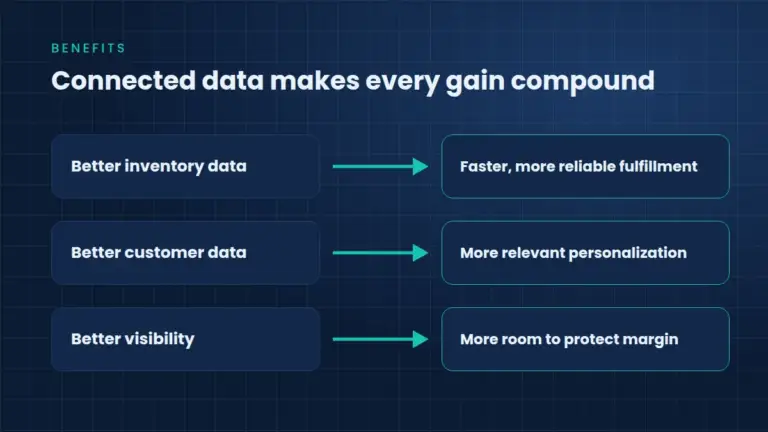
These gains reinforce one another. For instance, better inventory data improves fulfillment. Similarly, connected customer data improves personalization. As a result, pricing teams get more room to protect margin.
Why Custom Retail Technologies Outperform Off-the-Shelf Software
Off-the-shelf retail technologies work well when the business follows fairly standard workflows. The economics become less attractive when retailers start building layers of workarounds around unusual catalogs, fulfillment models, pricing rules, or clienteling processes.
Custom systems cost more upfront, but they can remove the integration debt and operating compromises that accumulate when packaged software no longer fits. Innostax builds custom commerce and retail systems, including marketplace products such as Nuw, the fashion-resale marketplace that reached over 100,000 US downloads, where catalog, payments, and fulfillment have to work as one connected experience.
Challenges in Implementing Technology in Retail Industry Solutions
Technology projects in retail rarely fail because the software cannot be built. The harder problems usually sit around integration, store operations, data quality, and rollout timing.
Pressure points include legacy systems that take longer to connect than expected, store teams resisting new workflows, poor data becoming visible only after integration, and peak-season freeze windows leaving little room for change. Strong implementations plan for those realities early, roll out in phases, and keep a clear rollback path when stores are involved.
Choosing a Partner for the Application of IT in the Retail Industry
The right partner needs to understand more than the software. Retail systems sit across inventory, pricing, payments, stores, e-commerce, and fulfillment, so a decision in one area can quickly create problems somewhere else.
Innostax works with retail teams that need custom systems, integration ownership, and technical leadership across the delivery cycle. The value is not simply adding more developers. It is having one delivery model that keeps architecture, integrations, and rollout decisions aligned as the retail stack becomes more complex.
Ready to build retail systems that actually fit your operation? Book a free retail technology review with the Innostax team.