

Most MVP timelines fail before coding even starts – weeks get lost to vendor selection, staffing, and contracting. A genuinely lean MVP process isn’t about cutting corners once building begins; it’s about ruthless scoping (test one hypothesis, defer everything else), building in short visible sprints with a senior-heavy team that owns decisions, and launching with proper instrumentation from day one. Speed comes from discipline and clarity about what not to build – not from working faster or skipping steps.
- 1 Most MVP delays occur before development begins, where selection of vendors, staffing, and contractual negotiations can take weeks before code is even written.
- 2 Scope creep before day 1 is the most common reason for lean MVPs turning into much larger undertakings than expected.
- 3 A lean MVP is centered around testing one hypothesis, and not a laundry list of features making the argument of which to cut extremely subjective.
- 4 Perfectionism tends to mask itself as progress, while MVPs focus on learning, not polish.
- 5 Seniority-heavy teams have significantly lower rework rates and identify issues at an earlier stage, therefore, accelerating the rate of progress, rather than individual speed.
Most MVP timelines fail not because the engineering is hard, but because the process around it is slow , weeks of vendor selection, weeks of contracting, weeks of staffing, before a single line of production code gets written.
By the time development actually starts, founders have often already spent a meaningful chunk of their runway on process rather than product which makes the pressure to ship fast, once building finally begins, even more intense.
This pressure often leads to a second, less obvious failure mode: teams that finally start building try to make up for lost time by cutting corners on the wrong things , skipping basic instrumentation, for instance rather than cutting the scope that was inflated in the first place.
A genuinely lean MVP process treats speed and discipline as the same thing, not opposites. The fastest path to a validated product is rarely the path with the fewest rules , it’s the path with the fewest unnecessary ones.
At Innostax, we’ve built our engagement model to compress that timeline: AI-native managed engineering pods for SaaS founders, senior-heavy teams that own delivery, built for quick turnaround.
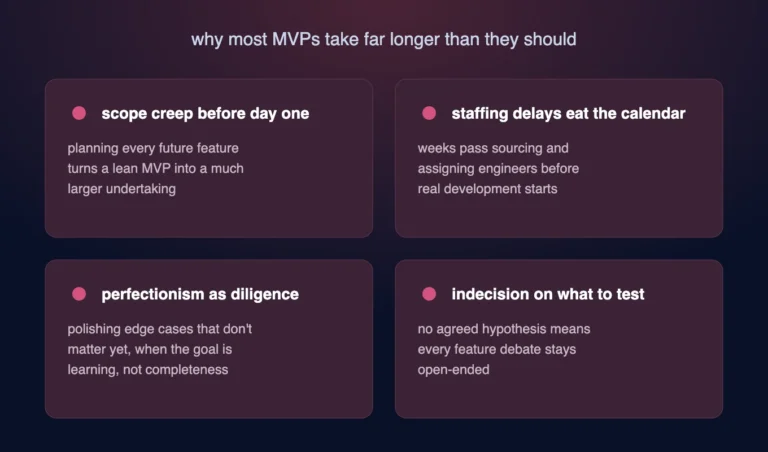
Why Most MVPs Take Far Longer Than They Should
Scope Creep Before Day One
Teams often try to define every feature of the eventual full product before writing any code, turning a lean MVP into a much larger, slower undertaking. The instinct to be thorough during planning is understandable, but it works against the entire purpose of an MVP.
The Cost of Building for a Product That Doesn’t Exist Yet
There’s a specific version of scope creep that’s easy to miss because it feels responsible: building infrastructure for scale the product doesn’t have yet. Multi-tenant architecture designed for ten thousand users when the MVP needs to prove it can get ten. Configurable permission systems built for enterprise customers before a single customer has signed on.
None of this is wrong in isolation. It’s wrong in sequence. An MVP’s job is to answer one question cheaply and quickly — not to arrive pre-built for a future that hasn’t been validated yet. Every hour spent on infrastructure for hypothetical scale is an hour not spent getting real users in front of the actual product.
The teams that avoid this trap tend to ask a blunt question before building anything non-essential: if this MVP fails to validate, will we regret not having built this, or will it turn out to have been wasted effort either way? More often than founders expect, it’s the latter.
Staffing Delays Eat the Calendar
By the time a vendor sources and assigns the right engineers, weeks have often passed before real development even starts. For a founder racing a market window, those weeks are rarely recoverable later in the process.
Perfectionism Disguised as Diligence
It’s easy to mistake thoroughness for progress. Founders sometimes delay launch to polish edge cases that don’t matter yet, when the actual goal of an MVP is learning, not completeness.
Indecision About What Actually Needs Testing
Some MVP timelines stall simply because the team never agreed on the one hypothesis the MVP is meant to test. Without that clarity, every feature debate becomes open-ended, because there’s no shared criteria for what’s essential and what isn’t.
The Vendor Selection Trap Nobody Talks About
Founders are told to “choose carefully” when picking an engineering partner, and that advice isn’t wrong — it’s just incomplete. The real trap isn’t picking the wrong vendor. It’s spending the same amount of diligence on a six-week MVP engagement that you’d spend hiring a full-time VP of Engineering.
Reference calls, technical deep-dives, multi-round proposals — all reasonable for a multi-year partnership. For an MVP that needs to be live in eight weeks, that same process can quietly consume a third of your available runway before anyone’s written code.
The better question isn’t “is this the perfect long-term partner.” It’s “can this team ship something real, fast, that I can learn from.” Those are different evaluations, and conflating them is one of the quieter reasons timelines slip before they even start.
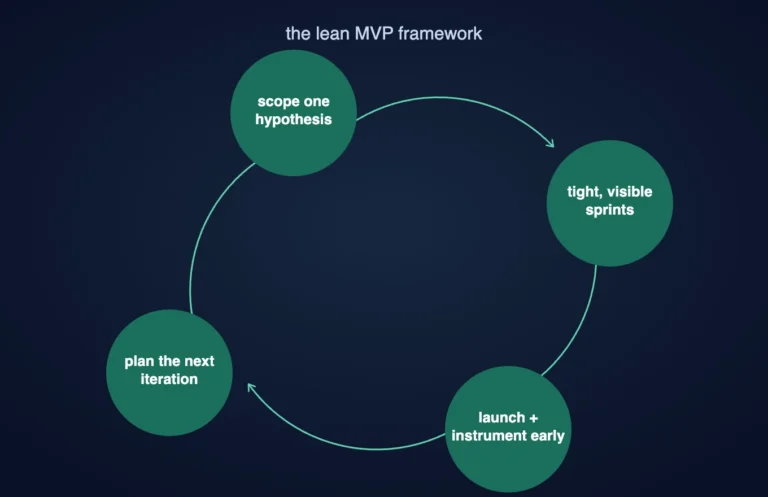
The Lean MVP Framework
Start With Focused Scoping, Not Exhaustive Planning
Rather than mapping the entire product, the first stage identifies the single core hypothesis the MVP needs to test, and scopes only what’s needed to test it. Everything else gets explicitly deferred, not quietly forgotten.
Build in Tight, Visible Sprints
A senior-heavy team builds in short cycles with frequent visibility, so founders can course-correct in near real time rather than waiting for a big reveal. Short cycles also make it easier to catch scope drift before it accumulates.
Launch and Instrument Early
The final stage focuses on getting the MVP live and properly instrumented for feedback because an MVP without measurement can’t validate anything. Instrumentation isn’t a nice-to-have add-on; it’s the entire point of building an MVP in the first place.
Plan the Next Iteration Before Launch, Not After
A lean MVP process also defines, in advance, what signals would justify continuing to invest versus pivoting, so the team isn’t scrambling to interpret ambiguous early data after launch, under pressure, without a clear framework in place.
What “Instrumented” Actually Means in Practice
It’s easy to nod along with “launch and instrument early” without knowing what that looks like day to day. In practice, it’s rarely complicated — it’s just consistently skipped.
At minimum, a properly instrumented MVP tracks who’s using it, what they’re doing once they’re in, and where they drop off. That might mean basic event tracking on core actions, a simple funnel view, or even just clean logging that lets someone answer “did anyone actually do the thing we built this to test.”
The mistake isn’t usually a lack of tooling — most teams have access to analytics platforms that would do the job. The mistake is treating instrumentation as a post-launch task, something to “add once things settle down.” Things rarely settle down. The MVP that ships without measurement built in from day one usually stays that way for longer than anyone intends, which means the first real signal a founder gets is often anecdotal feedback rather than actual usage data.
What Makes a Fast Timeline Realistic, Not Aspirational
Senior Engineers Reduce Rework
Junior-heavy teams often need more review cycles and produce more rework, which quietly extends timelines. A senior-heavy pod catches issues earlier, before they’ve had a chance to compound into something more expensive to fix.
Ownership, Not Ticket Execution
A team that owns the outcome makes judgment calls about what to cut and what to keep, rather than waiting for direction on every decision which is often the real reason lean timelines slip into much longer ones.
Why Communication Cadence Matters More Than Communication Volume
Founders often think about visibility in terms of frequency — more updates, more checks in, more dashboards — but in reality, what a lean MVP process needs is less, more decision centric touch points, timed around the moments where a founder has to make a choice
A daily status update is not visibility. What a founder needs is a short and focused check in at the end of a sprint that highlights the decisions made, those deferred, and the learnings that could inform pivots. It’s a fundamentally different kind of communication than a running log of resolved tickets.
The biggest threat to velocity in a fast moving lean MVP process isn’t being uninformed. It’s being systematically informed of the wrong things, while the true scoping or directional decisions languish, unaddressed, for two weeks because no one thought to prioritize them.
Cutting Scope Without Cutting Confidence
The hardest part of a lean MVP isn’t the engineering , it’s the discipline to leave features out. A senior team can tell the difference between a cut that weakens the hypothesis being tested and one that trims polish, and that judgment is what keeps a fast timeline from becoming a reckless one.
The Questions Worth Asking Before Scope Gets Cut
Not every scope decision requires a drawn-out debate, but the ones that do always seem to boil down to a few questions:
Does this cut hurt what we’re trying test in the MVP, or does it merely impact polish? You can’t treat both the same, as either you’ll ship a useless MVP or spend too long polishing before anyone sees it.
Will the user even encounter what we’re debating in the first place? Does this affect the MVP’s stickiness or simply its polish? The former is far more important than the latter to most MVPs, since the whole point of an MVP is convincing the user to come back a second time.
Is this really something that would save development time if we built it now, or are we simply rationalizing that we “might as well” because we already have the context to do so? The last one is particularly subtle, but a common source of accidental scope creep even after a team has resolved to do an MVP in the first place.
Speed Comes From Discipline, Not Shortcuts
A fast MVP isn’t a rushed MVP , it’s a disciplined one, with a tightly scoped hypothesis and a team experienced enough to execute without constant hand-holding. Firms like Innostax, Velotio, or Simform each specialize in exactly this kind of lean, fast-start engagement, though the team structure behind that speed varies.
The founders who get the most out of an MVP process are usually the ones willing to let a small, senior team make real calls about scope not just execute a wish list. That trust, more than any particular framework, compresses the timeline.
What ultimately separates a successful fast MVP from a failed one usually isn’t the code quality at launch, it’s whether the team built in a way that made the next iteration easy, instead of treating launch as the finish line.
Founders who’ve been through this process more than once tend to agree on one thing: the speed came from clarity about what not to build, far more than from how quickly anyone typed.
Have an Idea That Needs to Be Live Fast?
At Innostax, we specialize in getting founders from zero to a live, testable MVP quickly – with a senior team that owns the outcome.
Schedule a Free MVP Sprint Planning Session →
Let’s map out your fastest realistic path to launch.