

AI software development has been sold with dramatic claims, but the real story is quieter: AI removes friction across planning, coding, review and testing rather than replacing engineers or slashing every timeline. Teams that build AI deliberately into the full SDLC shorten development cycles without lowering code quality. Teams that simply bolt a tool onto an unchanged process see far less value. Generated code still needs senior human review, because it can look correct before it’s been proven correct. Innostax integrates AI across planning, coding, review and testing while keeping experienced engineers in control of architecture, security and final sign-off.
- 1 AI creates the most reliable timeline gains in planning, coding, review and testing — not by letting agents write production code unsupervised.
- 2 Teams that redesign their workflow around AI see far more benefit than teams that simply add an AI tool on top of an unchanged process.
- 3 Every phase of the SDLC gains differently: faster first drafts in planning, faster scaffolding in coding, AI-supported pre-review, and faster test generation in QA.
- 4 Generated code needs human review by default — it can compile, pass linting and look consistent while still missing an edge case or a security assumption.
- 5 AI is especially useful for legacy modernization, helping engineers trace dependencies and draft refactors before making changes.
- 6 The engineering role is shifting: senior engineers move toward architecture and oversight, and junior mentorship has to become more deliberate as AI absorbs routine coding.
AI software development has been sold with plenty of dramatic claims. The more useful story is quieter. Artificial intelligence for coding is improving delivery by taking friction out of multiple stages of the SDLC, not by replacing the engineering team or compressing every project into a fraction of the time.
The strongest gains come when AI is used deliberately across planning, coding, review and testing. Teams that build it into the workflow can shorten development cycles without lowering code quality. Teams that simply add an AI tool on top of an unchanged process often see far less value. The real question is where AI genuinely saves time, where it introduces new risks and how teams can capture the upside without weakening engineering standards.
The Real Impact of AI and Software Development in 2026
AI and software development is no longer an experiment. After several years of widespread use, the areas that consistently create value are becoming clearer.
Planning support, boilerplate generation, test scaffolding and code review augmentation are practical uses because they remove repetitive work without handing over critical engineering decisions. Autonomous agents writing production code with little supervision remain a much less reliable proposition.
That distinction matters. Teams that focus on proven use cases free engineers to spend more time on architecture, debugging and product decisions. Teams that chase full autonomy often give some of that time back in review, rework and troubleshooting.
Shortening the AI Development Lifecycle: Phase-by-Phase Timeline Gains
The impact of AI varies by development phase. This table outlines where teams can typically remove manual effort across the SDLC.
| SDLC phase | Traditional workflow | With AI assist | Where the gain comes from |
| Requirements and planning | Manual drafting and refinement | Faster first drafts | User story and acceptance-criteria support |
| Design and architecture | Manual documentation and exploration | Faster iteration | AI-assisted diagramming and documentation |
| Coding | Repetitive implementation work | Faster scaffolding | Code generation and boilerplate |
| Code review | Reviewer starts from scratch | AI-supported pre-review | Suggestions and issue flagging |
| QA and testing | Manual test-case creation | Faster test generation | Test scaffolding and regression support |
| Deployment | Manual release preparation | More automated preparation | Release notes and checks |
1. Accelerated Planning and Requirements Gathering
AI helps product teams turn scattered notes, stakeholder input and rough requirements into defined user stories, acceptance criteria and a structured backlog.
That does not remove the need for product judgement. It removes some of the administrative work around expressing decisions clearly. Product managers can spend less time formatting requirements and more time resolving priorities, dependencies and edge cases before development begins.
2. High-Velocity Coding via AI-Assisted Development
The most visible gains from AI-assisted development come from routine implementation work.
Boilerplate, test scaffolds, type definitions, adapters and repetitive transformations can be generated quickly with modern AI coding software. That changes where engineers spend their time.
Instead of manually producing familiar patterns, developers can focus on the parts that require deeper understanding: architecture, business logic, failure handling, performance and integration with the rest of the system. The value is not more code for its own sake. It is more engineering attention available for the difficult parts.
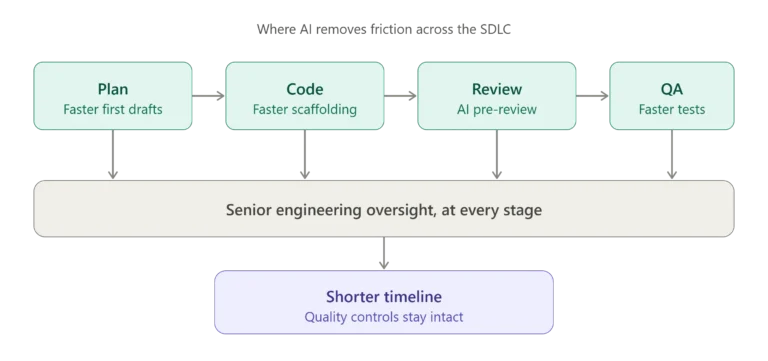
3. Automated QA and Earlier Vulnerability Detection
AI can also reduce the amount of manual preparation required in testing and review.
Code changes can be used to generate initial test cases, surface likely edge cases and identify suspicious patterns earlier in the delivery cycle. Manual QA still matters, particularly for business-critical workflows and behaviour that cannot be validated reliably from code alone.
The advantage is that QA teams can spend less time creating basic coverage from scratch and more time investigating the scenarios where defects are likely to matter most.
Why AI-Assisted Development Requires Human Oversight
Generated code has a particular risk: it often looks plausible before it has been proven correct. An AI assistant can produce code that compiles, passes linting and appears consistent with the surrounding repository while still misunderstanding a business rule, missing an edge case or making a weak security assumption.
That is why AI-assisted development works best when generated code is treated as a first draft rather than a final commit. Teams still need reviewers to ask the harder questions. Does this implementation fit the architecture? What happens under failure? Is the data handled safely? Does the code solve the actual business requirement?
The faster AI makes generation, the more important that review discipline becomes. Speed at the writing stage has little value if it creates more work downstream.
How AI in Software Engineering Is Refactoring Legacy Systems
AI in software engineering is especially useful in legacy environments where understanding the codebase can take longer than changing it. Older systems often contain undocumented dependencies, unfamiliar patterns and business logic spread across multiple modules. AI assistants with sufficient codebase context can help explain that structure, trace dependencies and draft refactoring options before an engineer begins making changes.
The process still depends on human verification. AI can summarise and propose. Engineers need to validate behaviour, protect existing functionality and decide whether the suggested change actually improves the system. That combination can make legacy modernisation less intimidating. Engineers spend less time reconstructing the codebase from scratch and more time making deliberate changes to it.
From Coder to Architectural Orchestrator
The engineering role is shifting as AI takes on more routine implementation work. Senior engineers increasingly spend time on architecture, review, integration and technical direction rather than writing every line themselves. Their value moves towards deciding what should be built, how components should fit together and whether generated output is safe to ship.
The change is just as important for junior engineers. Routine coding has traditionally been part of how developers learn. If AI now completes more of that work, mentorship has to become more deliberate. Junior engineers still need to understand why the code works, how to debug it and when an AI-generated solution is wrong.
Teams that adapt hiring and mentorship to this shift will get more value from AI than teams that continue measuring engineering output by how much code an individual writes.
The Innostax Advantage: Our AI-Integrated SDLC
Innostax integrates AI assistance across planning, implementation, review and testing rather than treating it as a standalone productivity tool.
Our managed engineering teams use AI tools for software development to reduce repetitive work while keeping senior engineering oversight in the loop. Generated code is reviewed before it reaches the repository. Test coverage is checked against expected behaviour. Architecture and security decisions remain with experienced engineers.
The aim is straightforward: use AI where it removes friction without allowing it to weaken the controls that keep software maintainable and reliable. If your team is already experimenting with AI but not seeing meaningful delivery improvements, the issue may be less about the tool and more about how it has been integrated into the development process.
Conclusion: Embracing AI as a Force Multiplier for Quality
AI software development works best as a force multiplier for a sound engineering process. It can reduce repetitive work across requirements, implementation, testing and review, but it does not remove the need for engineering judgement.
The teams that benefit most will be those that use AI to accelerate the predictable parts of delivery while keeping architecture, validation, security and accountability firmly in human hands. The competitive advantage is not simply writing code faster. It is giving skilled engineers more time to work on the decisions that determine whether the software is actually good.
Ready to Build AI Into Your SDLC the Right Way?
Adding an AI coding assistant is easy. Building a delivery process that consistently benefits from it is harder.
Innostax’s managed engineering teams integrate AI-assisted planning, coding, review and testing into existing workflows with senior-engineer oversight built in. The goal is to reduce development friction, improve delivery speed and keep quality controls intact.
Talk to our engineering team to see where your SDLC has room to speed up.
Frequently Asked Questions
Can AI-assisted development help with existing legacy code?
Yes. AI can help engineers understand unfamiliar modules, trace dependencies, draft refactors and generate initial tests. The resulting changes still need to be reviewed against the existing system behaviour before they are shipped.
What are the main risks of AI-driven software development?
The main risks include subtle logic defects, inconsistent architectural patterns, insecure assumptions and technical debt created by accepting generated code too quickly. There is also a skills risk if developers rely on AI without understanding the code it produces.
Is AI in software engineering replacing senior developers?
No. Senior developers remain central because architecture, review, debugging and technical trade-offs still require judgement. AI changes the balance of the role by reducing some routine coding and increasing the importance of direction and verification.