

Vendor onboarding should be specific, time-bound, and measurable rather than an open-ended ramp-up period. Greenfield projects should typically reach meaningful work within days, existing-codebase handoffs within 1–2 weeks, and complex or regulated systems should still have a clearly defined timeline. Clear milestones, ownership, and a written onboarding plan help identify strong vendors and avoid prolonged onboarding delays.
- 1 Onboarding should have a defined end point - It should include access setup, product/codebase context, and structured knowledge transfer, with clear criteria for when onboarding is complete.
- 2 Greenfield projects should move quickly - For new projects, a senior team should be able to begin meaningful architecture and development within days of kickoff.
- 3 Existing codebases typically need 1–2 weeks - A reasonable vendor should begin contributing meaningfully within one to two weeks rather than spending an entire month ramping up.
- 4 Complexity may extend timelines, but should not remove accountability - Regulated, legacy, or multi-repository environments can require additional onboarding time, but the vendor should provide a bounded, documented plan.
- 5 Watch for onboarding red flags - Excessive internal vendor processes, undefined onboarding completion criteria, and billing that begins during a lengthy onboarding period can indicate broader delivery problems.
“Onboarding” is one of the vaguest terms in vendor engagements , it can mean anything from a single kickoff call to a multi-week ramp-up period before real work begins. Founders rarely have a clear benchmark for what’s actually reasonable.
Without a benchmark, it’s easy to accept whatever timeline a vendor proposes as simply “how long it takes.” In reality, onboarding timelines vary enormously across vendors doing comparable work, and much of that variance comes down to structural choices rather than the inherent complexity of the handoff.
This matters more than it might seem, because onboarding sets the tone for everything that follows. A slow, unclear onboarding process often previews how the rest of the engagement will run, not an isolated exception.
Treating onboarding as its own distinct phase, with its own timeline and success criteria, is a simple mental shift that makes it far easier to hold a vendor accountable rather than letting it blur indistinguishably into the rest of the engagement.
At Innostax, we treat onboarding as a specific, measurable phase: AI-native managed engineering pods for SaaS founders, senior-heavy teams that own delivery, built for quick turnaround.
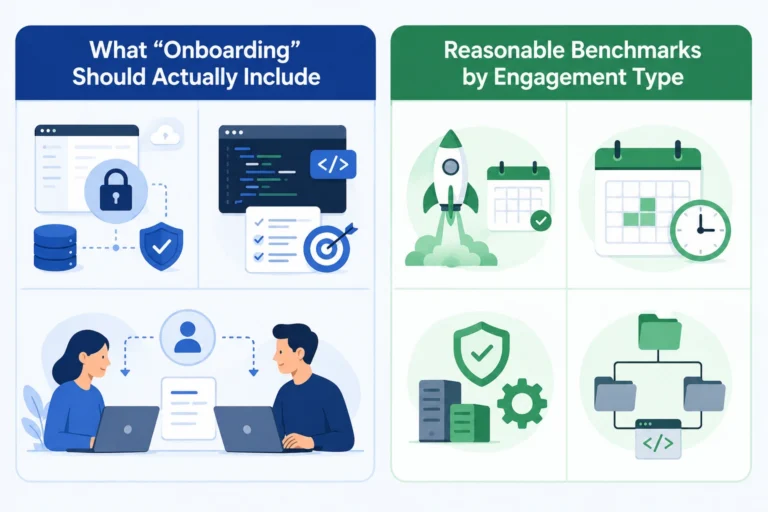
What “Onboarding” Should Actually Include
Access and Environment Setup
Getting the team proper access to code repositories, environments, and tools this alone can take days at vendors with heavy internal security processes.
Product and Codebase Context
A focused ramp-up on the existing codebase and product goals, ideally structured as a short, defined sprint rather than an open-ended ramp period.
A Clear Handoff of Institutional Knowledge
Where possible, direct time with whoever previously owned the codebase or product context, a structured knowledge transfer, not just documentation left behind for the new team to interpret on their own.
Reasonable Benchmarks by Engagement Type
Greenfield Projects: Days, Not Weeks
For a new project with no existing codebase, a senior team should be able to start meaningful architecture and build work within days of kickoff.
Existing Codebase Handoffs: One to Two Weeks
Taking over an existing codebase reasonably requires more ramp-up time, but a senior team should be contributing meaningfully within one to two weeks, not a full month.
Regulated or Highly Complex Systems: A Bit Longer, But Bounded
Compliance-heavy or deeply complex systems may reasonably need more onboarding time but even then, the timeline should be a specific, bounded estimate, not an open-ended “we’ll see.”
Multi-Repository or Legacy Systems Need a Plan, Not Just Time
For engagements involving several interconnected systems or older legacy code, the relevant benchmark isn’t just duration, it’s whether the vendor can articulate a specific onboarding plan for each piece, rather than treating the whole thing as one open-ended ramp-up.

Red Flags in the Onboarding Timeline
Onboarding That’s Mostly Internal Vendor Process
If most of the onboarding time is spent on the vendor’s internal staffing and process rather than your actual codebase, that’s a signal about how the rest of the engagement may run.
No Clear Definition of “Done” for Onboarding
A well-run engagement has a clear point at which onboarding ends and active development begins vagueness here often predicts vagueness throughout the project.
Billing Starts Before Any Real Work Does
Watch for engagements where the meter starts running during a long, loosely defined onboarding period. A vendor confident in their process is usually willing to bind that period tightly, or absorb some of the cost themselves.
What to Do If Onboarding Is Already Dragging
Name the Slippage Explicitly, Early
If onboarding is already running past the agreed timeline, raise it directly and immediately rather than assuming it will self-correct. Vague discomfort rarely produces a fix , a specific, dated conversation usually does.
Ask for a Revised, Concrete Plan
Rather than accepting another vague reassurance, ask the vendor for a specific revised timeline with new milestones. Their willingness, or reluctance, to provide one tells you a great deal about what to expect going forward.
Ask for a Specific Onboarding Timeline in Writing
Before signing an engagement, ask the vendor to commit to a specific onboarding timeline with clear milestones, not just a general assurance that they’ll “move quickly.” Specificity here strongly predicts specificity later.
A vendor who can commit to concrete onboarding milestones has almost certainly done this before and refined their process. A vendor who can’t is, in effect, telling you that your project will be their onboarding pilot.
This one document , a written, milestone-based onboarding plan is worth insisting on even when everything else about a proposal feels informal. It costs the vendor almost nothing to produce, and it tells you a great deal about how seriously they take commitments.
A clean, well-defined onboarding phase is one of the easiest things to get right in a vendor relationship which is exactly why it’s worth treating as non-negotiable rather than an afterthought.
Key Metrics to Track Vendor Onboarding Efficiency
To ensure your engineering partner isn’t turning onboarding into an open-ended ramp period, founders should To ensure that your engineering partner isn’t pulling you along an open-ended ramp period, founders should consider using these three operational metrics to evaluate the handoff:
- Time-to-First-Commit (TTFC): The number of business days between signing the contract with a vendor engineering partner and the vendor engineer pushing his first reviewed / merged code commit into your repo. Your senior engineering teams should be able to achieve this milestone within 3-5 business days.
- Environment Readiness Ratio: Measures how quickly required access credentials, cloud permissions, and API keys are verified. A streamlined vendor provides an automated environment setup checklist on Day 1 to prevent administrative bottlenecks.
- Knowledge Transfer Velocity: Measures the speed at which the incoming team can perform independent local builds, test suite executions, and staging deployments without relying on your internal team’s guidance.
Overcoming Common Onboarding Bottlenecks
Even well-intentioned engagements can stall if structural friction isn’t addressed immediately. Here is how high-performing engineering teams bypass typical ramp-up delays:
1. Bottleneck: Overly Restrictive Security & IAM Policies
Waiting for enterprise IT or security teams to grant access permissions can stall an entire dev team for a week.
- The Fix: Request a pre-configured IAM role template or a temporary developer sandbox environment prior to official kickoff so credentials are live on Day 1.
2. Bottleneck: Outdated or Non-Existent Documentation
Legacy codebases rarely come with comprehensive setup guides, forcing new developers to waste days troubleshooting local environment builds.
- The Fix: Instruct the incoming vendor team to make updating and containerizing the local development setup (via Docker) their very first milestone deliverable.
Framework for a Structured 14-Day Onboarding Sprint
Rather than leave onboarding as an informal ramp up period, top engineering teams treat the transition as a 14-day execution cycle to remove ambiguity, drive accountability from day one.
- Days 1–3 (Access & Environment Provisioning): Focus exclusively on administrative setup. The vendor team receives IAM permissions, repository access, and staging credentials. Success is measured by running a clean local build without configuration errors.
- Days 4–7 (Architecture & Codebase Discovery): The incoming team conducts a deep-dive review of system architecture, data schemas, and dependency trees. They document existing tech debt and validate system behavior against product specifications.
- Days 8–10 (The First Low-Risk Commit): The vendor delivers their first functional pull request—typically addressing a minor bug fix or small refactoring task. This tests the deployment pipeline, CI/CD automated checks, and code review workflows.
- Days 11–14 (Full Sprint Integration): The team transitions into regular sprint planning, taking ownership of primary feature backlog items and participating in daily standups seamlessly.
Protecting Product Momentum After Onboarding Ends
A successful onboarding should be picking up speed towards consistency immediately. In order to prevent lose of momentum during the transition:
Establish Weekly Velocity Reviews: To get the throughput out there early to make sure the new onboarded team isn’t being a drag on your other internal stakeholders..
Keep communication channels open: Set up an ad-hoc communication channel, such as a slack or teams channel, on which your core product team and vendor engineers can talk about issues that require a quick resolution.
Have a 30 Day Retrospective: Conduct a 30 day retrospective. After the first month of onboarding, take a look back, review how the process went, what areas of access slow to provide, and have takeaways for the next similar team onboarding to your organisation.
Want a Concrete Onboarding Timeline for Your Project?
At Innostax, we commit to specific, milestone-based onboarding timelines built around quick turnaround from kickoff. We eliminate the guesswork by defining clear delivery checkpoints, environment readiness SLAs, and early commit expectations before contract signing.
Instead of letting onboarding drift into an open-ended ramp period, our senior engineering pods take full ownership of the handoff process—ensuring your codebase, context, and deployment pipelines are fully operational in days.
Schedule a Free Onboarding Timeline Consultation →
Let’s put real dates on your project’s start.