


- 1 PHP is best at speedy handling of the web requests and is good for it for those websites that are used frequently, on the other hand Python is best for complicated computations and AI and includes millionaire features for data oriented applications.
- 2 While PHP has the C style language and is inclined toward Web development, Python’s syntax is a great deal more readable and flexible to suit Web and data analysis, which defines PHP or Python based on a project and programmers’ acquaintance with a language.
- 3 Different PHP frameworks including Laravel and Python frameworks including Django and Flask exist because they are used under different circumstances; while PHP excels mostly in web based projects, Python is used in a variety of things including data analysis.
Join us in our recent blog post where we explore the current PHP vs Python talk in the realm of backend web development.
We’ll look at everything from performance to community support. This helps you make an informed choice. Along the way, we’ll track the evolution of web coding and highlight PHP’s strengths for web-specific tasks alongside Python’s multi-purpose capabilities.
Whether Laravel (a PHP framework) catches your eye, or you can’t imagine working without Python’s libraries, this guide gives you the information you need to decide.
Understanding the history helps make sense of where things stand today.
Ultimately, the best language for your web app depends on your project requirements, your team’s skillset.
Also, your scalability goals.
Let’s dive into the PHP and Python landscape and lay the groundwork for durable web applications.
PHP: Hypertext Processor
PHP originally stood for “Personal Home Page.” Since its creation by Rasmus Lerdorf in 1994, it has grown into one of the most key server-side scripting languages in web development.
From the start, PHP focused on being easy and reliable — a tool anyone could use to build dynamic webpages.
Its open-source nature helped build one of the richest developer communities around. This makes PHP as both a standard and a source of current innovation.
Over time, PHP became the backbone of the world’s leading content management systems — WordPress, Joomla.
Also, Drupal. This helped fuel massive growth across the web.
PHP’s ease of use, rich ecosystem.
Also, wide adoption have also kept it relevant alongside newer technologies like GraphQL.
This flexibility is a big reason PHP remains a strong choice for both developers and teams — and a key point in any PHP vs Python discussion.
Python: A Versatile Backend Option
Python has been steadily gaining ground alongside PHP for web development. Its code is easy to read and write. It appeals to developers looking for efficient backend solutions.
Python is also widely used in data science and machine learning.
That name carries over into web development, where Python’s fast project turnaround and extensive library ecosystem make it a strong option.
Python supports fast programming. It enables high-performance websites. Combined with a strong community and solid documentation, it’s an increasingly appealing choice for backend work.
Frameworks like Django and Flask simplify backend coding — Django offers a full-featured, batteries-included approach, while Flask stays lightweight and flexible.
Libraries like SQLAlchemy and Requests further strengthen Python’s backend capabilities. This lets developers build large, efficient websites.
In today’s web coding landscape, Python stands out for its simplicity, flexibility.
Also, performance — a strong option alongside PHP for backend development.
Performance Showdown: PHP vs Python
People often compare PHP and Python for web development. Testing both languages reveals clear strengths and weaknesses for each.
PHP is known for responding quickly to web requests. It tends to outperform Python when a site needs fast server-side script execution.
Python, on the other hand, is better suited to heavy calculations and data handling — though it runs a bit slower than PHP in typical web request scenarios.
Several factors affect performance for both languages.
PHP works well with web servers like Apache and Nginx.
It helps it respond quickly.
Python’s setup and flexible data handling can introduce some overhead — but major libraries like NumPy and TensorFlow give it serious strength in data science and machine learning tasks.
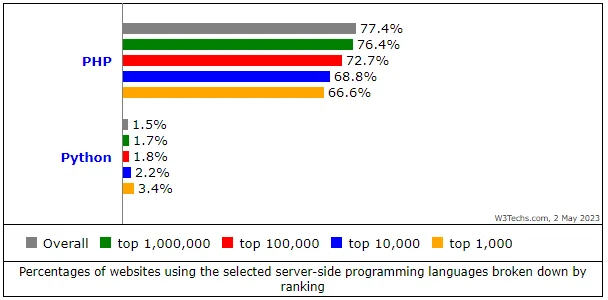
Ultimately, the exact volume and nature of traffic your website experiences affect your hosting requirements, along with your overall site efficacy. Each of those points leaves a unique mark on the decision between Python and PHP. Knowing the different web traffic patterns and what each language and its caching method offers can give you the edge you need. Remember: Both coding tools offer distinct advantages in different use cases. They work for different reasons and thrive in different scenarios.
PHP vs Python: key Differences
| Features | PHP | Python |
| Syntax and Readability | PHP syntax is similar to C-style languages and is designed mostly for web development. It tends to have a more step-by-step style of coding. | Python syntax is known for its simplicity and readability, using indentation to define code blocks. It supports both step-by-step and object coding paradigms |
| Performance | Historically, PHP has been optimized for web server performance and is often faster for processing web requests compared to Python | While Python can be slower than PHP for web applications, it excels in tasks that involve heavy math or data work due to its rich ecosystem of libraries and frameworks. |
| Frameworks and Ecosystem | PHP has several popular frameworks like Laravel, Symfony. Also, CodeIgniter. Each with its own set of features and rules for web development. | Python offers frameworks such as Django and Flask for web development. Django is a full-featured framework with built-in ORM (Object-Relational Mapping) and admin interface, while Flask is lightweight and allows for more flexibility. |
| Community and Support | PHP has a large and active community with extensive documentation, tutorials. Also, resources available online. It’s been around for a long time and powers many popular websites and applications. | Python also has a thriving community and is widely used in various domains beyond web development. It’s known for its supportive community and complete documentation. |
| Database Support | PHP has strong support for databases like MySQL, PostgreSQL. Also, SQLite. It has built-in functions and libraries for database interaction. | Python’s database support is also robust. It has libraries like SQLAlchemy for ORM, psycopg2 for PostgreSQL, pymysql for MySQL. Also, sqlite3 for SQLite. |
| Concurrency and Asynchronous Programming | Traditionally, PHP has lacked strong support for fast coding and concurrency, although recent versions have introduced improvements in this area. | Python offers better support for fast coding with libraries like asyncio. It allows developers to write concurrent code more easily. |
| Deployment and Hosting | PHP apps are typically deployed on servers with Apache or Nginx using PHP-FPM or mod_php. | Python web apps can be deployed using WSGI-compatible servers like Gunicorn or uWSGI. It is often with Nginx or Apache serving as a reverse proxy |
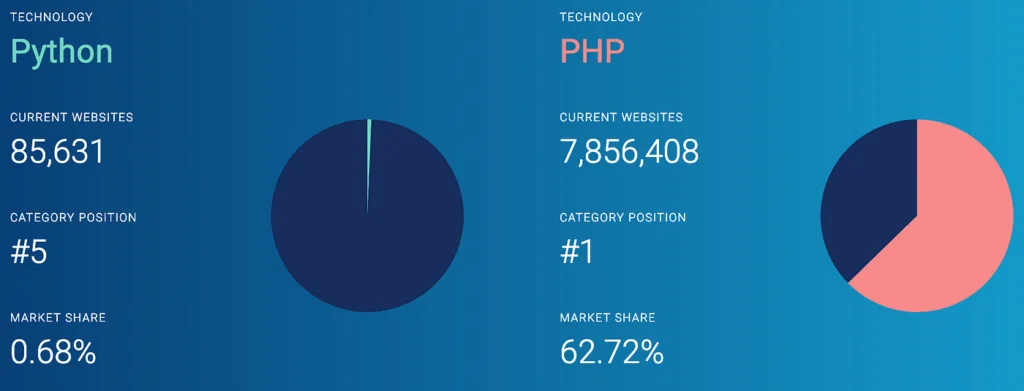
Making the Choice: PHP or Python for Your Project
Choosing between PHP and Python takes careful thought.
PHP is a strong choice for fast-moving web apps — especially sites that see heavy traffic.
Python offers more flexibility. It has a rich set of tools for working with data and machine learning.
Long-term growth and upkeep matter too.
PHP’s wide adoption makes it easier to scale a growing project with available talent.
Python, meanwhile, lets projects work more effectively with data and intelligent features.
In the end, the right choice depends on what your project actually needs:
- Choose PHP if your site changes frequently and needs fast, reliable request handling.
- Choose Python if your project needs to understand and process data, or add machine learning.
Weighing these factors carefully will help set your project up for success.
Conclusion
In summary, PHP is best known for speed and efficiency, while Python stands out for versatility and readability. At Innostax, we specialize in both PHP and Python development, drawing on the strengths of each.
Backend web coding with either language gives you powerful tools — the right choice comes down to your project’s exact needs and goals.
We move between PHP and Python regularly, adapting to whatever our clients need.
As one of our developers, Jesus, puts it: “The real story is what you want to do with the code, much more than either PHP or Python’s versatility.” Scalability, maintainability.
Also, community support are just a few of the other factors worth weighing.
Both languages are well-suited to building strong web apps — each simply brings distinct advantages to different types of projects.